







Question: please solve this completely and I'll give you upvot Problem 2. Water evaporated from the equatorial Pacific Ocean to form a large air mass with
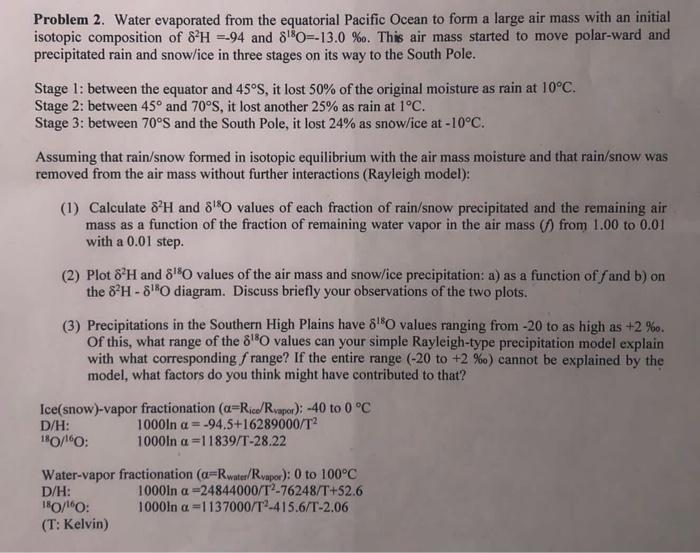
Problem 2. Water evaporated from the equatorial Pacific Ocean to form a large air mass with an initial isotopic composition of 8H --94 and 8180=-13.0 %o. This air mass started to move polar-ward and precipitated rain and snow/ice in three stages on its way to the South Pole. Stage 1: between the equator and 45s, it lost 50% of the original moisture as rain at 10C. Stage 2: between 45 and 70's, it lost another 25% as rain at 1C. Stage 3: between 70S and the South Pole, it lost 24% as snow/ice at -10C. Assuming that rain/snow formed in isotopic equilibrium with the air mass moisture and that rain/snow was removed from the air mass without further interactions (Rayleigh model): m (1) Calculate 8'H and 8' values of each fraction of rain/snow precipitated and the remaining air mass as a function of the fraction of remaining water vapor in the air mass (from 1.00 to 0.01 with a 0.01 step. (2) Plot PH and 8'80 values of the air mass and snow/ice precipitation: a) as a function of fand b) on the 8H - 8!diagram. Discuss briefly your observations of the two plots. (3) Precipitations in the Southern High Plains have 8'80 values ranging from -20 to as high as +2 %. of this, what range of the 8'O values can your simple Rayleigh-type precipitation model explain with what corresponding frange? If the entire range (-20 to +2 %o) cannot be explained by the model, what factors do you think might have contributed to that? Ice(snow)-vapor fractionation (a=Rice/Ryapor): -40 to 0 C D/H: 1000ln a = -94.5+16289000/T2 18O/: 1000ln a=11839/T-28.22 Water-vapor fractionation (a=Rwater/Rvapor): 0 to 100C D/H: 1000ln a =24844000/T2-76248/T+52.6 180/O: 1000ln a=1137000/T2-415.6/T-2.06 (T: Kelvin) Problem 2. Water evaporated from the equatorial Pacific Ocean to form a large air mass with an initial isotopic composition of 8H --94 and 8180=-13.0 %o. This air mass started to move polar-ward and precipitated rain and snow/ice in three stages on its way to the South Pole. Stage 1: between the equator and 45s, it lost 50% of the original moisture as rain at 10C. Stage 2: between 45 and 70's, it lost another 25% as rain at 1C. Stage 3: between 70S and the South Pole, it lost 24% as snow/ice at -10C. Assuming that rain/snow formed in isotopic equilibrium with the air mass moisture and that rain/snow was removed from the air mass without further interactions (Rayleigh model): m (1) Calculate 8'H and 8' values of each fraction of rain/snow precipitated and the remaining air mass as a function of the fraction of remaining water vapor in the air mass (from 1.00 to 0.01 with a 0.01 step. (2) Plot PH and 8'80 values of the air mass and snow/ice precipitation: a) as a function of fand b) on the 8H - 8!diagram. Discuss briefly your observations of the two plots. (3) Precipitations in the Southern High Plains have 8'80 values ranging from -20 to as high as +2 %. of this, what range of the 8'O values can your simple Rayleigh-type precipitation model explain with what corresponding frange? If the entire range (-20 to +2 %o) cannot be explained by the model, what factors do you think might have contributed to that? Ice(snow)-vapor fractionation (a=Rice/Ryapor): -40 to 0 C D/H: 1000ln a = -94.5+16289000/T2 18O/: 1000ln a=11839/T-28.22 Water-vapor fractionation (a=Rwater/Rvapor): 0 to 100C D/H: 1000ln a =24844000/T2-76248/T+52.6 180/O: 1000ln a=1137000/T2-415.6/T-2.06 (T: Kelvin)
Step by Step Solution
There are 3 Steps involved in it

Get step-by-step solutions from verified subject matter experts
 Study Help