







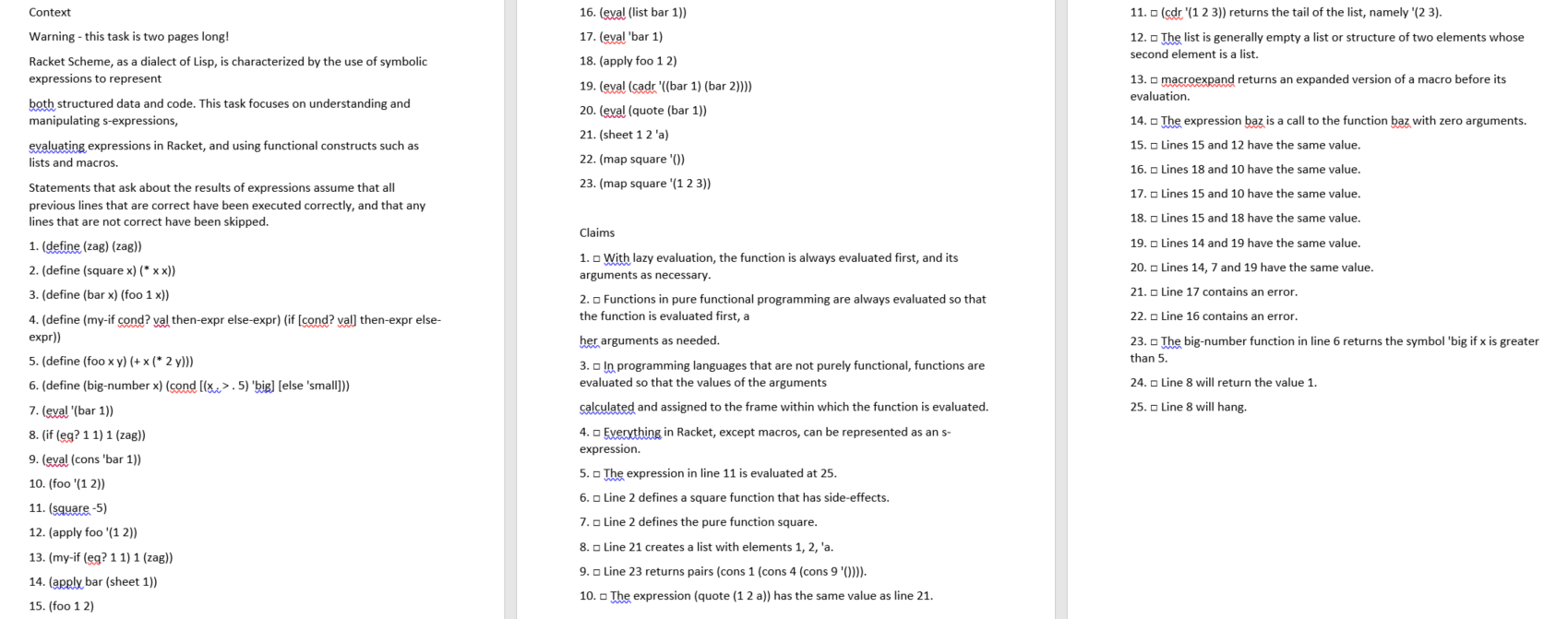
Question: please solve this. It is functional programming - - > LISP ( RACKET ) Context Warning - this task is two pages long! Racket Scheme,
please solve this. It is functional programming LISP RACKET Context
Warning this task is two pages long!
Racket Scheme, as a dialect of Lisp, is characterized by the use of symbolic expressions to represent
both structured data and code. This task focuses on understanding and manipulating sexpressions,
evaluating expressions in Racket, and using functional constructs such as lists and macros.
Statements that ask about the results of expressions assume that all previous lines that are correct have been executed correctly, and that any lines that are not correct have been skipped.
define zagzag
define square x x x
define bar x foo x
define myif cond? val thenexpr elseexprif cond val thenexpr elseexpr
define foo x y x y
define bignumber x cond xi 'bigelse 'small
eval bar
if egzag
eval cons 'bar
foo
square
apply foo
myif egzag
apply bar sheet
foo
eval list bar
eval 'bar
apply foo
eval cadr bar bar
eval quote bar
sheet a
map square
map square
Claims
square With lazy evaluation, the function is always evaluated first, and its arguments as necessary.
Functions in pure functional programming are always evaluated so that the function is evaluated first, a
her arguments as needed.
square In programming languages that are not purely functional, functions are evaluated so that the values of the arguments
calculated and assigned to the frame within which the function is evaluated.
Everything in Racket, except macros, can be represented as an sexpression.
The expression in line is evaluated at
square Line defines a square function that has sideeffects.
square Line defines the pure function square.
Line creates a list with elements a
Line returns pairs cons cons cons prime
square The expression quote a has the same value as line
square The list is generally empty a list or structure of two elements whose second element is a list.
macroexpand returns an expanded version of a macro before its evaluation.
square The expression baz is a call to the function baz with zero arguments.
Lines and have the same value.
square Lines and have the same value.
Lines and have the same value.
Lines and have the same value.
square Lines and have the same value.
square Lines and have the same value.
square Line contains an error.
square Line contains an error.
square The bignumber function in line returns the symbol 'big if x is greater than
Line will return the value
Line will hang.
Step by Step Solution
There are 3 Steps involved in it
1 Expert Approved Answer
Step: 1 Unlock

Question Has Been Solved by an Expert!
Get step-by-step solutions from verified subject matter experts
Step: 2 Unlock
Step: 3 Unlock
 Study Help