







Question: please solve this problem and don't coppy other tutor's solution please. I checked them already.thank you 3. Contemporary issues in chemical engineering: Energy consumption and
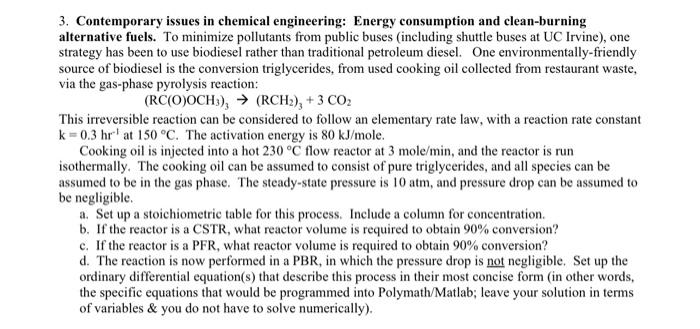
3. Contemporary issues in chemical engineering: Energy consumption and clean-burning alternative fuels. To minimize pollutants from public buses (including shuttle buses at UC Irvine), one strategy has been to use biodiesel rather than traditional petroleum diesel. One environmentally-friendly source of biodiesel is the conversion triglycerides, from used cooking oil collected from restaurant waste, via the gas-phase pyrolysis reaction: (RC(O)OCH3), (RCH2), + 3 CO2 This irreversible reaction can be considered to follow an elementary rate law, with a reaction rate constant k=0.3 hr at 150C. The activation energy is 80 kJ/mole. Cooking oil is injected into a hot 230 C flow reactor at 3 mole/min, and the reactor is run isothermally. The cooking oil can be assumed to consist of pure triglycerides, and all species can be assumed to be in the gas phase. The steady-state pressure is 10 atm, and pressure drop can be assumed to be negligible. a. Set up a stoichiometric table for this process. Include a column for concentration. b. If the reactor is a CSTR, what reactor volume is required to obtain 90% conversion? c. If the reactor is a PFR, what reactor volume is required to obtain 90% conversion? d. The reaction is now performed in a PBR, in which the pressure drop is not negligible. Set up the ordinary differential equation(s) that describe this process in their most concise form (in other words, the specific equations that would be programmed into Polymath/Matlab; leave your solution in terms of variables & you do not have to solve numerically)
Step by Step Solution
There are 3 Steps involved in it

Get step-by-step solutions from verified subject matter experts
 Study Help