







Question: Please Solve this problem using Matlab. I know this is a big question! But please complete it as good as you can. Please show the
Please Solve this problem using Matlab. I know this is a big question! But please complete it as good as you can. Please show the code of how you get to the answers.
Thanks in advance!!
min for example,
a marks Implement the QR algorithm to compute the eigenvalues of Use a suitable preliminary reduction,
but no shifts or deflation. Terminate when the largest magnitude entry on the subdiagonal is less than
How many QR iterations are required? Note: You may use builtin codes to compute the preliminary reduction
and the QR factorisation at each step, but you should implement the QR iteration yourself ie not simply call
MATLABs eig routine!Bonus Since is symmetric, what form does the preliminary reduction take? What about
the resulting Is the structure of A preserved during the iterations? If not, why? Add an additional line of code
to ensure the structure is preserved.
b marks Repeat the above including the preliminary reduction but now using a Rayleigh shift and deflating with
a tolerance of as described in the lecture notes. How many iterations are required here?
c marks Use your software system to compute the Cholesky factorisation of for a few small values of and hence
convince yourself that is SPD Comment on any interesting properties of the Cholesky factors and and
discuss how this property could be used to evaluate in FLOPs. Use this idea to implement an efficient
normalised power iteration to find the largest eigenvalue of
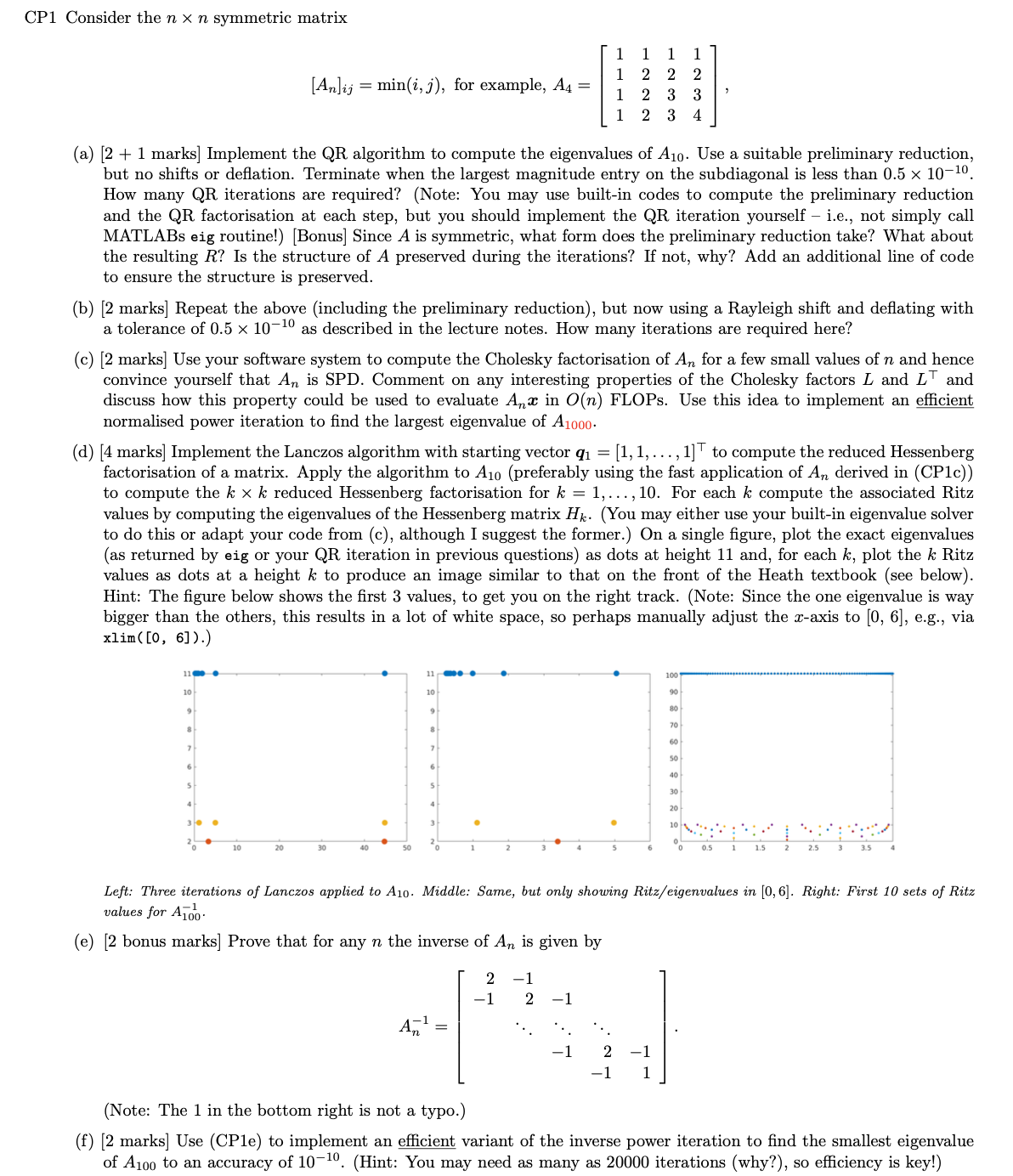
d marks Implement the Lanczos algorithm with starting vector dots, to compute the reduced Hessenberg
factorisation of a matrix. Apply the algorithm to preferably using the fast application of derived in CPc
to compute the reduced Hessenberg factorisation for dots, For each compute the associated Ritz
values by computing the eigenvalues of the Hessenberg matrix You may either use your builtin eigenvalue solver
to do this or adapt your code from c although I suggest the former. On a single figure, plot the exact eigenvalues
as returned by eig or your QR iteration in previous questions as dots at height and, for each plot the Ritz
values as dots at a height to produce an image similar to that on the front of the Heath textbook see below
Hint: The figure below shows the first values, to get you on the right track. Note: Since the one eigenvalue is way
bigger than the others, this results in a lot of white space, so perhaps manually adjust the axis to eg via
Left: Three iterations of Lanczos applied to Middle: Same, but only showing Ritzeigenvalues in Right: First sets of Ritz
values for
e bonus marks Prove that for any the inverse of is given by
Note: The in the bottom right is not a typo.
f marks Use CPe to implement an efficient variant of the inverse power iteration to find the smallest eigenvalue
of to an accuracy of Hint: You may need as many as iterations why so efficiency is key!
Step by Step Solution
There are 3 Steps involved in it
1 Expert Approved Answer
Step: 1 Unlock

Question Has Been Solved by an Expert!
Get step-by-step solutions from verified subject matter experts
Step: 2 Unlock
Step: 3 Unlock
 Study Help