







Question: please solve this question 2. The demand for Q is assumed to be deterministic, while the supply of Q is subject to some random disturbances.
please solve this question
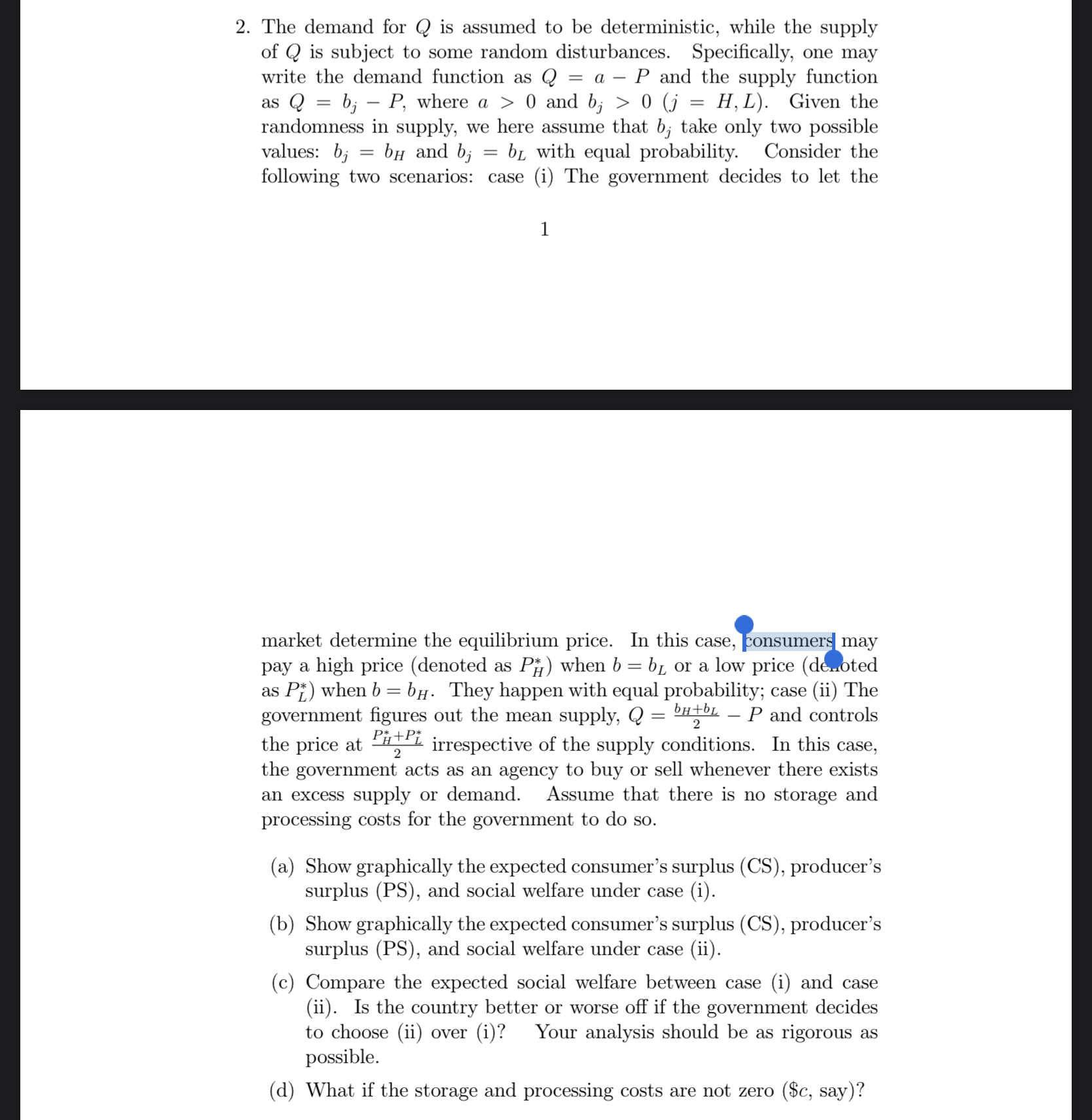
2. The demand for Q is assumed to be deterministic, while the supply of Q is subject to some random disturbances. Specically, one may write the demand function as Q = a P and the supply function as Q = b,- P, where a > 0 and b,- > 0 (j = H,L). Given the randomness in supply, we here assume that I), take only two possible values: bj = by and bj = ()1, with equal probability. Consider the following two scenarios: case (i) The government decides to let the 1 market determine the equilibrium price. In this case,$onsume may pay a high price (denoted as PE) when I) = ()1, or a low price (d ted as PE) when E) 2 bar. They happen with equal probability; case (ii) The government gures out the mean supply, Q = % P and controls the price at @ irrespective of the supply conditions. In this case, the government acts as an agency to buy or sell whenever there exists an excess supply or demand. Assume that there is no storage and processing costs for the government to do so. (a) Show graphically the expected consumer's surplus (CS), producer's surplus (PS), and social welfare under case (i). (b) Show graphically the expected consumer's surplus (CS), producer's surplus (PS), and social welfare under case (ii). (c) Compare the expected social welfare between case (i) and case (ii). Is the country better or worse off if the government decides to choose (ii) over (i)? Your analysis should be as rigorous as possible. ((1) What if the storage and processing costs are not zero ($c, say)
Step by Step Solution
There are 3 Steps involved in it

Get step-by-step solutions from verified subject matter experts
 Study Help