







Question: please solve this question with clear handwriting with all steps Reference Book : Understanding Linear Algebra by David Austin 5. In this section, we looked
please solve this question with clear handwriting with all steps
Reference Book : Understanding Linear Algebra by David Austin
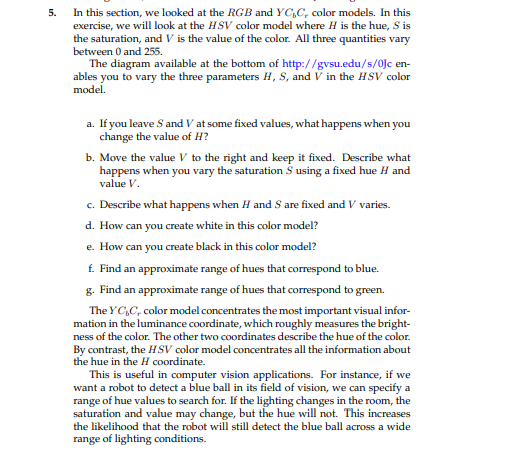
5. In this section, we looked at the RGB and YCC, color models. In this exercise, we will look at the HSV color model where # is the hue, S is the saturation, and V is the value of the color. All three quantities vary between 0 and 255. The diagram available at the bottom of http://gvsu.edu/s/OJc en- ables you to vary the three parameters H, S, and V in the HSV color model. a. If you leave S and V at some fixed values, what happens when you change the value of H? b. Move the value V to the right and keep it fixed. Describe what happens when you vary the saturation $ using a fixed hue H and value V. c. Describe what happens when H and S are fixed and V varies. d. How can you create white in this color model? e. How can you create black in this color model? f. Find an approximate range of hues that correspond to blue. g. Find an approximate range of hues that correspond to green. The Y'CC, color model concentrates the most important visual infor- mation in the luminance coordinate, which roughly measures the bright- ness of the color. The other two coordinates describe the hue of the color. By contrast, the HSV color model concentrates all the information about the hue in the H coordinate. This is useful in computer vision applications. For instance, if we want a robot to detect a blue ball in its field of vision, we can specify a range of hue values to search for. If the lighting changes in the room, the saturation and value may change, but the hue will not. This increases the likelihood that the robot will still detect the blue ball across a wide range of lighting conditions
Step by Step Solution
There are 3 Steps involved in it

Get step-by-step solutions from verified subject matter experts
 Study Help