







Question: Please solve using Java eclipse No stack over flow!! code Question 12 (coder) Refer to the Coders and Tracers sheet for sample runs showing what
Please solve using Java eclipse
No stack over flow!!
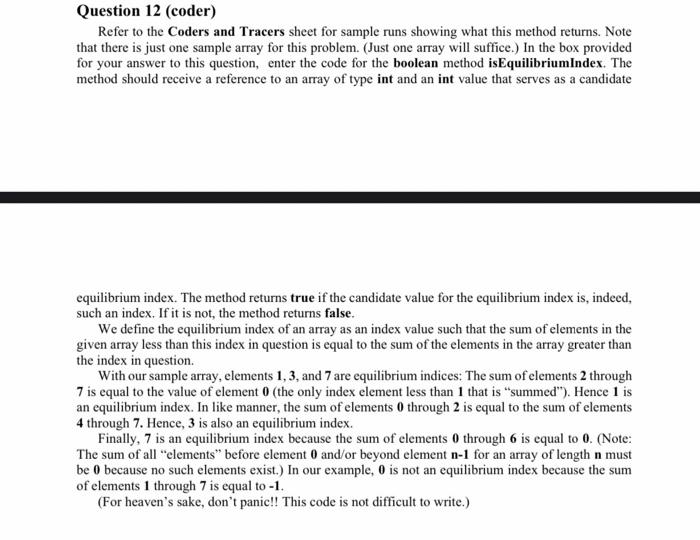
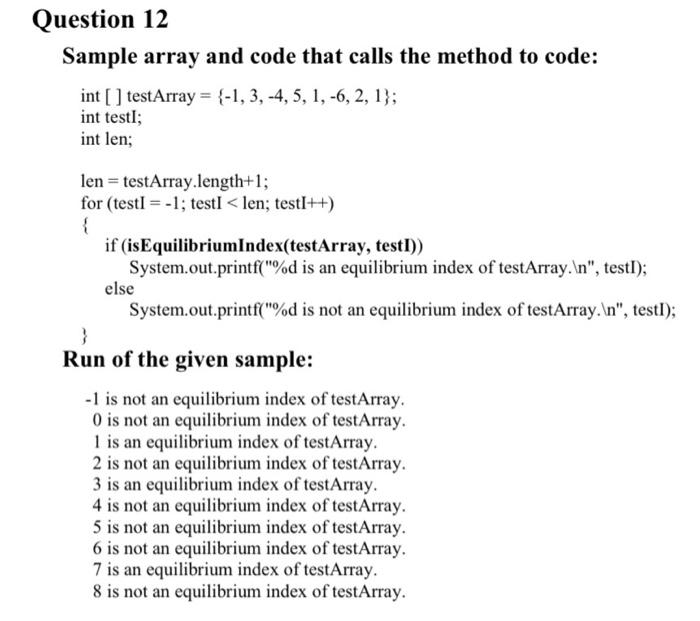
Question 12 (coder) Refer to the Coders and Tracers sheet for sample runs showing what this method returns. Note that there is just one sample array for this problem. (Just one array will suffice.) In the box provided for your answer to this question, enter the code for the boolean method isEquilibriumIndex. The method should receive a reference to an array of type int and an int value that serves as a candidate equilibrium index. The method returns true if the candidate value for the equilibrium index is, indeed, such an index. If it is not, the method returns false. We define the equilibrium index of an array as an index value such that the sum of elements in the given array less than this index in question is equal to the sum of the elements in the array greater than the index in question. With our sample array, elements 1,3 , and 7 are equilibrium indices: The sum of elements 2 through 7 is equal to the value of element 0 (the only index element less than 1 that is "summed"). Hence 1 is an equilibrium index. In like manner, the sum of elements 0 through 2 is equal to the sum of elements 4 through 7 . Hence, 3 is also an equilibrium index. Finally, 7 is an equilibrium index because the sum of elements 0 through 6 is equal to 0 . (Note: The sum of all "elements" before element 0 and/or beyond element n1 for an array of length n must be 0 because no such elements exist.) In our example, 0 is not an equilibrium index because the sum of elements 1 through 7 is equal to 1. (For heaven's sake, don't panic!! This code is not difficult to write.) Sample array and code that calls the method to code: int [ ] testArray = {1,3,4,5,1,6,2,1}; int testI; int len; len = testArray.length +1; for (testI = 1; testI
Step by Step Solution
There are 3 Steps involved in it

Get step-by-step solutions from verified subject matter experts
 Study Help