







Question: Please solve using matlab Part c) Consider the following two ODEs for the parts c-g below, which approximate the 2DoF Setups: m x + x
Please solve using matlab
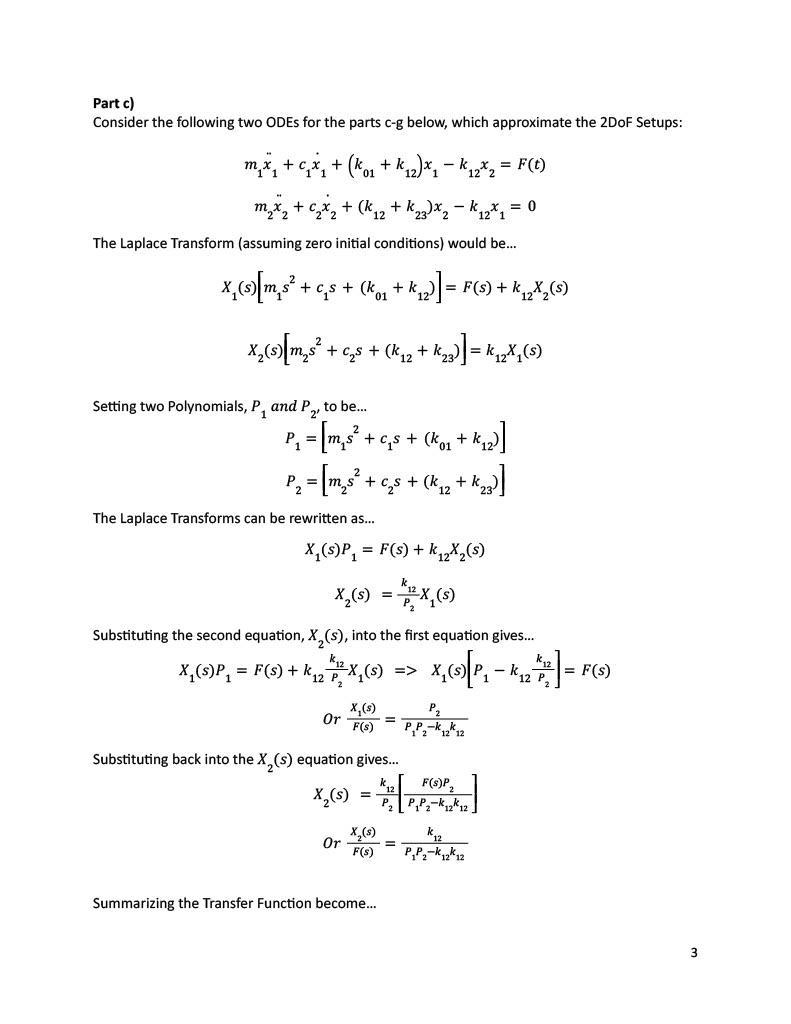
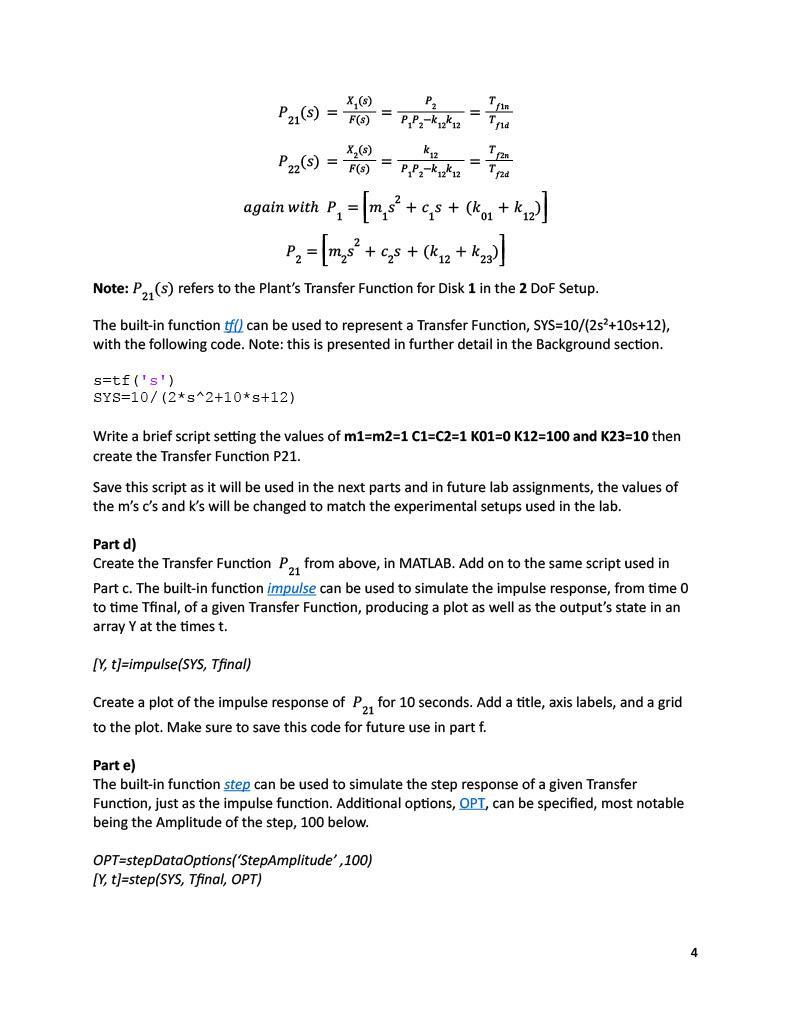
Part c) Consider the following two ODEs for the parts c-g below, which approximate the 2DoF Setups: m x + x + (+k)x K2* = F(t) 01 + K23) x - K12 1 The Laplace Transform (assuming zero initial conditions) would be... m x + c x + (K 2 X(s)[ms + cs + (k+k2)] = F(s) +kX (s) X2(s)[ms + + CS + (K2 + K3)] = k2X(s) k Setting two Polynomials, P, and P, to be... P = [m + 3 + (+] P = [m + es + (x + x] s The Laplace Transforms can be rewritten as... X(s)P = = F(s) + kX (s) Or X (s) = x(s) Substituting the second equation, X (S), into the first equation gives... X(s)P = F(s) + kX (s) => Or X, (s) F(s) PP-k Substituting back into the X(s) equation gives... = F(s)P x_h = z[x ] X (s) F(s) Summarizing the Transfer Function become... 0 X,(s)[P, -R = F(0) k = PP-k1212 3
Step by Step Solution
There are 3 Steps involved in it

Get step-by-step solutions from verified subject matter experts
 Study Help