







Question: Please Solve with fully detail solution with each steps and neat and clean Asap (c) Determine the radius of convergence R of the o =
Please Solve with fully detail solution with each steps and neat and clean Asap
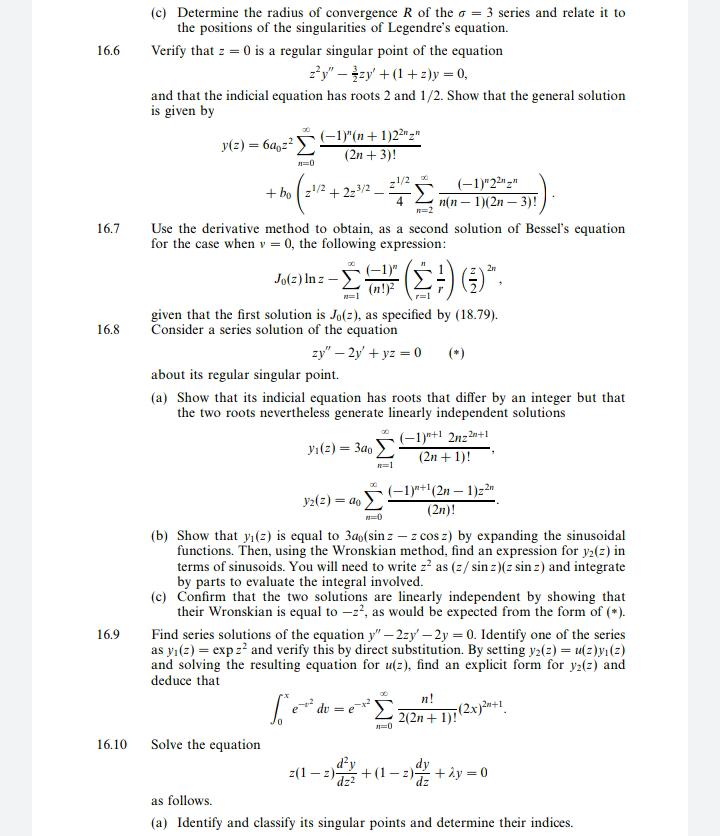
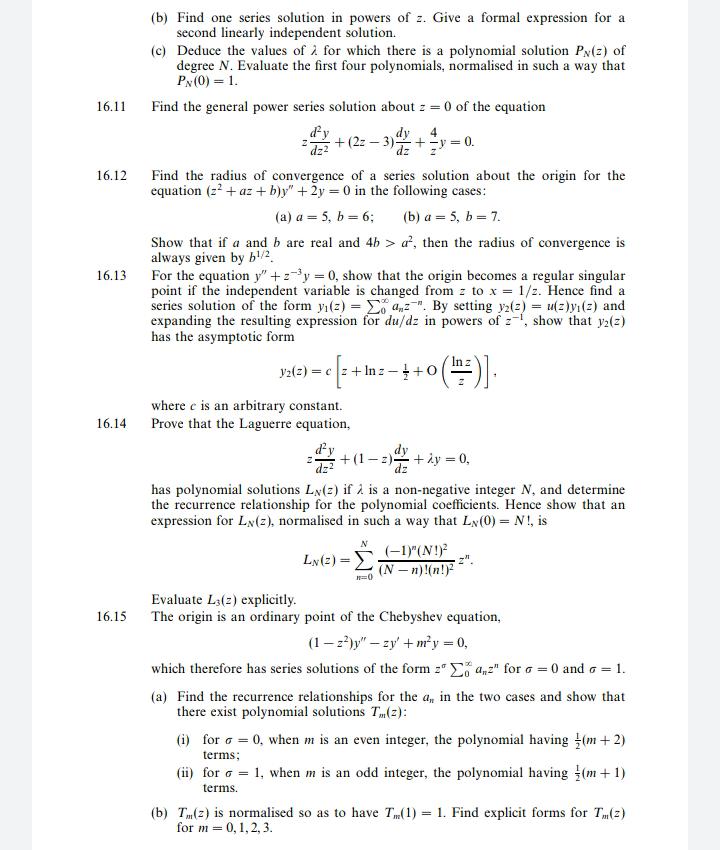
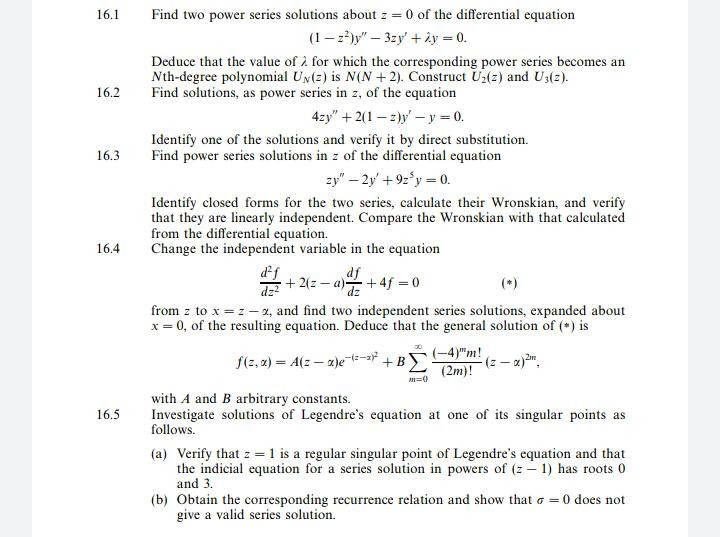
(c) Determine the radius of convergence R of the o = 3 series and relate it to the positions of the singularities of Legendre's equation. 16.6 Verify that z = 0 is a regular singular point of the equation zy" - {zy't(1+ z )y =0, and that the indicial equation has roots 2 and 1/2. Show that the general solution is given by v(=) = 600=2 (-1)"(n + 1)220-" 1=0 (2n + 3)! + ho ( 21/2 + 2=3/2 _ = 21/2 (-1)"22020 11 =2 n(n - 1)(2n - 3)! 16.7 Use the derivative method to obtain, as a second solution of Bessel's equation for the case when v = 0, the following expression: Jo(=) In= - >CI given that the first solution is Jo(=), as specified by (18.79). 16.8 Consider a series solution of the equation zy" - 2y' + yz =0 (+) about its regular singular point. (a) Show that its indicial equation has roots that differ by an integer but that the two roots nevertheless generate linearly independent solutions Vi(z) = 30, 1)" 2nzan+1 (2n + 1)! 12(=) = do (-1)"+1(2n - 1)220 (2n)! (b) Show that vi(z) is equal to 3as(sinz - z cos z) by expanding the sinusoidal functions. Then, using the Wronskian method, find an expression for yz(z) in terms of sinusoids. You will need to write z' as (z/ sin z)(z sin z) and integrate by parts to evaluate the integral involved. (c) Confirm that the two solutions are linearly independent by showing that their Wronskian is equal to -25, as would be expected from the form of (* ). 16.9 Find series solutions of the equation y" -2zy' -2y =0. Identify one of the series as yi(z) = expz and verify this by direct substitution. By setting yz(2) = (=)y (z) and solving the resulting equation for u(z), find an explicit form for yz(z) and deduce that n! 2 ( 2n + 1) ( 2 x 1 2 0+1 16.10 Solve the equation =(1 -3)72 dry + (1 -=)d dy thy = 0 as follows. (a) Identify and classify its singular points and determine their indices.(b) Find one series solution in powers of z. Give a formal expression for a second linearly independent solution. (c) Deduce the values of 1 for which there is a polynomial solution PM(z) of degree N. Evaluate the first four polynomials, normalised in such a way that PN(0) = 1. 16.11 Find the general power series solution about = =0 of the equation 2daz + (2: - 3) d= y = 0. 16.12 Find the radius of convergence of a series solution about the origin for the equation (zz + az + b)y" + 2y =0 in the following cases: (a) a = 5, b =6; (b) a = 5, b = 7. Show that if a and b are real and 4b > a, then the radius of convergence is always given by b1/2. 16.13 For the equation y" + z y =0, show that the origin becomes a regular singular point if the independent variable is changed from : to x = 1/z. Hence find a series solution of the form yi(z) = _. a,z ". By setting )2(=) = u(=)yi(=) and expanding the resulting expression for du/dz in powers of z , show that 12(2) has the asymptotic form 12(z) = =+lz -+ +0 (12:)] where c is an arbitrary constant. 16.14 Prove that the Laguerre equation. has polynomial solutions Ly(z) if 1 is a non-negative integer N, and determine the recurrence relationship for the polynomial coefficients. Hence show that an expression for Ly(z), normalised in such a way that Ly(0) = N!, is LN(=) = C. (-1)"(N1) ( N - n) in!) =. Evaluate Ly(=) explicitly. 16.15 The origin is an ordinary point of the Chebyshev equation, (1 -z!)y" - zy +my =0, which therefore has series solutions of the form ?" _, a,?" for G = 0 and 6 = 1. (a) Find the recurrence relationships for the a, in the two cases and show that there exist polynomial solutions To(=): (i) for a = 0. when m is an even integer, the polynomial having {(m + 2) terms; (ii) for a = 1, when m is an odd integer, the polynomial having =(m + 1) terms. (b) T.(z) is normalised so as to have 7,(1) = 1. Find explicit forms for Tm(=) for m = 0, 1,2, 3.lt'i.l 16.2 145.3 1&4 16.5 Find two power series solutions about 2 = t) of the di'erential equation [I zily" 3zy'+.i_v =l]. Deduce that the value of .i for which the corresponding power series becomes an Nth-degree polynomial thz} is MIN + 2]. Construct UrlZ] and U312}. Find solutions, as power series in z, of the equation 43].?" +2121 z}}r' y = . Identify one of the solutions and verify it by direct substitution. Find power series solutions in z of the di'erential equation 2}?" 2}" +925}: = . Identify closed forms for the two series, calculate their Wronskian. and verify that the}.r are linearly independent. Compare the 1|W'ronskian with that calculated from the differential equation. Change the independent variable in the equation d2)\" if F+2tzo}E+-U= [*1 from z to x = 2 st, and nd two independent series solutions, expanded about .1: = ll1 of the resulting equation. Deduee that the general solution of {s} is _ :III 1! (11me in: fiz,st]A[zm]el +3; limit [ster} , with A and B arbitrary constants. Investigate solutions of Legendre's equation at one of its singular points as follows. {a} verify that z = l is a regular singular point of Legendre's equation and that the indicial equation for a series solution in powers of {z 1} has roots t] and 3. {b} Obtain the corresponding recurrence relation and show that o = C! does not give a valid series solution
Step by Step Solution
There are 3 Steps involved in it

Get step-by-step solutions from verified subject matter experts
 Study Help