



Question: Please solve with precision In order to model the seasonality of a particular data set an actuary is asked to consider the following model: (1-8
Please solve with precision
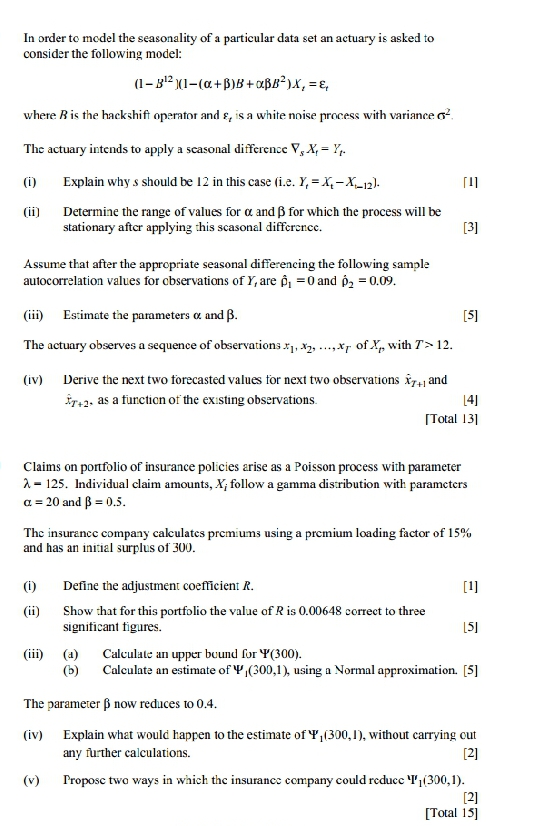
In order to model the seasonality of a particular data set an actuary is asked to consider the following model: (1-8 =](1-(a +B)B + DIBB= )X, =E. where R is the hackshift operator and , is a white noise process with variance of. The actuary intends to apply a seasonal difference V, X, = Y. (i) Explain why s should be 12 in this case (i.e. Y, = X -M_12). (ii] Determine the range of values for o and B for which the process will be stationary after applying this scasonal difference. [3] Assume that after the appropriate seasonal differencing the following sample autocorrelation values for observations of Y, are p, =0 and p2 = 0.09. (iii) Estimate the parameters o and B. [5] The actuary observes a sequence of observations *1, *2, ...,X/ of X,, with ?'> 12. (iv) Derive the next two forecasted values for next two observations x7+, and *y+2. as a function of the existing observations. [Total 13] Claims on portfolio of insurance policies arise as a Poisson process with parameter 2 - 125. Individual claim amounts, X; follow a gamma distribution with parameters a = 20 and B = 0.5. The insurance company calculates premiums using a premium loading factor of 15% and has an initial surplus of 300. Define the adjustment coefficient R. [1] (ii) Show that for this portfolio the value of R is 0.00648 correct to three significant figures. (iii) (a) Calculate an upper bound for 'T(300). (b) Calculate an estimate of P(300,1), using a Normal approximation. [5] The parameter [ now reduces to 0.4. (iv) Explain what would happen to the estimate of 'I' (300,1), without carrying out any further calculations. [2] (v) Propose two ways in which the insurance company could reduce 'T(300,1). [2] [Total 15]
Step by Step Solution
There are 3 Steps involved in it

Get step-by-step solutions from verified subject matter experts