







Question: please solve with steps on how you solved it. will leave like for correct solution Q1. (6 points) A 13.8 m watershed has rural peak
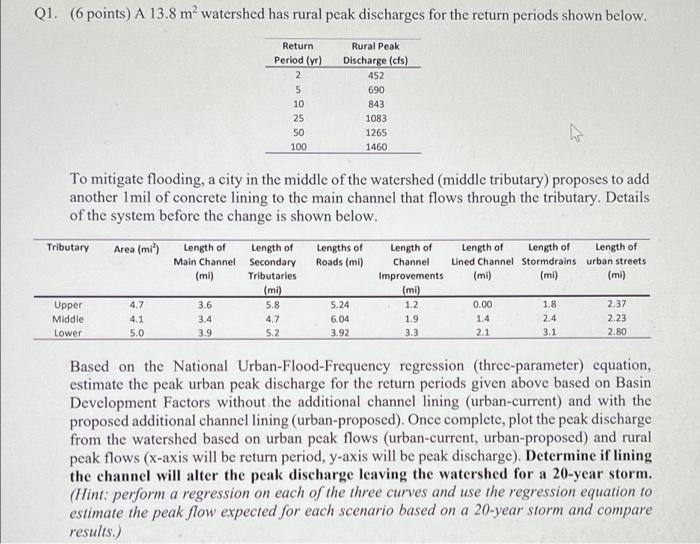
Q1. (6 points) A 13.8 m watershed has rural peak discharges for the return periods shown below. Return Period (y) 2 5 10 25 50 100 Rural Peak Discharge (cfs) 452 690 843 1083 1265 1460 To mitigate flooding, a city in the middle of the watershed (middle tributary) proposes to add another 1 mil of concrete lining to the main channel that flows through the tributary. Details of the system before the change is shown below. Tributary Area (mil) Length of Main Channel (mi) Lengths of Roads (mi) Length of Length of Length of Lined Channel Stormdrains urban streets (mi) (mi) (mi) Length of Secondary Tributaries (mi) 5.8 4.7 5.2 Length of Channel Improvements (mi) 1.2 1.9 3.3 Upper Middle Lower 4.7 4.1 5.0 3.6 3.4 3.9 5.24 6.04 3.92 0.00 1.4 2.1 1.8 2.4 3.1 2.37 2.23 2.80 Based on the National Urban-Flood-Frequency regression (three-parameter) equation, estimate the peak urban peak discharge for the return periods given above based on Basin Development Factors without the additional channel lining (urban-current) and with the proposed additional channel lining (urban-proposed). Once complete, plot the peak discharge from the watershed based on urban peak flows (urban-current, urban-proposed) and rural peak flows (X-axis will be return period, y-axis will be peak discharge). Determine if lining the channel will alter the peak discharge leaving the watershed for a 20-year storm. (Ilint: perform a regression on each of the three curves and use the regression equation to estimate the peak flow expected for each scenario based on a 20-year storm and compare results.) Q1. (6 points) A 13.8 m watershed has rural peak discharges for the return periods shown below. Return Period (y) 2 5 10 25 50 100 Rural Peak Discharge (cfs) 452 690 843 1083 1265 1460 To mitigate flooding, a city in the middle of the watershed (middle tributary) proposes to add another 1 mil of concrete lining to the main channel that flows through the tributary. Details of the system before the change is shown below. Tributary Area (mil) Length of Main Channel (mi) Lengths of Roads (mi) Length of Length of Length of Lined Channel Stormdrains urban streets (mi) (mi) (mi) Length of Secondary Tributaries (mi) 5.8 4.7 5.2 Length of Channel Improvements (mi) 1.2 1.9 3.3 Upper Middle Lower 4.7 4.1 5.0 3.6 3.4 3.9 5.24 6.04 3.92 0.00 1.4 2.1 1.8 2.4 3.1 2.37 2.23 2.80 Based on the National Urban-Flood-Frequency regression (three-parameter) equation, estimate the peak urban peak discharge for the return periods given above based on Basin Development Factors without the additional channel lining (urban-current) and with the proposed additional channel lining (urban-proposed). Once complete, plot the peak discharge from the watershed based on urban peak flows (urban-current, urban-proposed) and rural peak flows (X-axis will be return period, y-axis will be peak discharge). Determine if lining the channel will alter the peak discharge leaving the watershed for a 20-year storm. (Ilint: perform a regression on each of the three curves and use the regression equation to estimate the peak flow expected for each scenario based on a 20-year storm and compare results.)
Step by Step Solution
There are 3 Steps involved in it

Get step-by-step solutions from verified subject matter experts
 Study Help