







Question: Please study the Case Application 1 in Chapter 11 on Page 307 of Textbook ( Robbins 11th edition management ) In the Driver's Seat and
Please study the Case Application 1 in Chapter 11 on Page 307 of Textbook ( Robbins 11th edition management ) "In the Driver's Seat" and answer the following questions, What does this case story tell you about how a company's vision and plans affect its structure?
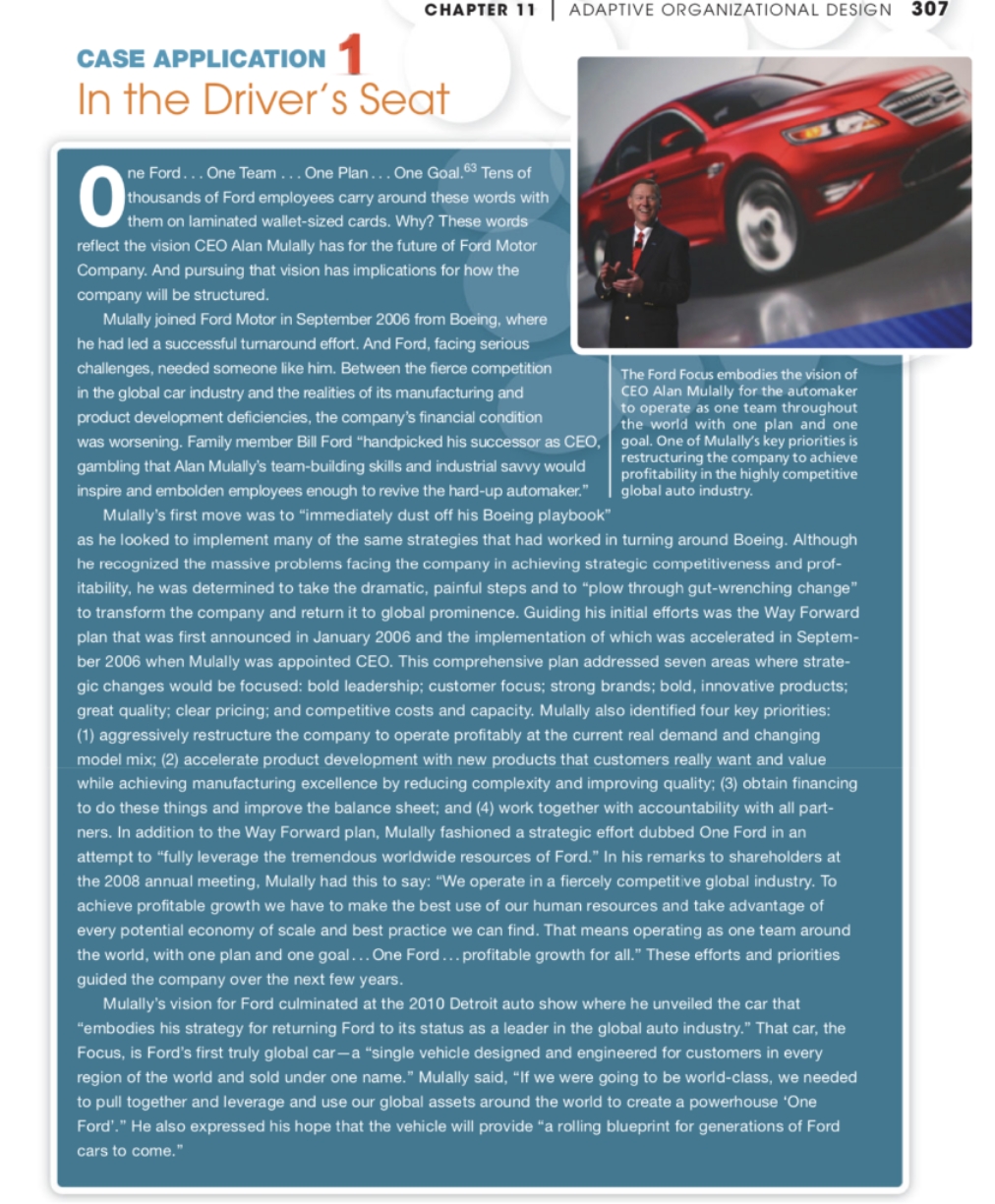
CHAPTER 11 | ADAPTIVE ORGANIZATIONAL DESIGN 307 CASE APPLICATION 1 In the Driver's Seat 0 he Ford . . . One Team . . . One Plan . . . One Goal. 63 Tens of thousands of Ford employees carry around these words with them on laminated wallet-sized cards. Why? These words reflect the vision CEO Alan Mulally has for the future of Ford Motor Company. And pursuing that vision has implications for how the company will be structured. Mulally joined Ford Motor in September 2006 from Boeing, where he had led a successful turnaround effort. And Ford, facing serious challenges, needed someone like him. Between the fierce competition The Ford Focus embodies the vision of in the global car industry and the realities of its manufacturing and CEO Alan Mulally for the automaker product development deficiencies, the company's financial condition to operate as one team throughout the world with one plan and one was worsening. Family member Bill Ford "handpicked his successor as CEO, goal. One of Mulally's key priorities is gambling that Alan Mulally's team-building skills and industrial savvy would restructuring the company to achieve profitability in the highly competitive inspire and embolden employees enough to revive the hard-up automaker." global auto industry. Mulally's first move was to "immediately dust off his Boeing playbook" as he looked to implement many of the same strategies that had worked in turning around Boeing. Although he recognized the massive problems facing the company in achieving strategic competitiveness and prof- itability, he was determined to take the dramatic, painful steps and to "plow through gut-wrenching change" to transform the company and return it to global prominence. Guiding his initial efforts was the Way Forward plan that was first announced in January 2006 and the implementation of which was accelerated in Septem- ber 2006 when Mulally was appointed CEO. This comprehensive plan addressed seven areas where strate- gic changes would be focused: bold leadership; customer focus; strong brands; bold, innovative products; great quality; clear pricing; and competitive costs and capacity. Mulally also identified four key priorities: (1) aggressively restructure the company to operate profitably at the current real demand and changing model mix; (2) accelerate product development with new products that customers really want and value while achieving manufacturing excellence by reducing complexity and improving quality; (3) obtain financing to do these things and improve the balance sheet; and (4) work together with accountability with all part- ners. In addition to the Way Forward plan, Mulally fashioned a strategic effort dubbed One Ford in an attempt to "fully leverage the tremendous worldwide resources of Ford." In his remarks to shareholders at the 2008 annual meeting, Mulally had this to say: "We operate in a fiercely competitive global industry. To achieve profitable growth we have to make the best use of our human resources and take advantage of every potential economy of scale and best practice we can find. That means operating as one team around the world, with one plan and one goal . .. One Ford . . . profitable growth for all." These efforts and priorities guided the company over the next few years. Mulally's vision for Ford culminated at the 2010 Detroit auto show where he unveiled the car that "embodies his strategy for returning Ford to its status as a leader in the global auto industry." That car, the Focus, is Ford's first truly global car-a "single vehicle designed and engineered for customers in every region of the world and sold under one name." Mulally said, "If we were going to be world-class, we needed to pull together and leverage and use our global assets around the world to create a powerhouse 'One Ford'." He also expressed his hope that the vehicle will provide "a rolling blueprint for generations of Ford cars to come."
Step by Step Solution
There are 3 Steps involved in it

Get step-by-step solutions from verified subject matter experts
 Study Help