







Question: please submit a Matlab scripts that print the solutions to assignments and exercise As a final example we have a stationary random process. This time,
please submit a Matlab scripts that print the solutions to assignments and exercise
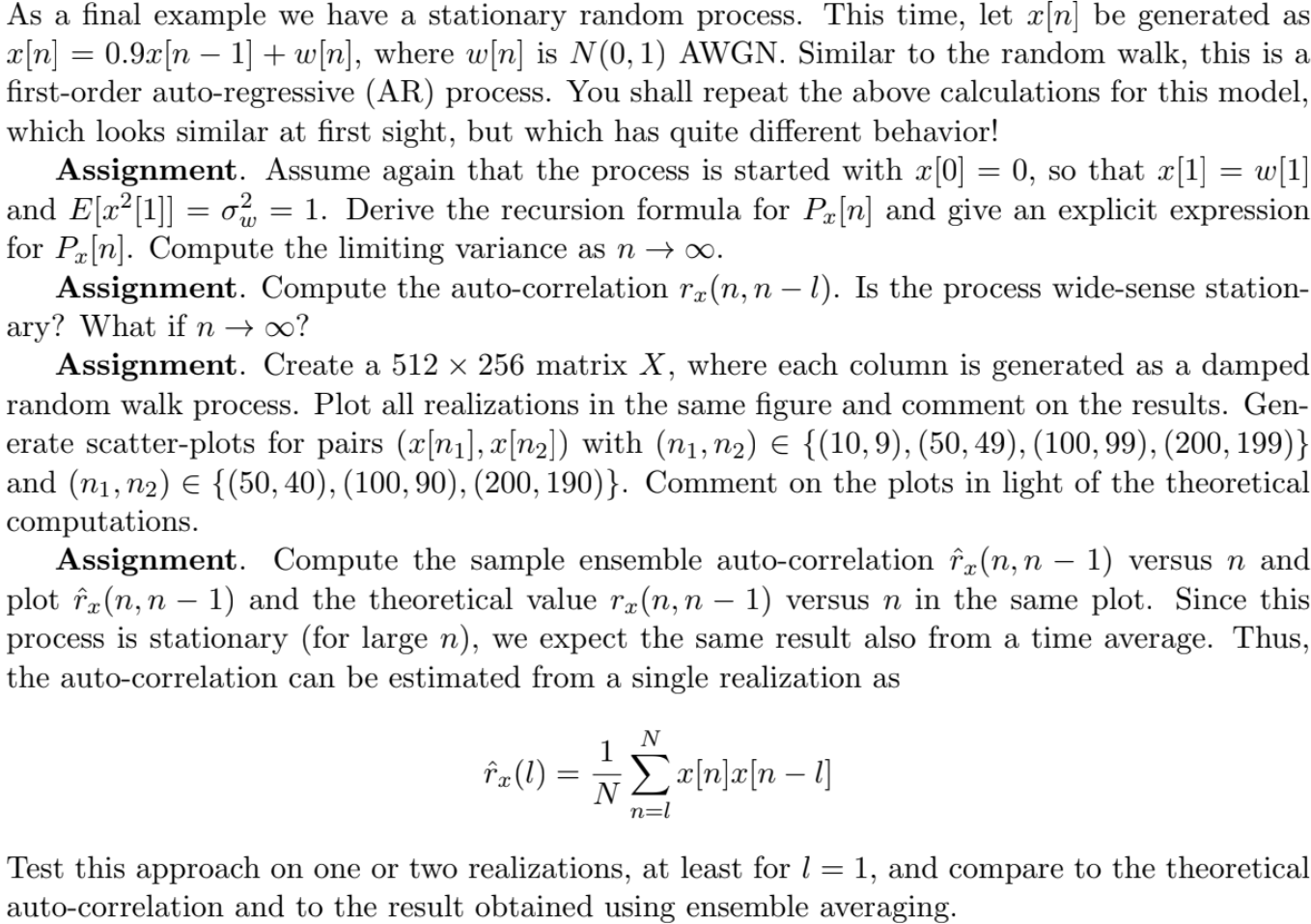
As a final example we have a stationary random process. This time, let x[n] be generated as x[n] = 0.9x[n 1] + w[n], where w[n] is N(0,1) AWGN. Similar to the random walk, this is a first-order auto-regressive (AR) process. You shall repeat the above calculations for this model, which looks similar at first sight, but which has quite different behavior! Assignment. Assume again that the process is started with x[0] = 0, so that x[1] = w[1] and E[x2[1]] = 0% = 1. Derive the recursion formula for Px [n] and give an explicit expression for Px [n]. Compute the limiting variance as n +00. Assignment. Compute the auto-correlation rx(n, n 1). Is the process wide-sense station- ary? What if n + oo? Assignment. Create a 512 x 256 matrix X, where each column is generated as a damped random walk process. Plot all realizations in the same figure and comment on the results. Gen- erate scatter-plots for pairs (x[n1], x[n2]) with (n1, n2) E {(10,9), (50,49), (100,99), (200, 199)} and (ni, n2) {(50, 40), (100, 90), (200, 190)}. Comment on the plots in light of the theoretical computations. Assignment. Compute the sample ensemble auto-correlation fx(n,n 1) versus n and plot fx(n,n 1) and the theoretical value rx(n, n 1) versus n in the same plot. Since this process is stationary (for large n), we expect the same result also from a time average. Thus, the auto-correlation can be estimated from a single realization as N 1 Fr(1) xa x[n]e[n 1] - n=1 Test this approach on one or two realizations, at least for 1 = 1, and compare to the theoretical auto-correlation and to the result obtained using ensemble averaging
Step by Step Solution
There are 3 Steps involved in it

Get step-by-step solutions from verified subject matter experts
 Study Help