



Question: please summarize IHRM in Action Case 4.2 Collaboration decision-making and loyalty in a German Chinese joint venture: Beljing Lufthansa Center Co. Ltd. The joint venture
please summarize 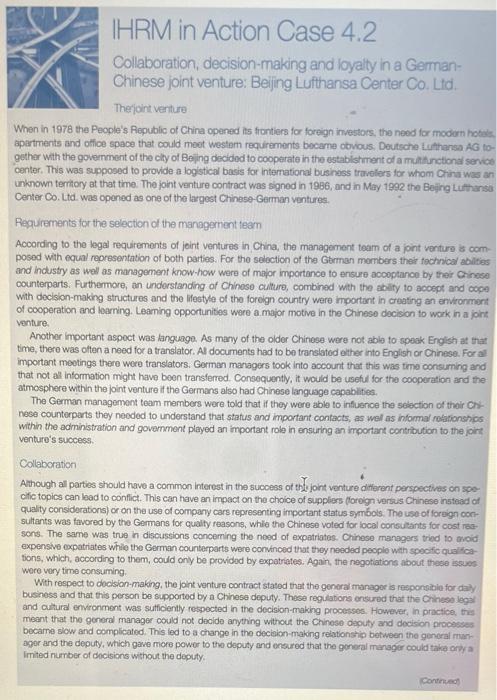
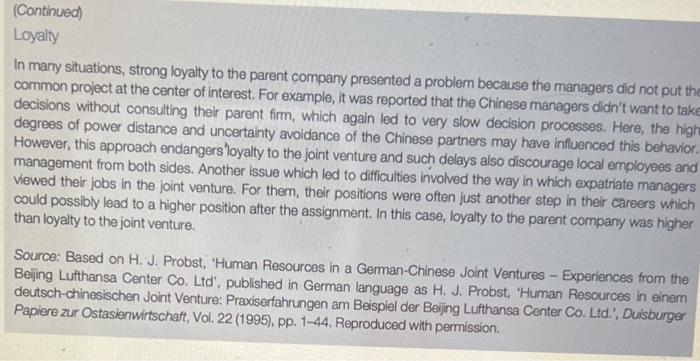
IHRM in Action Case 4.2 Collaboration decision-making and loyalty in a German Chinese joint venture: Beljing Lufthansa Center Co. Ltd. The joint venture When in 1978 the People's Republic of China opened its frontiers for foreign investors, the need for modern hotels apartments and office space that could moet westem requirements becarne obvious Deutsche Lufthansa AG to- gether with the government of the city of Bojing decided to cooperate in the establishment of a multifunctional service center. This was supposed to provide a logistical basis for international business travelers for whom China was an unknown territory at that time. The joint venture contract was signed in 1986, and in May 1992 the Beijing Lufthansa Center Co. Ltd. was opened as one of the largest Chinese-German ventures Requirements for the selection of the managernent team According to the legal requirements of joint ventures in China, the management team of a joint venture is com posed with equal representation of both parties. For the selection of the Goran members their technical abilities and Industry as well as management know-how were of major importance to ensure accoptance by their Chinese counterparts. Furthermore, an understanding of Chinese cultura, combined with the ability to scoopt and coce with decision-making structures and the lifestyle of the foreign country were important in creating an environment of cooperation and learning. Leaming opportunities were a major motive in the Chinese decision to work in a joint venture Another important aspect was kangungo. As many of the older Chinese were not ablo to speak English at that time, there was often a need for a translator. Al documents had to be translated other into English or Chinese. Foral important meetings there were translators, German managers took into account that this was time consurning and that not all information might have been transferred. Consequently, it would be useful for the cooperation and the atmosphere within the joint venture if the Germans also had Chinese language capabilities The German management team members were told that if they were able to infuence the selection of their nese counterparts they needed to understand that status and important contacts, as well as informal rolationships within the administration and government played an important role in ensuring an important contribution to the joint venture's success Collaboration Although all parties should have a common Interest in the success at ude joint venture diferent perspectives on se cific topics can lead to conflict. This can have an impact on the choice of suppliers foreign versus Chinese instead of quality considerations) or on the use of company cars representing important status symbols. The use of foreign con- sultants was favored by the Germans for quality reasons, while the Chinese voted for local consultants for costres sons. The same was true in discussions concerning the need of expatriates. Chinese managers tried to wid expensive expatriates while the German counterparts were convinced that they needed people with specific qualifica tions, which according to them, could only be provided by expatriates. Again the negotiations about these issues were very time consuming With respect to decision-making, the joint venture contract stated that the general manager is responsible for day business and that this person bo supported by a Chinese deputy. These regulations ensured that the Chinese legal and cultural environment was sufficiently respected in the decision-making processes. However, in practice, this meant that the general manager could not decide anything without the Chinese deputy and decision processes became slow and complicated. This led to a change in the decision-making relationship between the general man ager and the deputy, which gave more power to the deputy and ensured that the general manager could take ora Imited number of decisions without the deputy Continued (Continued) Loyalty In many situations, strong loyalty to the parent company presented a problem because the managers did not put the common project at the center of interest. For example, it was reported that the Chinese managers didn't want to take decisions without consulting their parent firm, which again led to very slow decision processes. Here, the high degrees of power distance and uncertainty avoidance of the Chinese partners may have influenced this behavior. However, this approach endangers loyalty to the joint venture and such delays also discourage local employees and management from both sides. Another issue which led to difficulties involved the way in which expatriate managers viewed their jobs in the joint venture. For them, their positions were often just another step in their careers which could possibly lead to a higher position after the assignment. In this case, loyalty to the parent company was higher than loyalty to the joint venture. Source: Based on H. J. Probst, 'Human Resources in a German-Chinese Joint Ventures - Experiences from the Beijing Lufthansa Center Co. Ltd', published in German language as H. J. Probst, 'Human Resources in einem deutsch-chinesischen Joint Venture: Praxiserfahrungen am Beispiel der Beijing Lufthansa Center Co. Ltd., Duisburger Papiere zur Ostasienwirtschaft, Vol. 22 (1995), pp. 1-44. Reproduced with permission Step by Step Solution
There are 3 Steps involved in it
1 Expert Approved Answer
Step: 1 Unlock

Question Has Been Solved by an Expert!
Get step-by-step solutions from verified subject matter experts
Step: 2 Unlock
Step: 3 Unlock