







Question: Please summarize the economic consequences from the article below Economic Consequences As a Substantive Issue Economic consequences have finally become accepted as a valid substantive
Please summarize the economic consequences from the article below
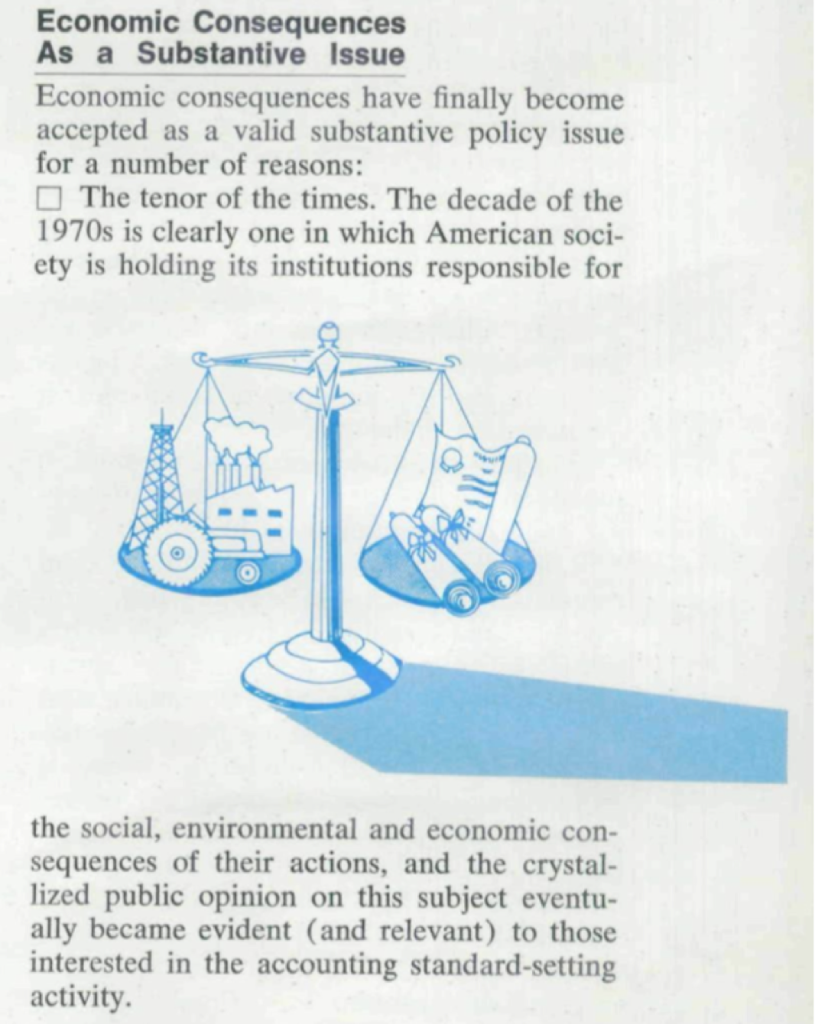
Economic Consequences As a Substantive Issue Economic consequences have finally become accepted as a valid substantive policy issue for a number of reasons: The tenor of the times. The decade of the 1970 s is clearly one in which American society is holding its institutions responsible for the social, environmental and economic consequences of their actions, and the crystallized public opinion on this subject eventually became evident (and relevant) to those interested in the accounting standard-setting activity. The sheer intractability of the accounting problems being addressed. Since the mid1960s, the APB and the FASB have been taking up difficult accounting questions on which industry positions have been well entrenched. To some degree, companies that are sensitive to the way their performances are evaluated through the medium of reported earnings have permitted their decision-making behavior to be influenced by their perceptions of how such behavior will be seen through the prism of accounting earnings. Still other such companies have tailored their accounting practices to reflect their economic performances in the best light - and the managers are evidently loathe to change their decision-making behavior in order to accommodate newly imposed accounting standards. This would also be a concern to managers who are being paid under incentive compensation plans." The enormity of the impact. Several of the issues facing the APB and the FASB in recent years have portended such a high degree of impact on either the volatility or level of earnings and other key financial figures and ratios that the FASB can no longer discuss the proposed accounting treatments without encountering incessant arguments over the probable economic consequences. Particularly apt examples are accounting for foreign exchange fluctuations, domestic inflation and relative price changes and the exploration and drilling costs of companies in the petroleum industry. The growth in the information economicssocial choice, behavioral, income smoothing and decision usefulness literature in accounting. Recent writings in the information economics-social choice literature have provided a broad analytical framework within which the problems of economic consequences may be conceptualized. Beginning with Stedry, 32 the literature on the behavioral implications of accounting numbers has grown significantly, drawing the attention of researchers and policy makers to the importance of considering the effects of accounting information. The literature on income smoothing has suggested the presence of a managerial motive for influencing the measurement of earnings trends. Finally, the decision usefulness literature, although it is confined to the direct users of accounting information, has served to lessen the inclination of accountants to argue over the inherent "truth" of different accounting incomes and, instead, to focus on the use of information by those who receive accounting reports. 33 The insufficiency of the procedural reforms adopted by the APB and the FASB. Despite the succession of procedural steps which both boards have taken to provide outside parties with a forum for expressing their views, the claims of economic consequences-and the resulting criticisms of the boards' pronouncements-have continued unabated. The conclusion has evidently been reached that procedural remedies alone will not meet the problem. The Moss and Metcalf investigations. By the middle of 1976, it was known that Congressman John E. Moss (D-Calif.) and the late Senator Lee Metcalf (D-Mont.) were conducting investigations of the performance of the accounting profession, including its standard-setting activities, and it could reasonably have been inferred that the responsiveness of the standard-setting bodies to the economic and social effects of their decisions would be an issue. The increasing importance to corporate managers of the earnings figure in capitalmarket transactions. Especially in the 1960s, when capital markets were intensely competitive and the merger movement was fast paced, the earnings figure came to be viewed as an important element of managerial strategy and tactics. This factor is of importance in today's markets, as the pace of merger activity has once again quickened. Accounting figures came to be viewed as an instrument of social control. The social control of American enterprise has been well known in the rate-regulated energy, transportation and communications fields, but in recent years the earnings figure has, to an increasing degree, been employed as a control device on a broader scale. 34 Examples are fiscal incentives (such as the investment tax credit and redefinitions of taxable income that diverge from accounting income) that have an influence on debates surrounding financial reporting, 35 the price-control mechanism of Phase II in 1972-73 336 and the data base contemplated by the Energy Policy and Conservation Act of 1975. The realization that outsiders could influence the outcome of accounting debates. Before the 1960s, accounting controversies were rarely reported in the financial press, and it was widely believed that accounting was a constant, if not a fixed parameter, in the management of business operations. With the publicity given to the accounting for the investment credit in 1962-63, to the fractious dialogue within the AICPA in 1963-64 over the authority of the APB and to other accounting disagreements involving the APB, managers and other outside parties have come to realize that accounting may be a variable after all-that the rules of accounting are not unyielding or even unbending. The growing use of the third argument, advanced earlier in the article, in accounting debates. Mostly for the reasons enumerated above, outside parties began to discard the pretense that their objections to proposed changes in accounting standards were solely, or even primarily, a function of differences over the proper interpretation of accounting principles. True reasons came out into the open, and accounting policy makers could no longer ignore their implications. It is significant that economic consequences have become an important issue at a time when accounting and finance academics have been arguing that the U.S. capital markets are efficient with respect to publicly available information and, moreover, that the market cannot be "fooled" by the use of different accounting methods to reflect the same economic reality. 37 Economic Consequences As a Substantive Issue Economic consequences have finally become accepted as a valid substantive policy issue for a number of reasons: The tenor of the times. The decade of the 1970 s is clearly one in which American society is holding its institutions responsible for the social, environmental and economic consequences of their actions, and the crystallized public opinion on this subject eventually became evident (and relevant) to those interested in the accounting standard-setting activity. The sheer intractability of the accounting problems being addressed. Since the mid1960s, the APB and the FASB have been taking up difficult accounting questions on which industry positions have been well entrenched. To some degree, companies that are sensitive to the way their performances are evaluated through the medium of reported earnings have permitted their decision-making behavior to be influenced by their perceptions of how such behavior will be seen through the prism of accounting earnings. Still other such companies have tailored their accounting practices to reflect their economic performances in the best light - and the managers are evidently loathe to change their decision-making behavior in order to accommodate newly imposed accounting standards. This would also be a concern to managers who are being paid under incentive compensation plans." The enormity of the impact. Several of the issues facing the APB and the FASB in recent years have portended such a high degree of impact on either the volatility or level of earnings and other key financial figures and ratios that the FASB can no longer discuss the proposed accounting treatments without encountering incessant arguments over the probable economic consequences. Particularly apt examples are accounting for foreign exchange fluctuations, domestic inflation and relative price changes and the exploration and drilling costs of companies in the petroleum industry. The growth in the information economicssocial choice, behavioral, income smoothing and decision usefulness literature in accounting. Recent writings in the information economics-social choice literature have provided a broad analytical framework within which the problems of economic consequences may be conceptualized. Beginning with Stedry, 32 the literature on the behavioral implications of accounting numbers has grown significantly, drawing the attention of researchers and policy makers to the importance of considering the effects of accounting information. The literature on income smoothing has suggested the presence of a managerial motive for influencing the measurement of earnings trends. Finally, the decision usefulness literature, although it is confined to the direct users of accounting information, has served to lessen the inclination of accountants to argue over the inherent "truth" of different accounting incomes and, instead, to focus on the use of information by those who receive accounting reports. 33 The insufficiency of the procedural reforms adopted by the APB and the FASB. Despite the succession of procedural steps which both boards have taken to provide outside parties with a forum for expressing their views, the claims of economic consequences-and the resulting criticisms of the boards' pronouncements-have continued unabated. The conclusion has evidently been reached that procedural remedies alone will not meet the problem. The Moss and Metcalf investigations. By the middle of 1976, it was known that Congressman John E. Moss (D-Calif.) and the late Senator Lee Metcalf (D-Mont.) were conducting investigations of the performance of the accounting profession, including its standard-setting activities, and it could reasonably have been inferred that the responsiveness of the standard-setting bodies to the economic and social effects of their decisions would be an issue. The increasing importance to corporate managers of the earnings figure in capitalmarket transactions. Especially in the 1960s, when capital markets were intensely competitive and the merger movement was fast paced, the earnings figure came to be viewed as an important element of managerial strategy and tactics. This factor is of importance in today's markets, as the pace of merger activity has once again quickened. Accounting figures came to be viewed as an instrument of social control. The social control of American enterprise has been well known in the rate-regulated energy, transportation and communications fields, but in recent years the earnings figure has, to an increasing degree, been employed as a control device on a broader scale. 34 Examples are fiscal incentives (such as the investment tax credit and redefinitions of taxable income that diverge from accounting income) that have an influence on debates surrounding financial reporting, 35 the price-control mechanism of Phase II in 1972-73 336 and the data base contemplated by the Energy Policy and Conservation Act of 1975. The realization that outsiders could influence the outcome of accounting debates. Before the 1960s, accounting controversies were rarely reported in the financial press, and it was widely believed that accounting was a constant, if not a fixed parameter, in the management of business operations. With the publicity given to the accounting for the investment credit in 1962-63, to the fractious dialogue within the AICPA in 1963-64 over the authority of the APB and to other accounting disagreements involving the APB, managers and other outside parties have come to realize that accounting may be a variable after all-that the rules of accounting are not unyielding or even unbending. The growing use of the third argument, advanced earlier in the article, in accounting debates. Mostly for the reasons enumerated above, outside parties began to discard the pretense that their objections to proposed changes in accounting standards were solely, or even primarily, a function of differences over the proper interpretation of accounting principles. True reasons came out into the open, and accounting policy makers could no longer ignore their implications. It is significant that economic consequences have become an important issue at a time when accounting and finance academics have been arguing that the U.S. capital markets are efficient with respect to publicly available information and, moreover, that the market cannot be "fooled" by the use of different accounting methods to reflect the same economic reality. 37
Step by Step Solution
There are 3 Steps involved in it

Get step-by-step solutions from verified subject matter experts
 Study Help