







Question: Please take the ID number 1234567 as an example. Please answer as fast as possible. Even if you haven't finished all questions, I will still
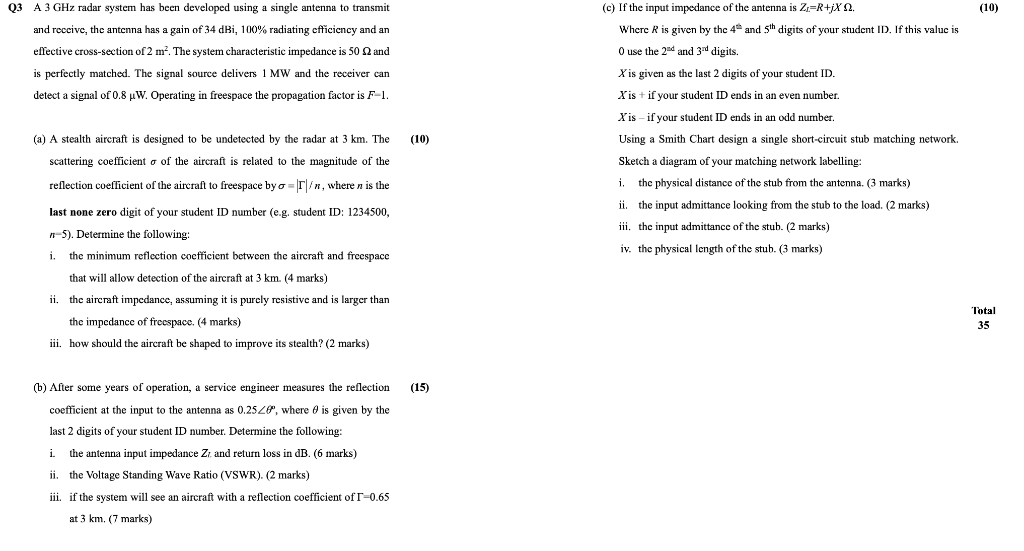
Please take the ID number 1234567 as an example.
Please answer as fast as possible. Even if you haven't finished all questions, I will still give you my thumb-up. Thanks!!
(10) Q3 A 3 GHz radar system has been developed using a single antenna to transmit and receive the antenna has a gain of 34 dBi, 100% radiating efficiency and an effective cross-section of 2 m. The system characteristic impedance is 50 Q and is perfectly matched. The signal source delivers 1 MW and the receiver can detect a signal of 0.8 uW. Operating in freespace the propagation factor is F-1. (c) If the input impedance of the antenna is 2:=R+jX. Where is given by the 4 and 5th digits of your student ID. If this value is O use the 2nd and 3d digits. X is given as the last 2 digits of your student ID. X is + if your student ID ends in an even number. X is - if your student ID ends in an odd number. Using a Smith Chart design a single short-circuit stub matching network. Sketch a diagram of your matching network labelling: i. the physical distance of the stub from the antenna. (3 marks) ii. the input admittance looking from the stub to the load. (2 marks) iii. the input admittance of the stub. (2 marks) iv. the physical length of the stub. (3 marks) (10) (a) A stealth aircraft is designed to be undetected by the radar at 3 km. The scattering coefficient o of the aircraft is related to the magnitude of the reflection coefficient of the aircraft to freespace by o=1, where n is the last none zero digit of your student ID number (e.g. student ID: 1234500, n-5). Determine the following: i. the minimum reflection coefficient between the aircraft and freespace that will allow detection of the aircraft at 3 km (4 marks) ii. the aircraft impedance, assuming it is purely resistive and is larger than the impedance of freespace. (4 marks) iii. how should the aircraft be shaped to improve its stealth? (2 marks) Total 35 (15) (b) After some years of operation, a service engineer measures the reflection coefficient at the input to the antenna as 0.2526", where 8 is given by the last 2 digits of your student ID number. Determine the following: i. the antenna input impedance Zt and return loss in dB. (6 marks) ii. the Voltage Standing Wave Ratio (VSWR). (2 marks) iii. if the system will see an aircraft with a reflection coefficient of T=0.65 at 3 km (7 marks) (10) Q3 A 3 GHz radar system has been developed using a single antenna to transmit and receive the antenna has a gain of 34 dBi, 100% radiating efficiency and an effective cross-section of 2 m. The system characteristic impedance is 50 Q and is perfectly matched. The signal source delivers 1 MW and the receiver can detect a signal of 0.8 uW. Operating in freespace the propagation factor is F-1. (c) If the input impedance of the antenna is 2:=R+jX. Where is given by the 4 and 5th digits of your student ID. If this value is O use the 2nd and 3d digits. X is given as the last 2 digits of your student ID. X is + if your student ID ends in an even number. X is - if your student ID ends in an odd number. Using a Smith Chart design a single short-circuit stub matching network. Sketch a diagram of your matching network labelling: i. the physical distance of the stub from the antenna. (3 marks) ii. the input admittance looking from the stub to the load. (2 marks) iii. the input admittance of the stub. (2 marks) iv. the physical length of the stub. (3 marks) (10) (a) A stealth aircraft is designed to be undetected by the radar at 3 km. The scattering coefficient o of the aircraft is related to the magnitude of the reflection coefficient of the aircraft to freespace by o=1, where n is the last none zero digit of your student ID number (e.g. student ID: 1234500, n-5). Determine the following: i. the minimum reflection coefficient between the aircraft and freespace that will allow detection of the aircraft at 3 km (4 marks) ii. the aircraft impedance, assuming it is purely resistive and is larger than the impedance of freespace. (4 marks) iii. how should the aircraft be shaped to improve its stealth? (2 marks) Total 35 (15) (b) After some years of operation, a service engineer measures the reflection coefficient at the input to the antenna as 0.2526", where 8 is given by the last 2 digits of your student ID number. Determine the following: i. the antenna input impedance Zt and return loss in dB. (6 marks) ii. the Voltage Standing Wave Ratio (VSWR). (2 marks) iii. if the system will see an aircraft with a reflection coefficient of T=0.65 at 3 km (7 marks)
Step by Step Solution
There are 3 Steps involved in it

Get step-by-step solutions from verified subject matter experts
 Study Help