Question: Please take your time and answer the question Question - Summarize the reasons for the diversification of the fast-food giants and state the new products
Please take your time and answer the question
Question - Summarize the reasons for the diversification of the fast-food giants and state the new products they added and the benefits of the decision.
The main aim is to complete the question provided in a very detailed manner and explain the question correctly.
Case - McDonald's and Burger King: The Evolution of Franchising and Benefits of the Burger Wars
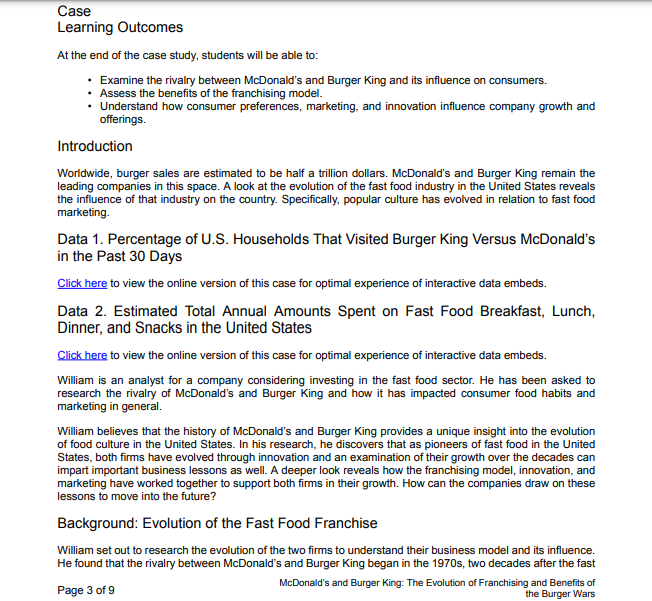
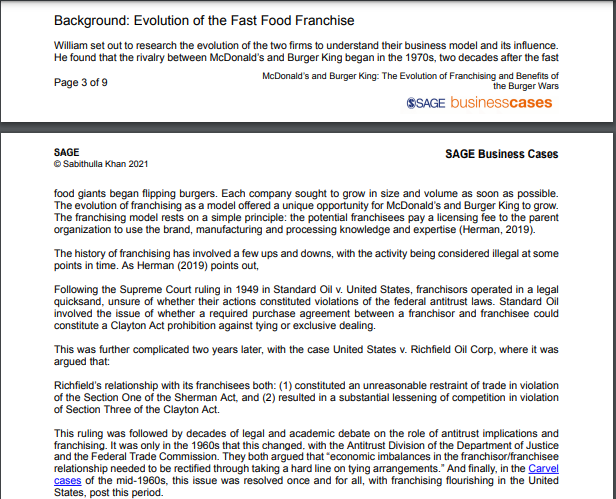
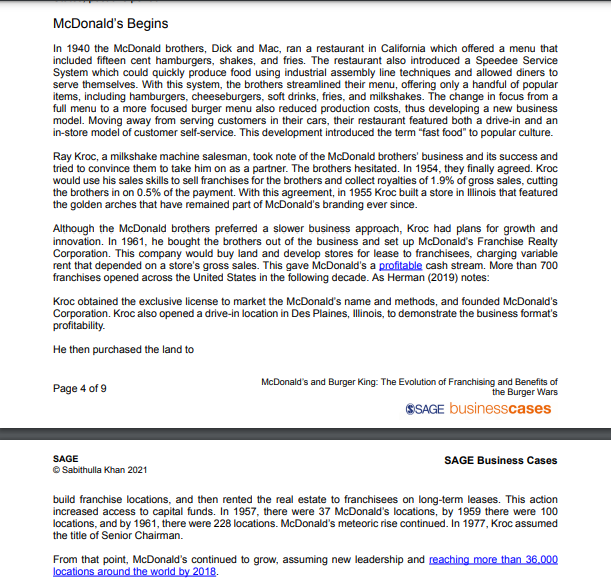
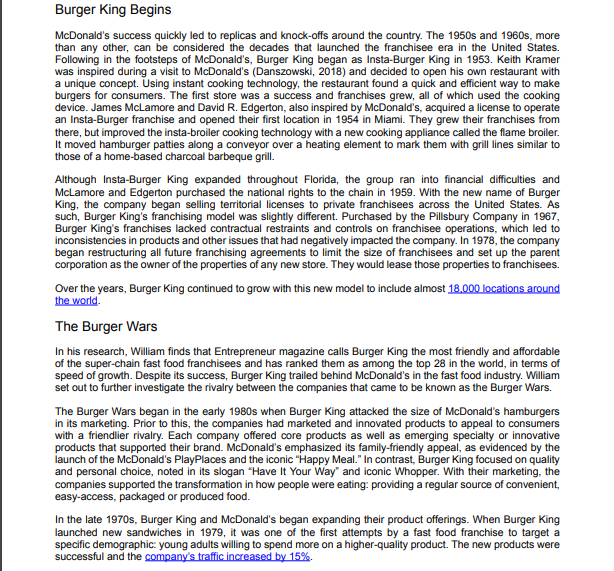
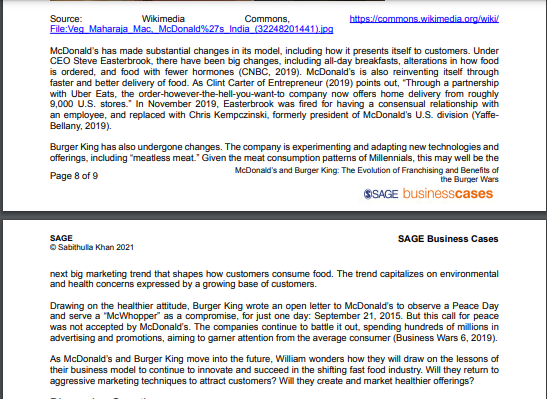
Case Learning Outcomes At the end of the case study, students will be able to: Examine the rivalry between McDonald's and Burger King and its influence on consumers. Assess the benefits of the franchising model. Understand how consumer preferences, marketing, and innovation influence company growth and offerings. Introduction Worldwide, burger sales are estimated to be half a trillion dollars. McDonald's and Burger King remain the leading companies in this space. A look at the evolution of the fast food industry in the United States reveals the influence of that industry on the country. Specifically, popular culture has evolved in relation to fast food marketing. Data 1. Percentage of U.S. Households That Visited Burger King Versus McDonald's in the Past 30 Days Click here to view the online version of this case for optimal experience of interactive data embeds. Data 2. Estimated Total Annual Amounts Spent on Fast Food Breakfast, Lunch, Dinner, and Snacks in the United States Click here to view the online version of this case for optimal experience of interactive data embeds. William is an analyst for a company considering investing in the fast food sector. He has been asked to research the rivalry of McDonald's and Burger King and how it has impacted consumer food habits and marketing in general. William believes that the history of McDonald's and Burger King provides a unique insight into the evolution of food culture in the United States. In his research, he discovers that as pioneers of fast food in the United States, both firms have evolved through innovation and an examination of their growth over the decades can impart important business lessons as well. A deeper look reveals how the franchising model, innovation, and marketing have worked together to support both firms in their growth. How can the companies draw on these lessons to move into the future? Background: Evolution of the Fast Food Franchise William set out to research the evolution of the two firms to understand their business model and its influence. He found that the rivalry between McDonald's and Burger King began in the 1970s, two decades after the fast Page 3 of 9 McDonald's and Burger King: The Evolution of Franchising and Benefits of the Burger Wars Background: Evolution of the Fast Food Franchise William set out to research the evolution of the two firms to understand their business model and its influence. He found that the rivalry between McDonald's and Burger King began in the 1970s, two decades after the fast Page 3 of 9 McDonald's and Burger King: The Evolution of Franchising and Benefits of the Burger Wars SSAGE businesscases SAGE Sabithulla Khan 2021 SAGE Business Cases food giants began flipping burgers. Each company sought to grow in size and volume as soon as possible. The evolution of franchising as a model offered a unique opportunity for McDonald's and Burger King to grow. The franchising model rests on a simple principle: the potential franchisees pay a licensing fee to the parent organization to use the brand, manufacturing and processing knowledge and expertise (Herman, 2019). The history of franchising has involved a few ups and downs, with the activity being considered illegal at some points in time. As Herman (2019) points out, Following the Supreme Court ruling in 1949 in Standard Oil v. United States, franchisors operated in a legal quicksand, unsure of whether their actions constituted violations of the federal antitrust laws. Standard Oil involved the issue of whether a required purchase agreement between a franchisor and franchisee could constitute a Clayton Act prohibition against tying or exclusive dealing. This was further complicated two years later, with the case United States v. Richfield Oll Corp, where it was argued that: Richfield's relationship with its franchisees both: (1) constituted an unreasonable restraint of trade in violation of the Section One of the Sherman Act, and (2) resulted in a substantial lessening of competition in violation of Section Three of the Clayton Act. This ruling was followed by decades of legal and academic debate on the role of antitrust implications and franchising. It was only in the 1960s that this changed, with the Antitrust Division of the Department of Justice and the Federal Trade Commission. They both argued that economic imbalances in the franchisor/franchisee relationship needed to be rectified through taking a hard line on tying arrangements." And finally, in the Carvel cases of the mid-1960s, this issue was resolved once and for all, with franchising flourishing in the United States, post this period. McDonald's Begins In 1940 the McDonald brothers, Dick and Mac, ran a restaurant in California which offered a menu that included fifteen cent hamburgers, shakes, and fries. The restaurant also introduced a Speedee Service System which could quickly produce food using industrial assembly line techniques and allowed diners to serve themselves. With this system, the brothers streamlined their menu, offering only a handful of popular items, including hamburgers, cheeseburgers, soft drinks, fries, and milkshakes. The change in focus from a full menu to a more focused burger menu also reduced production costs, thus developing a new business model. Moving away from serving customers in their cars, their restaurant featured both a drive-in and an in-store model of customer self-service. This development introduced the term "fast food" to popular culture. Ray Kroc, a milkshake machine salesman, took note of the McDonald brothers' business and its success and tried to convince them to take him on as a partner. The brothers hesitated. In 1954, they finally agreed. Kroc would use his sales skills to sell franchises for the brothers and collect royalties of 1.9% of gross sales, cutting the brothers in on 0.5% of the payment. With this agreement, in 1955 Kroc built a store in illinois that featured the golden arches that have remained part of McDonald's branding ever since. Although the McDonald brothers preferred a slower business approach, Kroc had plans for growth and innovation. In 1961, he bought the brothers out of the business and set up McDonald's Franchise Realty Corporation. This company would buy land and develop stores for lease to franchisees, charging variable rent that depended on a store's gross sales. This gave McDonald's a profitable cash stream. More than 700 franchises opened across the United States in the following decade. As Herman (2019) notes: Kroc obtained the exclusive license to market the McDonald's name and methods, and founded McDonald's Corporation. Kroc also opened a drive-in location in Des Plaines, Illinois, to demonstrate the business format's profitability. He then purchased the land to Page 4 of 9 McDonald's and Burger King: The Evolution of Franchising and Benefits of the Burger Wars SSAGE businesscases SAGE Sabithulla Khan 2021 SAGE Business Cases build franchise locations, and then rented the real estate to franchisees on long-term leases. This action increased access to capital funds. In 1957, there were 37 McDonald's locations, by 1959 there were 100 locations, and by 1961, there were 228 locations. McDonald's meteoric rise continued. In 1977, Kroc assumed the title of Senior Chairman. From that point, McDonald's continued to grow, assuming new leadership and reaching more than 36.000 locations around the world by 2018. Burger King Begins McDonald's success quickly led to replicas and knock-offs around the country. The 1950s and 1960s, more than any other, can be considered the decades that launched the franchisee era in the United States. Following in the footsteps of McDonald's, Burger King began as Insta-Burger King in 1953. Keith Kramer was inspired during a visit to McDonald's (Danszowski, 2018) and decided to open his own restaurant with a unique concept. Using instant cooking technology, the restaurant found a quick and efficient way to make burgers for consumers. The first store was a success and franchises grew, all of which used the cooking device. James McLamore and David R. Edgerton, also inspired by McDonald's, acquired a license to operate an Insta-Burger franchise and opened their first location in 1954 in Miami. They grew their franchises from there, but improved the insta-broiler cooking technology with a new cooking appliance called the flame broiler. It moved hamburger patties along a conveyor over a heating element to mark them with grill lines similar to those of a home-based charcoal barbeque grill. Although Insta-Burger King expanded throughout Florida, the group ran into financial difficulties and McLamore and Edgerton purchased the national rights to the chain in 1959. With the new name of Burger King, the company began selling territorial licenses to private franchisees across the United States. As such, Burger King's franchising model was slightly different. Purchased by the Pillsbury Company in 1967, Burger King's franchises lacked contractual restraints and controls on franchisee operations, which led to inconsistencies in products and other issues that had negatively impacted the company. In 1978, the company began restructuring all future franchising agreements to limit the size of franchisees and set up the parent corporation as the owner of the properties of any new store. They would lease those properties to franchisees. Over the years, Burger King continued to grow with this new model to include almost 18.000 locations around the world The Burger Wars In his research, William finds that Entrepreneur magazine calls Burger King the most friendly and affordable of the super-chain fast food franchisees and has ranked them as among the top 28 in the world, in terms of speed of growth. Despite its success, Burger King trailed behind McDonald's in the fast food industry. William set out to further investigate the rivalry between the companies that came to be known as the Burger Wars. The Burger Wars began in the early 1980s when Burger King attacked the size of McDonald's hamburgers in its marketing. Prior to this, the companies had marketed and innovated products to appeal to consumers with a friendlier rivalry. Each company offered core products as well as emerging specialty or innovative products that supported their brand. McDonald's emphasized its family-friendly appeal, as evidenced by the launch of the McDonald's PlayPlaces and the iconic "Happy Meal." In contrast, Burger King focused on quality and personal choice, noted in its slogan "Have It Your Way" and iconic Whopper. With their marketing, the companies supported the transformation in how people were eating providing a regular source of convenient, easy-access, packaged or produced food. In the late 1970s, Burger King and McDonald's began expanding their product offerings. When Burger King launched new sandwiches in 1979, it was one of the first attempts by a fast food franchise to target a specific demographic: young adults willing to spend more on a higher quality product. The new products were successful and the company's traffic increased by 15%. In the late 1970s, Burger King and McDonald's began expanding their product offerings. When Burger King launched new sandwiches in 1979, it was one of the first attempts by a fast food franchise to target a specific demographic young adults willing to spend more on a higher-quality product. The new products were successful and the company's traffic increased by 15%. The fast food market was saturated and the big franchises were fighting to stand out. As a result, the Page 5 of 9 McDonald's and Burger King: The Evolution of Franchising and Benefits of the Burger Wars SSAGE businesscases SAGE Sabithulla Khan 2021 SAGE Business Cases approach to marketing changed when Burger King launched a series of attack ads to draw attention to the poor quality of McDonald's products and the superiority of Burger King's taste and methods. The Burger Wars began. A series of comparative advertising campaigns emerged as Burger King attempted to increase its brand recognition and market share and McDonald's fought back. Other fast food restaurants jumped into the Burger Wars too, with television commercials, billboards, print advertising, and other media used to assert the superiority of each company. The growth of fast food restaurants in general, and that of McDonald's and Burger King in particular, remained quite high in the 1970s and 1980s. Although recession and other macro-economic forces dampened their growth in intervening years, the overall trajectory remained positive. Despite some positive growth, the advertising wars slowed for a while, as the advertising budgets proved too costly. It was estimated that McDonald's spent USD 350 million in advertising during the year that they launched and promoted their McDLT product, which featured a polystyrene package that separated the burger from its garnish to keep it fresh. This product was discontinued in 1991 as the company transitioned toward more environmentally friendly packaging. Over the years, Burger King also experimented with new products that cost too much to advertise. For example, the company launched a USD 70 million marketing campaign for a new fries product in 1997, but the product failed and there was a drop of 14% in sales (Business Wars 6, 2018). McDonald's was also going through a difficult time in this decade and posted its first loss in its four decades of being in business. Other brands, such as Wendy's, were impacting these two firms, while Starbucks and Subway were also competing for attention. Activism and environmental forces were about to impact both these firms in a big way, as consumers became more conscious of what they were eating and drinking. Other marketing campaigns, such as the "Subservient Chicken" worked well for Burger King, which captured the imagination of the common man and positioned itself as the fast food choice of Americans. Although the advertising budgets could not be sustained for the large attack campaigns of the 1980s, the Burger Wars flared in periodic battles as the companies fought for larger shares of the burger and fast food market. In this marketing, the size of burgers, quality of meat, value, and other factors were compared in an effort to grab fast food customer bases. The industry had diversified and Burger King and McDonald's had to evolve to attract consumers who valued quality over convenience, among other preferences. The Power of the Franchise William moved on to research how the fast food franchise giants chose to grow in the new millennium. He noted an important development in the first investor conference of Jim Cantaloupo, McDonald's CEO during the early 2000s. Cantaloupo pointed out the company's vision of having "clean restrooms and hot food" at every restaurant. This clear vision supported McDonald's continuing profits and success (Cunneen, 2010), His successor, Steve Easterbrook, who took over in 2015, followed the same logic and vision: to offer a great experience beyond just the core product. Having a clear vision and goal made McDonald's a leader in its space. As per the agreements of franchising, some of the more recent franchisees have landed in trouble with Burger King and McDonald's, following violations in health code or sanitary conditions. Despite those troubles, Burger King and McDonald's franchising has continued and McDonald's franchising around the world has outpaced that in the United States (Michaels, 2015). In the post-2008 economy, Burger King and McDonald's were both challenged. Wendy's surpassed Burger King in 2009 as the number 2 burger company (Business Wars 6, 2019). There were fears that McDonald's franchisees would not do well and the mood was somber through 2015, but it seems to have improved slightly since that period (Michaels, 2015). However, recent reporting from the Wall Street Journal confirms fears that some of the franchisees are still concerned that their investments are not paying off and that the remodeling costs they are being asked to bear may not have the required rate of retur (Jargon, 2018). As the article points out there has not been a big shift in sales since the turnaround efforts: "U.S. same-store sales growth a of 2.6% in the second quarter fell short of forecasts for 3% growth. McDonald's this summer made layoffs and other changes to its field operations to become nimbler" (Jargon, 2018). The competition from Burger King and others has caused some of the shift in revenues and has posed a challenge to the company's bottom Page 6 of 9 McDonald's and Burger King: The Evolution of Franchising and Benefits of the Burger Wars SSAGE businesscases SAGE Sabithula khan 2021 SAGE Business Cases line. As Entrepreneur magazine points out: Easterbrook also began strengthening the company's franchise network, selling thousands of corporate- owned stores to independent owners. "You've seen chains like Burger King, Wendy's, and Buffalo Wild Wings do this, too," says Mark Siebert, franchise consultant and CEO of the iFranchise Group. "This points to the growth of franchisees, which constituted 81 percent of total McDonald's outlets, with them occupying over 95 percent of the share and 90 percent worldwide." (Entrepreneur, 2019) William found that what both firms seem to have done well is to have put in place a solid management system that includes marketing, branding, and operations management, which franchisees get access to as soon as they sign on (Obringer, 2019). William knew that most businesses fail due to lack of management expertise and good systems in place. With this worry out of the way, franchisees can focus on superior customer service and great delivery, which can make success all the more guaranteed. William would argue that this is one of the biggest draws of franchising. ne. As Entrepreneur magazine points out: Easterbrook also began strengthening the company's franchise network, selling thousands of corporate- owned stores to independent owners. "You've seen chains like Burger King, Wendy's, and Buffalo Wild Wings do this, too," says Mark Siebert, franchise consultant and CEO of the iFranchise Group. "This points to the growth of franchisees, which constituted 81 percent of total McDonald's outlets, with them occupying over 95 percent of the share and 90 percent worldwide." (Entrepreneur, 2019) William found that what both firms seem to have done well is to have put in place a solid management system that includes marketing, branding, and operations management, which franchisees get access to as soon as they sign on (Obringer, 2019). William knew that most businesses fail due to lack of management expertise and good systems in place. With this worry out of the way, franchisees can focus on superior customer service and great delivery, which can make success all the more guaranteed. William would argue that this is one of the biggest draws of franchising. Future of Fast Food William notes that the future of the fast food industry is uncertain and sets out to research how each burger company positions itself and its offerings. He believes that how they position themselves in terms of healthy or wholesome meals for the family will be particularly significant the franchises. The growth of McDonald's franchises has included novel plans and innovations in what kinds of food can be served in a McDonald's restaurant (Sofa King Podcast, 2018). There has been a constant effort to reinvent the McDonald's brand and also cater to local tastes. The models that are evolving around the world are representative of the diversity of flavors that people prefer. Japan, for instance, has a McPrawn burger; there is a McCurry and a vegetarian "Maharaja Mac in India and similarly, cultural differentiators that are popular in different parts of the world. McDonald's even brought some of the international flavors to their U.S. locations for a limited time in 2019. https://commons.wikimedia.org/wiki/ Source: Wikimedia Commons, File:Veg Maharaja Mac. McDonald%27s India (32248201441).jpg McDonald's has made substantial changes in its model, including how it presents itself to customers. Under CEO Steve Easterbrook, there have been big changes, including all-day breakfasts, alterations in how food is ordered, and food with fewer hormones (CNBC, 2019). McDonald's is also reinventing itself through faster and better delivery of food. As Clint Carter of Entrepreneur (2019) points out, "Through a partnership with Uber Eats, the order-however-the-hell-you-want-to company now offers home delivery from roughly 9,000 U.S. stores." In November 2019, Easterbrook was fired for having a consensual relationship with an employee, and replaced with Chris Kempczinski, formerly president of McDonald's U.S. division (Yaffe- Bellany, 2019). Burger King has also undergone changes. The company is experimenting and adapting new technologies and offerings, including "meatless meat. Given the meat consumption patterns of Millennials, this may well be the Page 8 of 9 McDonald's and Burger King: The Evolution of Franchising and Benefits of the Burger Wars SSAGE businesscases SAGE Sabithulla Khan 2021 SAGE Business Cases next big marketing trend that shapes how customers consume food. The trend capitalizes on environmental and health concerns expressed by a growing base of customers. Drawing on the healthier attitude, Burger King wrote an open letter to McDonald's to observe a Peace Day and serve a "McWhopper' as a compromise, for just one day: September 21, 2015. But this call for peace was not accepted by McDonald's. The companies continue to battle it out, spending hundreds of millions in advertising and promotions, aiming to garner attention from the average consumer (Business Wars 6, 2019). As McDonald's and Burger King move into the future, William wonders how they will draw on the lessons of their business model to continue to innovate and succeed in the shifting fast food industry. Will they return to aggressive marketing techniques to attract customers? Will they create and market healthier offerings









 Study Help