







Question: Please tap the answer. do not handwrite. Thank you EC0250 Unit 7 ln-Class Exercise 1. What is the Central Limit Theorem? Try to state it
Please tap the answer. do not handwrite. Thank you
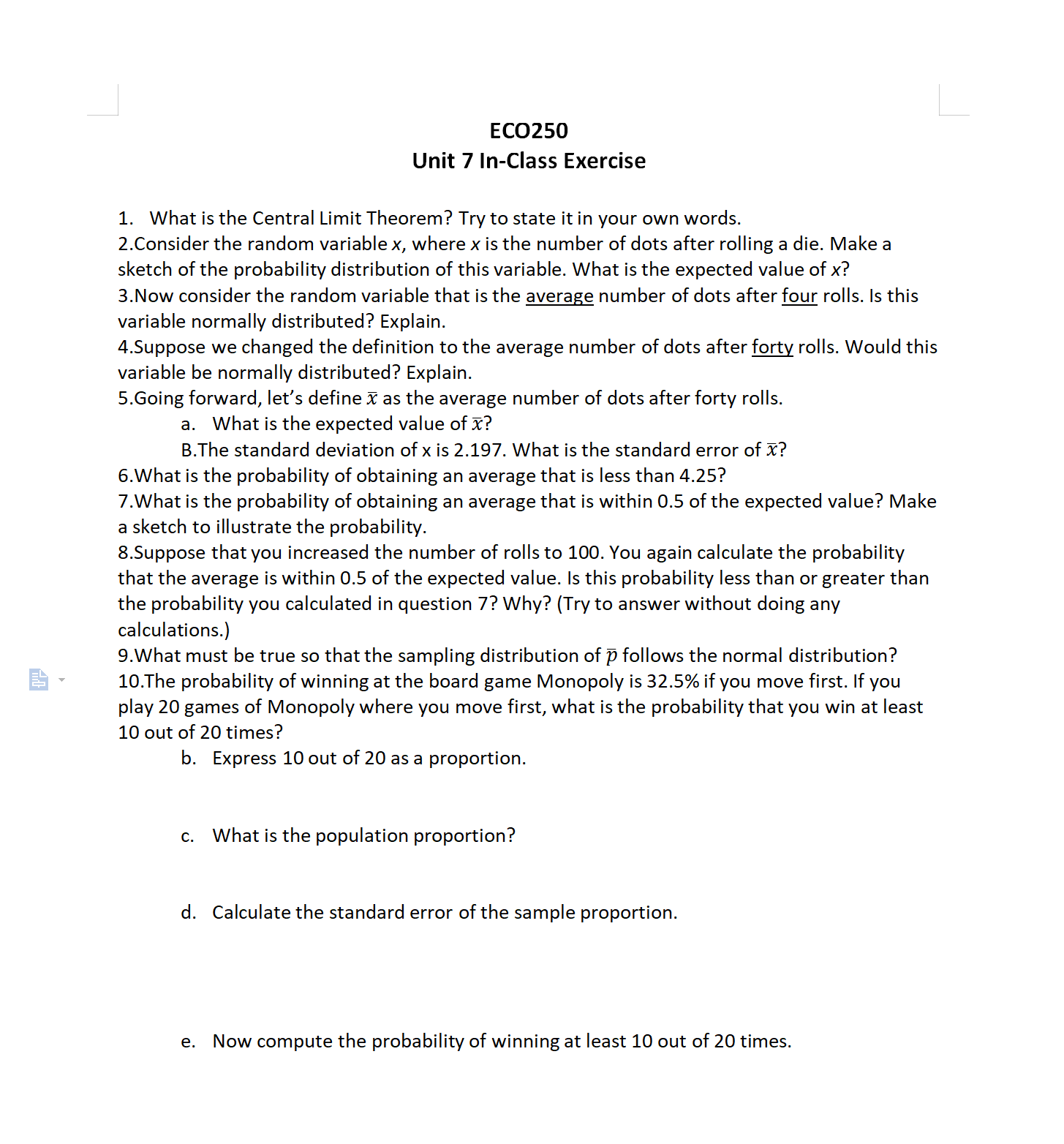
EC0250 Unit 7 ln-Class Exercise 1. What is the Central Limit Theorem? Try to state it in your own words. 2.Consider the random variable x, where x is the number of dots after rolling a die. Make a sketch of the probability distribution of this variable. What is the expected value of x? 3.Now consider the random variable that is the average number of dots after @ rolls. Is this variable normally distributed? Explain. 4.Suppose we changed the definition to the average number of dots afterfo_rty rolls. Would this variable be normally distributed? Explain. 5.Going forward, let's define Tc as the average number of dots afterforty rolls. a. What is the expected value of 97:? B.The standard deviation of x is 2.197. What is the standard error of :Tc? 6.What is the probability of obtaining an average that is less than 4.25? 7.What is the probability of obtaining an average that is within 0.5 ofthe expected value? Make a sketch to illustrate the probability. 8.Suppose that you increased the number of rolls to 100. You again calculate the probability that the average is within 0.5 of the expected value. Is this probability less than or greater than the probability you calculated in question 7? Why? (Try to answer without doing any calculations.) 9.What must be true so that the sampling distribution of T9 follows the normal distribution? 10.The probability of winning at the board game Monopoly is 32.5% if you move first. If you play 20 games of Monopoly where you move first, what is the probability that you win at least 10 out of 20 times? b. Express 10 out of 20 as a proportion. c. What is the population proportion? d. Calculate the standard error ofthe sample proportion. e. Now compute the probability of winning at least 10 out of 20 times
Step by Step Solution
There are 3 Steps involved in it

Get step-by-step solutions from verified subject matter experts
 Study Help