



Question: please tell me how to do : 1 Grossman Model (35 points) Consider a simple model of a person making decisions about their health over
please tell me how to do :
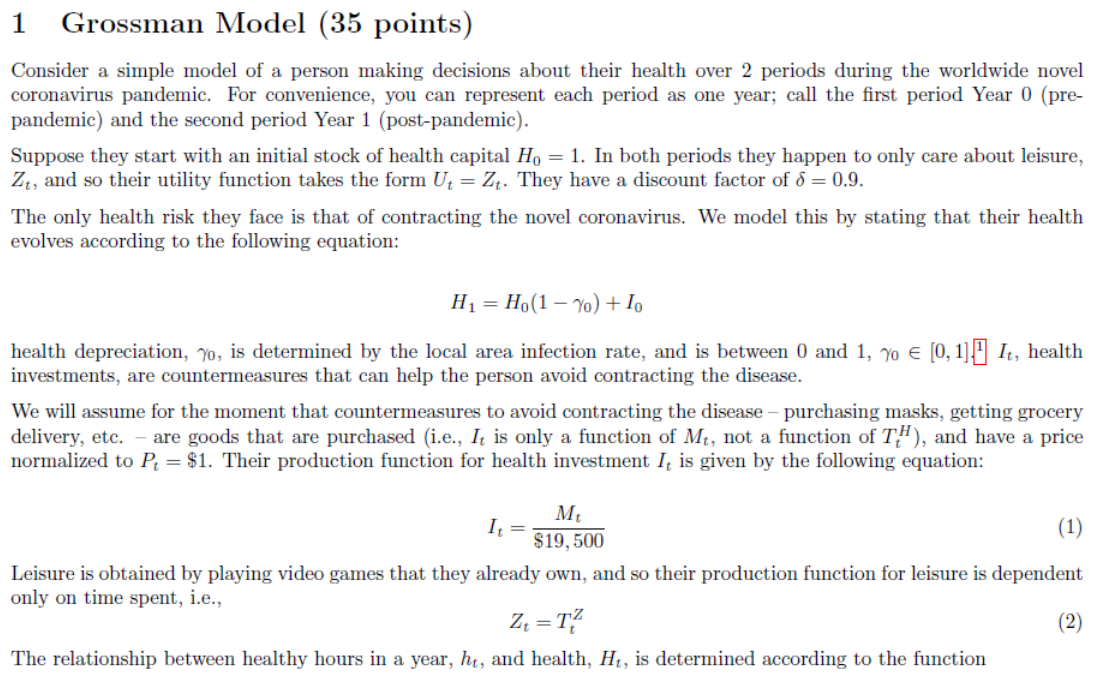
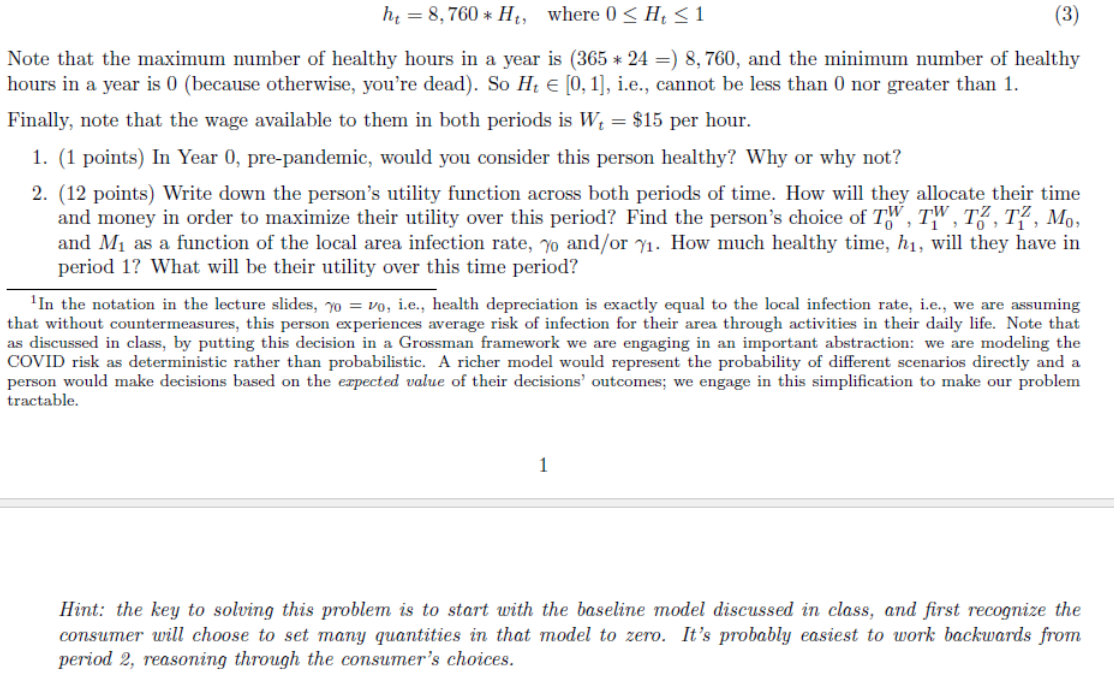
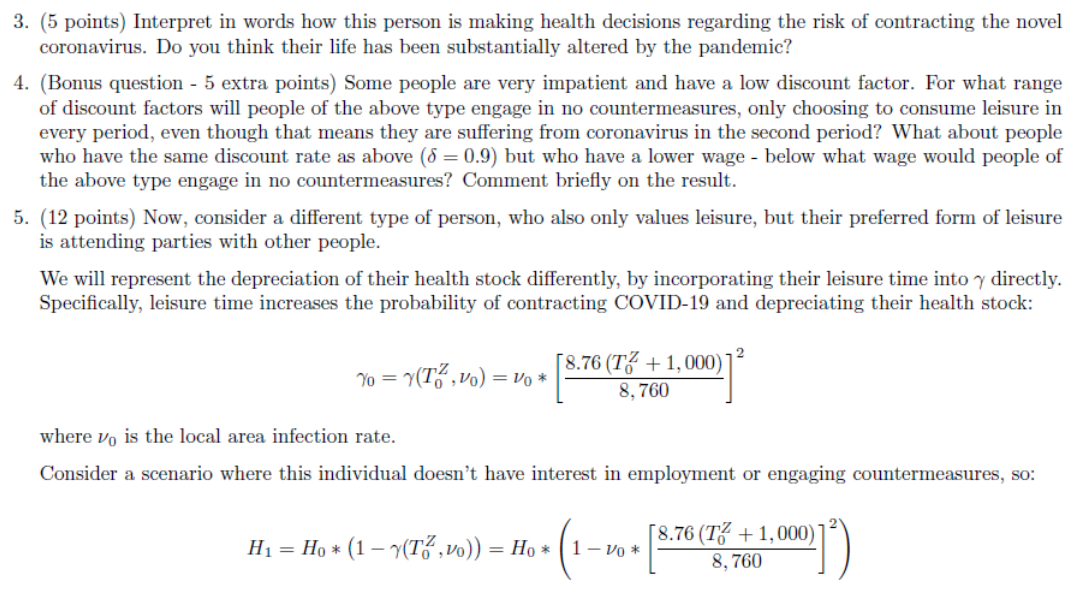
1 Grossman Model (35 points) Consider a simple model of a person making decisions about their health over 2 periods during the worldwide novel coronavirus pandemic For convenience, you can represent each period as one year; call the rst period Year 0 (pre pandemic) and the second period Year 1 (post-pandemic). Suppose they start with an initial stock of health capital Ha = I. In both periods they happen to only care about leisure, Zn and so their utility function takes the form U, = 2'. They have a discount factor of 6 = 0.9. The only health risk they face is that of contracting the novel coronavirus. We model this by stating that their health evolves according to the following equation: H1 = H(1T)+ In health depreciation, 70 is determined by the local area infection rate, and is between 0 and 1, 70 6 [0,1]. 1;, health investments, are countermeasures that can help the person avoid contracting the disease. We will assume for the moment that countermeasures to avoid contracting the disease purchasing masks, getting grocery delivery, etcr are goods that are purchased (i.e., I; is only a function of Mg, not a function of TI\" ), and have a price normalized to P, = $1. Their production function for health investment II is given by the following equation: M; ' $19,500 (1) Leisure is obtained by playing video games that they already own, and so their production function for leisure is dependent only on time spent, i.e., 1'; zt = T? (2) The relationship between healthy hours in a year, In, and health, Hg, is determined according to the function h,=8,760*H,, whereogh'tgl (3) Note that the maximum number of healthy hours in a year is (365 s 24 =) 8. 760, and the minimum number of healthy hours in a year is 0 (because otherwise, you're dead). So H; e [0, 1], Le, cannot be less than 0 not greater than 1. Finally, note that the wage available to them in both periods is W; = $15 per hour. 1. (1 points) In Year 0, pro-pandemic, would you consider this person healthy? Why or why not? 2. (12 points) Write down the person's utility function across both periods of time. How will they allocate their time and money in order to maximize their utility over this period? Find the person's choice of T3", le , T02. T13, Mg, and M; as a function of the local area infection rate, \"In and/or 71. How much healthy time, in, will they have in period 1'? What will be their utility over this time period? 1111 the notation in the lecture slides, \"m = w, i.e.. health depreciation is exactly equal to the local infection rate, ie., we are assuming that without countermeasures, this person experienws avenge r'nk of infection for their area through activities in their daily liie. Note that as dismissal in clam, by putting this decision in a Grossman framework we are engaging in an important abstraction: we are modeling the COVID risk as deterministic rather than probabilistic. A richer model would represent the probability of di'erent scenarios directly and a person would make decisions based on the expected value of their decisions' outcomes; we engage in this simplification to melee our problem tractable. Hint: the key to solving this problem is to start with the baseline model discussai in class, and rst recognize the master- will choose to set many quantities in that model to zero. It's probably easiest to work backwards from period 2, reasoning through the consumer's choices. 3. (5 points) Interpret in words how this person is making health decisions regarding the risk of contracting the novel coronavirus. Do you think their life has been substantially altered by the pandemic? 4. (Bonus question - 5 extra points) Some people are very impatient and have a low discount factor. For what range of discount factors will people of the above type engage in no countermeasures, only choosing to consume leisure in every period, even though that means they are suffering from coronavirus in the second period? What about people who have the same discount rate as above (6 = 0.9) but who have a lower wage - below what wage would people of the above type engage in no countermeasures? Comment briefly on the result. 5. (12 points) Now, consider a different type of person, who also only values leisure, but their preferred form of leisure is attending parties with other people. We will represent the depreciation of their health stock differently, by incorporating their leisure time into y directly. Specifically, leisure time increases the probability of contracting COVID-19 and depreciating their health stock: 70 = 7(To , Vo) = Vo* 8.76 (T. + 1, 000) 12 8. 760 where vo is the local area infection rate. Consider a scenario where this individual doesn't have interest in employment or engaging countermeasures, so: H1 = Ho * (1 -y(To , vo)) = Ho * 1 -vo * 8.76 (T, + 1,000) 8, 760
Step by Step Solution
There are 3 Steps involved in it

Get step-by-step solutions from verified subject matter experts