







Question: please try to solve it the way it is, there is no more info that i can add Q2. (50 pts) A raw material, which
please try to solve it the way it is, there is no more info that i can add
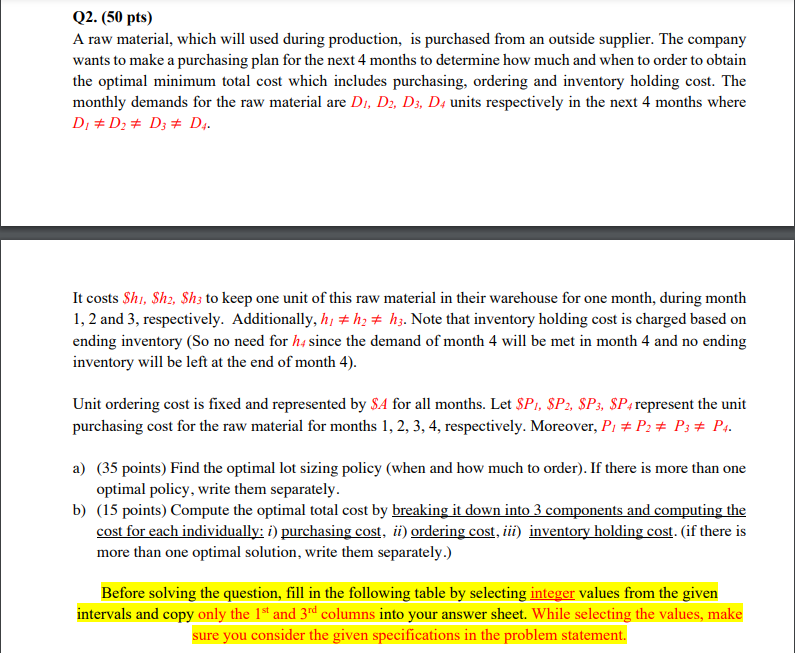
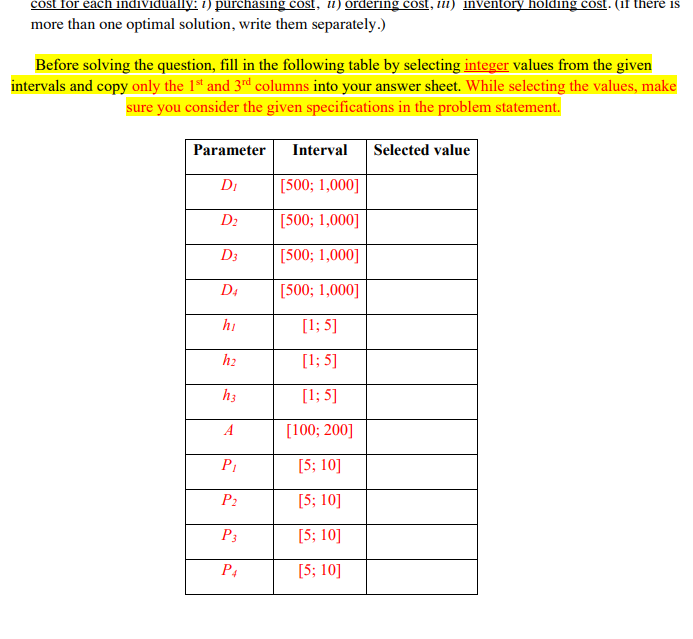
Q2. (50 pts) A raw material, which will used during production, is purchased from an outside supplier. The company wants to make a purchasing plan for the next 4 months to determine how much and when to order to obtain the optimal minimum total cost which includes purchasing, ordering and inventory holding cost. The monthly demands for the raw material are D1, D2, D3, D4 units respectively in the next 4 months where D, # D2 # D3 # DA. It costs $hi, Sh2, $hz to keep one unit of this raw material in their warehouse for one month, during month 1, 2 and 3, respectively. Additionally, h; #h2 # hz. Note that inventory holding cost is charged based on ending inventory (So no need for h4 since the demand of month 4 will be met in month 4 and no ending inventory will be left at the end of month 4). Unit ordering cost is fixed and represented by $A for all months. Let $P., $P2, $P3, $P4 represent the unit purchasing cost for the raw material for months 1, 2, 3, 4, respectively. Moreover, P, # P2 # P3 # P4. a) (35 points) Find the optimal lot sizing policy (when and how much to order). If there is more than one optimal policy, write them separately. b) (15 points) Compute the optimal total cost by breaking it down into 3 components and computing the cost for each individually: i) purchasing cost, ii) ordering cost, iii) inventory holding cost. (if there is more than one optimal solution, write them separately.) Before solving the question, fill in the following table by selecting integer values from the given intervals and copy only the 1* and 3rd columns into your answer sheet. While selecting the values, make sure you consider the given specifications in the problem statement. cost for each individually: 1) purchasing cost, l1) ordering cost, u) inventory holding cost. (if there is more than one optimal solution, write them separately.) Before solving the question, fill in the following table by selecting integer values from the given intervals and copy only the 1st and 3rd columns into your answer sheet. While selecting the values, make sure you consider the given specifications in the problem statement. Parameter Interval Selected value D [500; 1,000] [500; 1,000] D D3 [500; 1,000] D [500; 1,000] h [1; 5) h2 [1; 5) h3 [1; 5) [100; 200] P [5; 10] P2 [5; 10] P3 [5; 10] PA [5; 10] Q2. (50 pts) A raw material, which will used during production, is purchased from an outside supplier. The company wants to make a purchasing plan for the next 4 months to determine how much and when to order to obtain the optimal minimum total cost which includes purchasing, ordering and inventory holding cost. The monthly demands for the raw material are D1, D2, D3, D4 units respectively in the next 4 months where D, # D2 # D3 # DA. It costs $hi, Sh2, $hz to keep one unit of this raw material in their warehouse for one month, during month 1, 2 and 3, respectively. Additionally, h; #h2 # hz. Note that inventory holding cost is charged based on ending inventory (So no need for h4 since the demand of month 4 will be met in month 4 and no ending inventory will be left at the end of month 4). Unit ordering cost is fixed and represented by $A for all months. Let $P., $P2, $P3, $P4 represent the unit purchasing cost for the raw material for months 1, 2, 3, 4, respectively. Moreover, P, # P2 # P3 # P4. a) (35 points) Find the optimal lot sizing policy (when and how much to order). If there is more than one optimal policy, write them separately. b) (15 points) Compute the optimal total cost by breaking it down into 3 components and computing the cost for each individually: i) purchasing cost, ii) ordering cost, iii) inventory holding cost. (if there is more than one optimal solution, write them separately.) Before solving the question, fill in the following table by selecting integer values from the given intervals and copy only the 1* and 3rd columns into your answer sheet. While selecting the values, make sure you consider the given specifications in the problem statement. cost for each individually: 1) purchasing cost, l1) ordering cost, u) inventory holding cost. (if there is more than one optimal solution, write them separately.) Before solving the question, fill in the following table by selecting integer values from the given intervals and copy only the 1st and 3rd columns into your answer sheet. While selecting the values, make sure you consider the given specifications in the problem statement. Parameter Interval Selected value D [500; 1,000] [500; 1,000] D D3 [500; 1,000] D [500; 1,000] h [1; 5) h2 [1; 5) h3 [1; 5) [100; 200] P [5; 10] P2 [5; 10] P3 [5; 10] PA [5; 10]Step by Step Solution
There are 3 Steps involved in it
1 Expert Approved Answer
Step: 1 Unlock

Question Has Been Solved by an Expert!
Get step-by-step solutions from verified subject matter experts
Step: 2 Unlock
Step: 3 Unlock
 Study Help