







Question: * * * * please upload written workings if possible * * * * * Question 1 A rectangular concrete channel ( n = 0
please upload written workings if possible Question
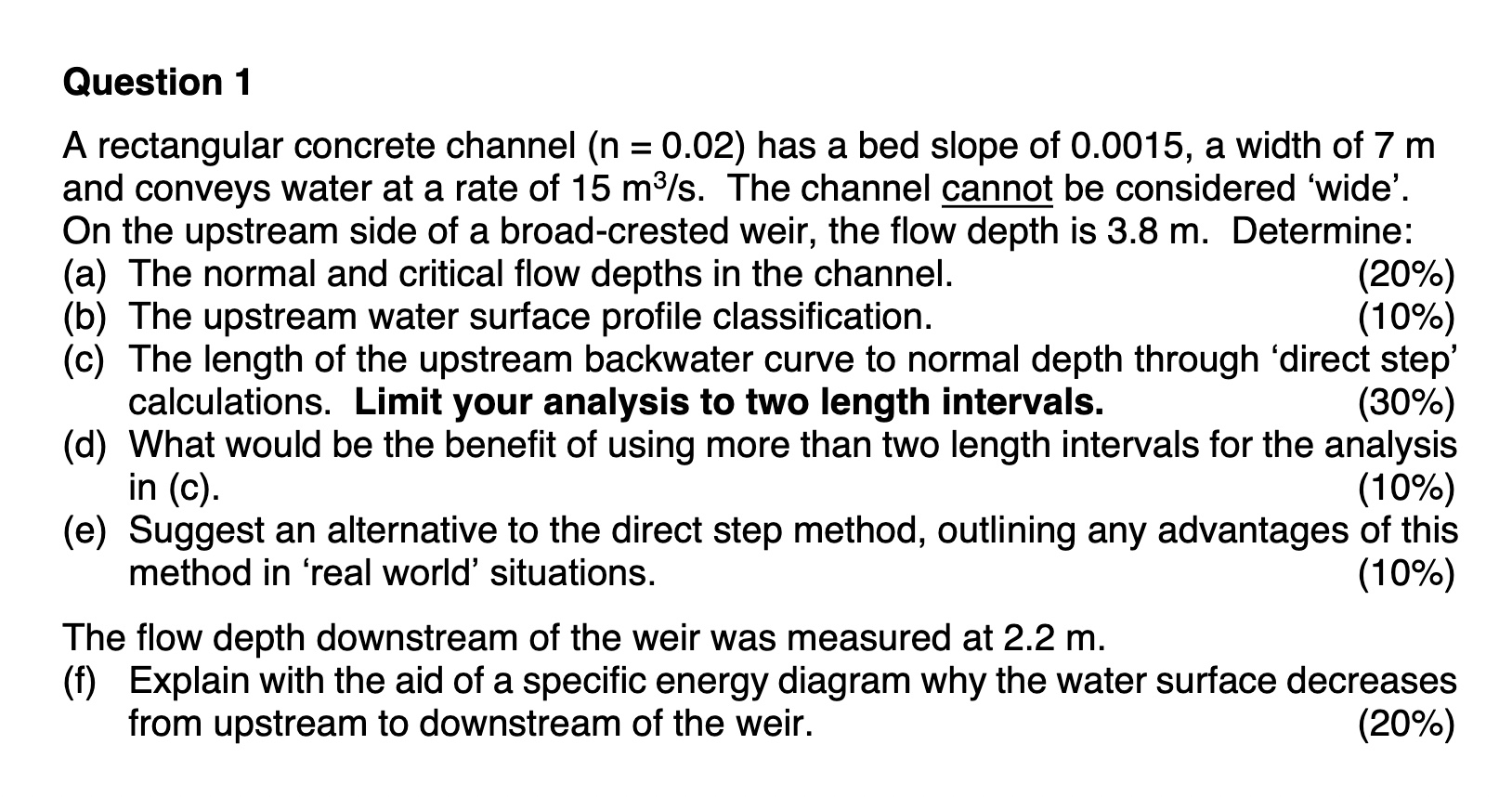
A rectangular concrete channel has a bed slope of a width of
and conveys water at a rate of The channel cannot be considered 'wide'.
On the upstream side of a broadcrested weir, the flow depth is Determine:
a The normal and critical flow depths in the channel.
b The upstream water surface profile classification.
c The length of the upstream backwater curve to normal depth through 'direct step'
calculations. Limit your analysis to two length intervals.
d What would be the benefit of using more than two length intervals for the analysis
in c
e Suggest an alternative to the direct step method, outlining any advantages of this
method in 'real world' situations.
The flow depth downstream of the weir was measured at
f Explain with the aid of a specific energy diagram why the water surface decreases
from upstream to downstream of the weir.
A rectangular concrete channel n has a bed slope of a width of m
and conveys water at a rate of ms The channel cannot be considered wide
On the upstream side of a broadcrested weir, the flow depth is m Determine:
a The normal and critical flow depths in the channel.
b The upstream water surface profile classification.
c The length of the upstream backwater curve to normal depth through direct step
calculations. Limit your analysis to two length intervals.
d What would be the benefit of using more than two length intervals for the analysis
in c
e Suggest an alternative to the direct step method, outlining any advantages of this
method in real world situations.
The flow depth downstream of the weir was measured at m
f Explain with the aid of a specific energy diagram why the water surface decreases
from upstream to downstream of the weir.
Question
a In the context of pumppipeline system analysis, explain the following:
i system curve ii pump characteristic curve
iii duty point iv cavitation
bi A site contractor wishing to pour the foundations for a large retail development
requires the water level in an excavated site to be lowered. A number of
identical centrifugal pumps are located on site. The headdischarge
characteristics for one such pump operating at test speed is in Table
Table
The static lift in pumping the water from the excavation to an onsite water
storage facility can be taken as m The excavation and storage facility are
connected by an m long pipe of diameter m The Darcy Weisbach
friction factor for the pipe can be taken as and local losses through the
pipe total Vg
In an attempt to minimise the time required for the removal of the flood water
in the excavated site, the contractor is considering either operating two of the
pumps in parallel at test speed or operating a single pump at times the test
speed.
Determine the time saving that could be made by choosing one configuration
over the other if the volume of water in the excavation is m
ii Based on assumptions inherent in your analysis, suggest how the accuracy of
your analysis might be improved. Discharge Q ls
Head m
Step by Step Solution
There are 3 Steps involved in it
1 Expert Approved Answer
Step: 1 Unlock

Question Has Been Solved by an Expert!
Get step-by-step solutions from verified subject matter experts
Step: 2 Unlock
Step: 3 Unlock
 Study Help