







Question: **Please Use Arm Assembly Language** I need it in ARM Language Cortex A-7 NOT MIPS or Intel. PLEASE USE SKELETON BELOW (Fill in solution into
**Please Use Arm Assembly Language**
I need it in ARM Language Cortex A-7
NOT MIPS or Intel.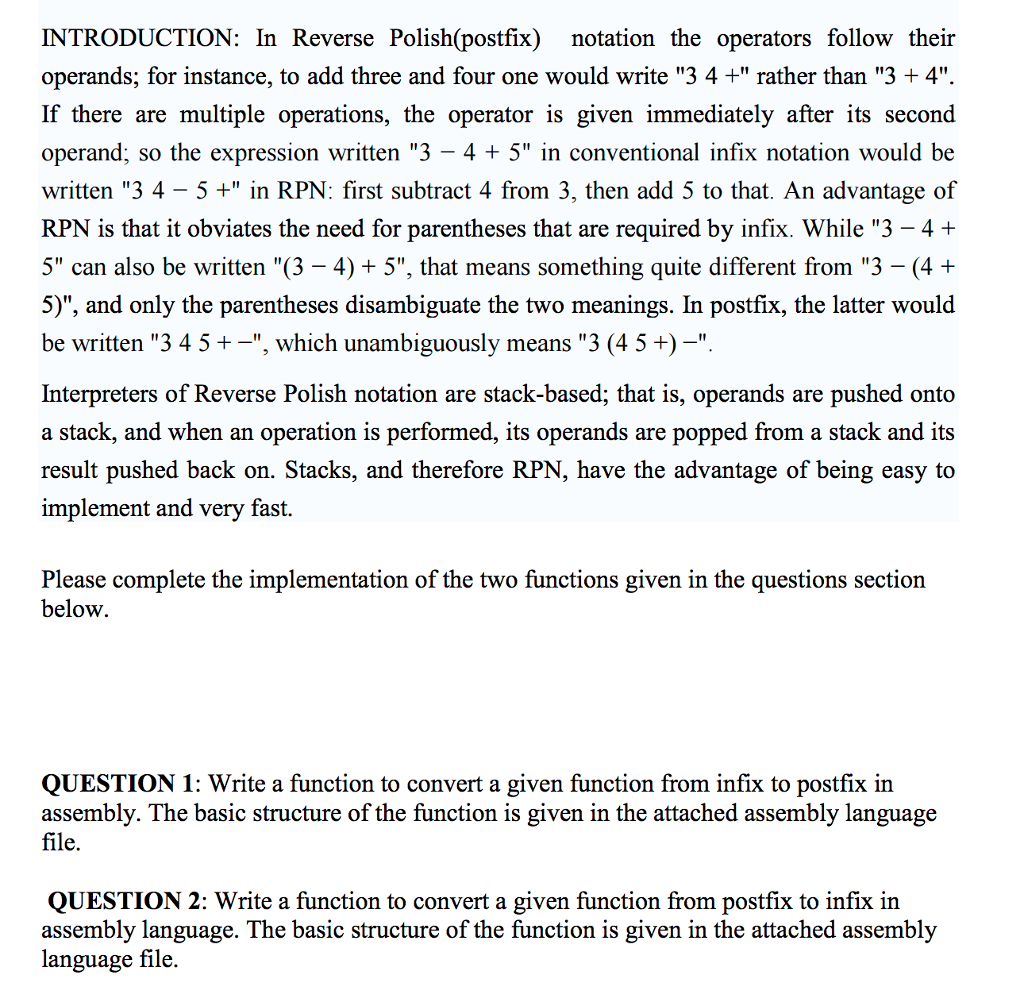
PLEASE USE SKELETON BELOW (Fill in solution into "Your Solution Here"):
.global toInFix .data // declare any global variables here .text toInFix: mov r12,r13 // save stack pointer into register r12 sub sp,#32 // reserve 32 bytes of space for local variables push {lr} // push link register onto stack -- make sure you pop it out before you return INTRODUCTION: In Reverse Polish (postfix) notation the operators follow their operands, for instance, to add three and four one would write "3 4 rather than "3 4". If there are multiple operations, the operator is given immediately after its second operand, so the expression written "3 4 5" in conventional infix notation would be written "3 4 5 in RPN: first subtract 4 from 3, then add 5 to that. An advantage of RPN is that it obviates the need for parentheses that are required by infix. While "3 4 5" can also be written "(3 4) 5", that means something quite different from "3 (4 5)", and only the parentheses disambiguate the two meanings. In postfix, the latter would be written "3 4 5 +-i, which unambiguously means "3 (4 5 Interpreters of Reverse Polish notation are stack-based, that is, operands are pushed o a stack, and when an operation is performed, its operands are popped from a stack and it result pushed back on. Stacks, and therefore RPN, have the advantage of being easy to implement and very fast. Please complete the implementation of the two functions given in the questions section below QUESTION 1: Write a function to convert a given function from infix to postfix in assembly. The basic structure of the function is given in the attached assembly language file QUESTION 2: Write a function to convert a given function from postfix to infix in assembly language. The basic structure of the function is given in the attached assembly language file INTRODUCTION: In Reverse Polish (postfix) notation the operators follow their operands, for instance, to add three and four one would write "3 4 rather than "3 4". If there are multiple operations, the operator is given immediately after its second operand, so the expression written "3 4 5" in conventional infix notation would be written "3 4 5 in RPN: first subtract 4 from 3, then add 5 to that. An advantage of RPN is that it obviates the need for parentheses that are required by infix. While "3 4 5" can also be written "(3 4) 5", that means something quite different from "3 (4 5)", and only the parentheses disambiguate the two meanings. In postfix, the latter would be written "3 4 5 +-i, which unambiguously means "3 (4 5 Interpreters of Reverse Polish notation are stack-based, that is, operands are pushed o a stack, and when an operation is performed, its operands are popped from a stack and it result pushed back on. Stacks, and therefore RPN, have the advantage of being easy to implement and very fast. Please complete the implementation of the two functions given in the questions section below QUESTION 1: Write a function to convert a given function from infix to postfix in assembly. The basic structure of the function is given in the attached assembly language file QUESTION 2: Write a function to convert a given function from postfix to infix in assembly language. The basic structure of the function is given in the attached assembly language file
Step by Step Solution
There are 3 Steps involved in it

Get step-by-step solutions from verified subject matter experts
 Study Help