







Question: Please use beginner level java As with all other labs, this should be done individually. Contact your instructor and/or visit the Computer Science Learning Center
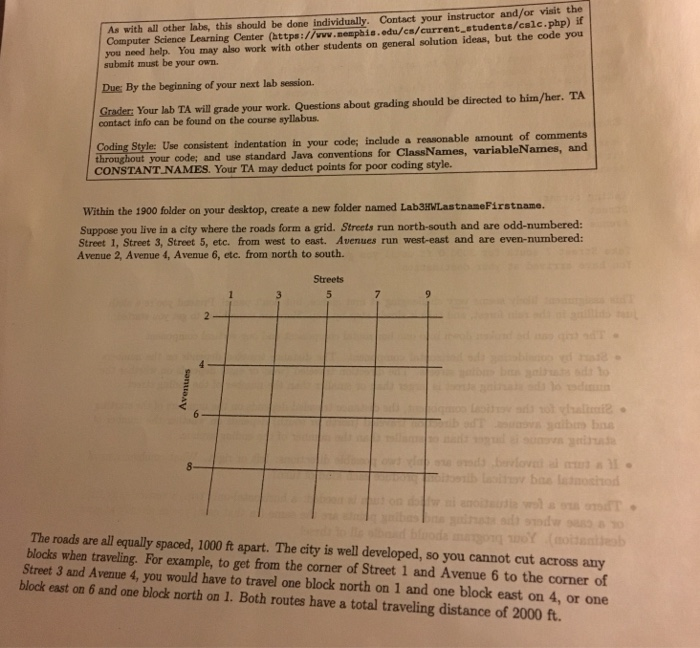
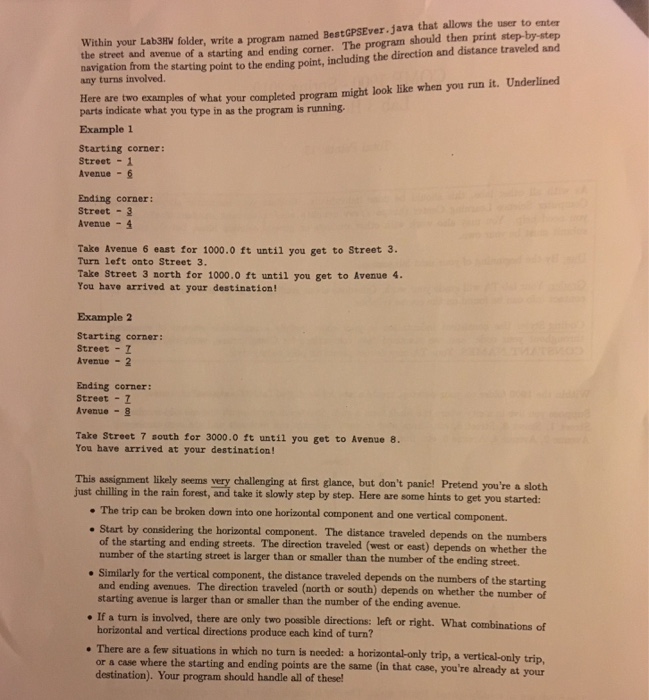
As with all other labs, this should be done individually. Contact your instructor and/or visit the Computer Science Learning Center (attps:/w.mempbia.edu/cs/current students/cslc.php) if you need help. You may also work with other students on general solution ideas, but the code you submit must be your own Due By the beginning of your next lab session. Graders Your lab TA will grade your work. Questions about grading should be directed to him/her. TA contact info can be found on the course syllabus. Style: Use consistent indentation in your code; include a reasonable amount of comments use standard Java conventions for ClassNames, variableNames, and your code; and CONSTANT NAMES. Your TA may deduct points for poor coding style. Within the 1900 folder on your desktop, create a new folder named Lab3HWLastnameFirstname. Suppose you live in a city where the roads form a grid. Streets run north-south and are odd-numbered: Street 1, Street 3, Street 5, etc. from west to east. Avenues run west-east and are even-numbered: Avenue 2, Avenue 4, Avenue 6, etc. from north to south. Streets 7 The roads are all equally spaced, 1000 ft apart. The city is well developed, so you cannot cut across any blocks when traveling. For example, to get from the corner of Street 1 and Avenue 6 to the corner of Street 3 and A venue 4, you would have to travel one block north on 1 and one block east on 4, or one block east on 6 and one block north on 1. Both routes have a total traveling distance of 2000 ft. , write a program named Best GPSEver.java that allows the user to enter The program should then print step-by-step Within your Lab3HW folder the street and avenue of a starting and ending corner. navigation from any turns involved. direction and distance traveled and the starting point to the ending point, including the ere are two examples of what your completed program might look like when you run it. Underlined parts indicate what you type in as the program is running Example1 Starting corner: Street 1 Avenue- Ending corner: Street 3 Avenue 4 Take Avenue 6 east for 1000.0 ft until you get to Street 3. Turn left onto Street 3. Take Street 3 north for 1000.0 ft until you get to Avenue 4. You have arrived at your destination! Example2 Starting corner Street I venue 2 Ending corner: Street z Avenue 8 Take Street 7 south for 3000.0 ft until you get to Avenue 8 You have arrived at your destination! This assignment likely seems very challenging at first glance, but don't panic! Pretend you're a sloth just chilling in the rain forest, and take it slowly step by step. Here are some hints to get you started: The trip can be broken down into one horizontal component and one vertical component. Start by considering the horizontal component. The distance traveled depends on the numbers of the starting and ending streets. The direction traveled (west or east) depends on whether the number of the starting street is larger than or smaller than the number of the ending street. Similarly for the vertical component, the distance traveled depends on the numbers of the s and ending avenues. The direction traveled (north or south) depends on whether the number of starting avenue is larger than or smaller than the number of the ending avenue. . If a turn is involved, there are only two possible directions: left or right. What combinations of horizontal and vertical directions produce each kind of turn? There are a few situations in which no turn is needed: a horizontal-only trip,a or a case where the starting and ending points are the same (in that case, you're already at your destination). Your program should handle all of these
Step by Step Solution
There are 3 Steps involved in it

Get step-by-step solutions from verified subject matter experts
 Study Help