







Question: PLEASE USE ECLIPSE TO DO THE FOLLOWING HOMEWORK PROBLEM (AND USE THE SAMPLE DATA BELOW). PLEASE BE SURE TO USE THE PROPER UNITS. THE PROBLEM
PLEASE USE ECLIPSE TO DO THE FOLLOWING HOMEWORK PROBLEM (AND USE THE SAMPLE DATA BELOW). PLEASE BE SURE TO USE THE PROPER UNITS. THE PROBLEM IS FROM THE TEXTBOOK "C++ FOR ENGINEERS AND SCIENTISTS, 4TH EDITION" BY GARY J. BRONSON. THANK YOU!
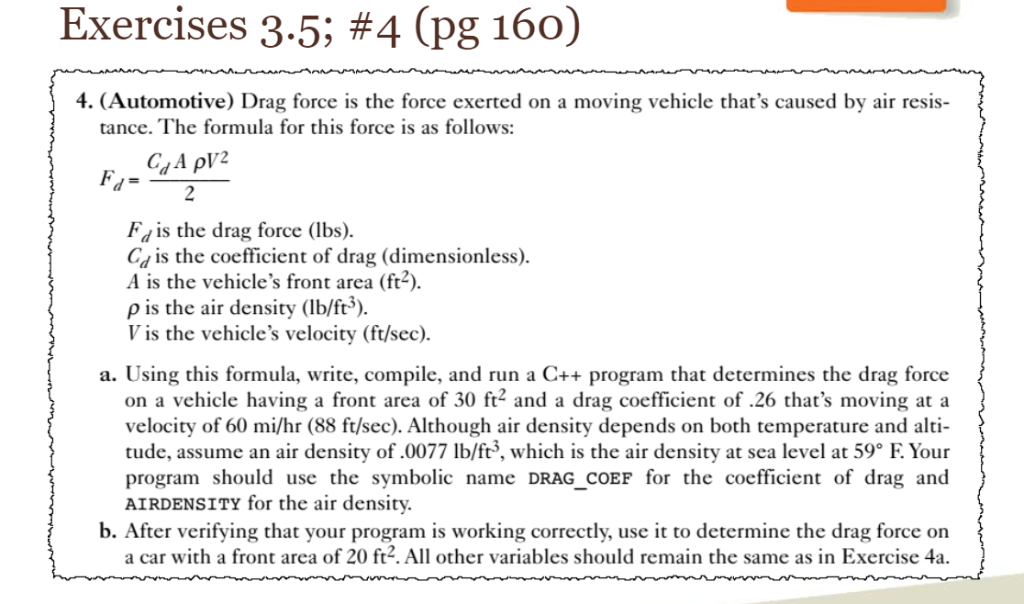
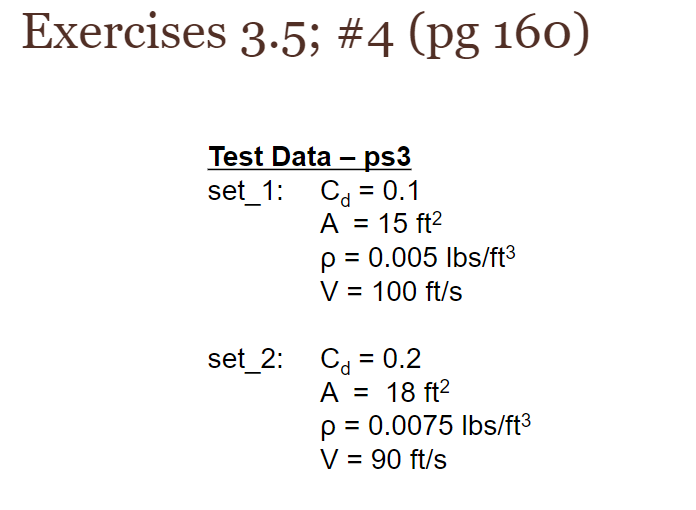
Exercises 3.5: #4 (pg 160) 4. (Automotive) Drag force is the force exerted on a moving vehicle that's caused by air resis- tance. The formula for this force is as follows: Fd is the drag force (Ibs). Cd is the coefficient of drag (dimensionless) A is the vehicle's front area (ft2) p is the air density (Ib/ft3). Vis the vehicle's velocity (ft/sec). a. Using this formula, write, compile, and run a C++ program that determines the drag force on a vehicle having a front area of 30 ft2 and a drag coefficient of .26 that's moving at a velocity of 60 mi/hr (88 ft/sec). Although air density depends on both temperature and al- tude, assume an air density of .0077 lb/ft3, which is the air density at sea level at 59 E Your program should use the symbolic name DRAG_CoEF for the coefficient of drag and AIRDENSITY for the air density. b. After verifying that your program is working correctly, use it to determine the drag force on a car with a front area of 20 ft2. All other variables should remain the same as in Exercise 4a Exercises 3.5: #4 (pg 160) Test Data -ps3 set 1 Cd 0.1 A 15 ft2 p0.005 lbs/ft3 V 100 ft/s set-2: C,-0.2 A 18 ft = 0.0075 lbs/ft3 V = 90 ft/s
Step by Step Solution
There are 3 Steps involved in it

Get step-by-step solutions from verified subject matter experts
 Study Help