







Question: PLEASE USE EXCEL SOLVER TO ANSWER PART 1'S QUESTIONS ! INCLUDE SCREENSHOTS THANK YOU! Pierre French, a day trading gambler/investor recently earned a windfall through
PLEASE USE EXCEL SOLVER TO ANSWER PART 1'S QUESTIONS ! INCLUDE SCREENSHOTS THANK YOU!
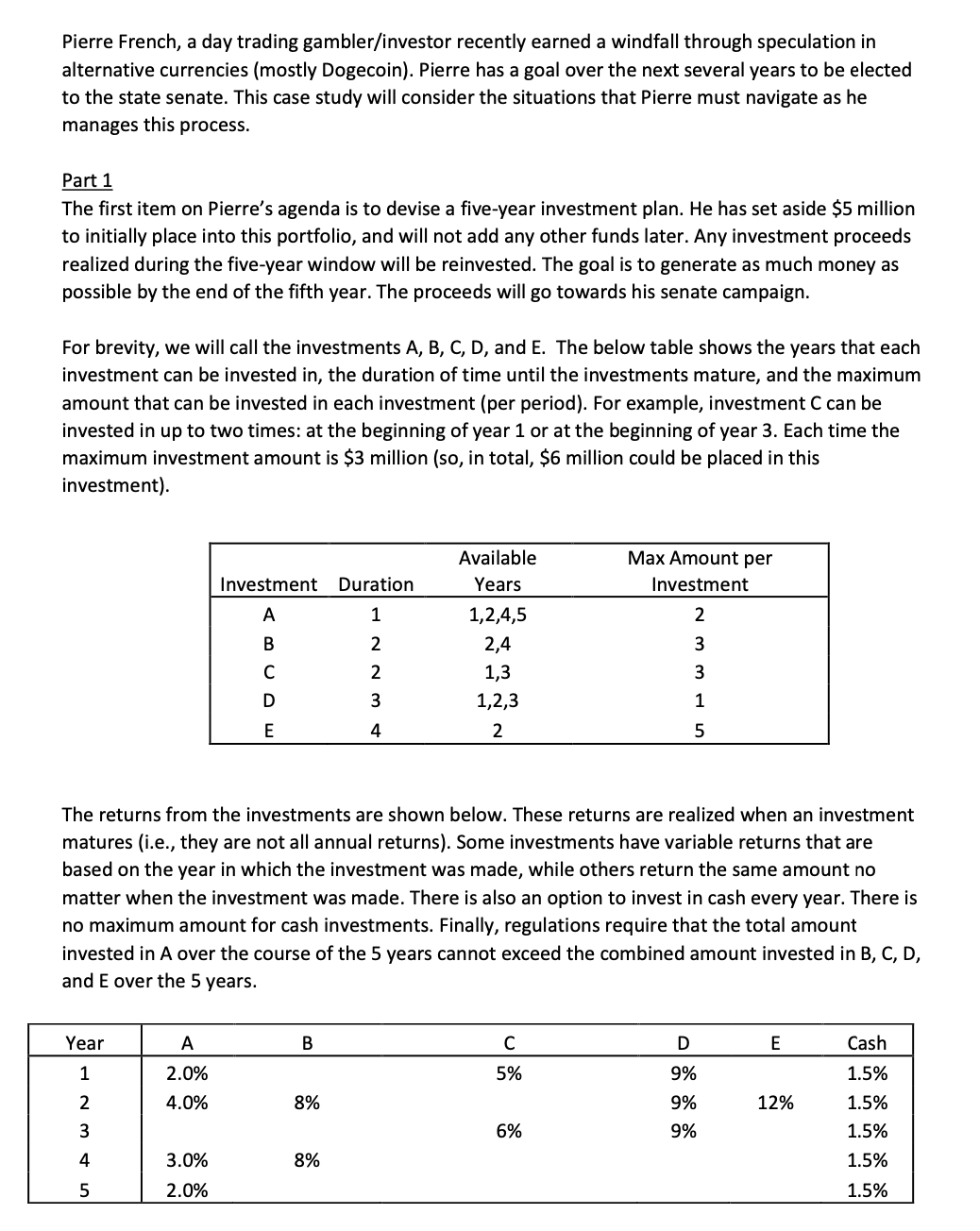
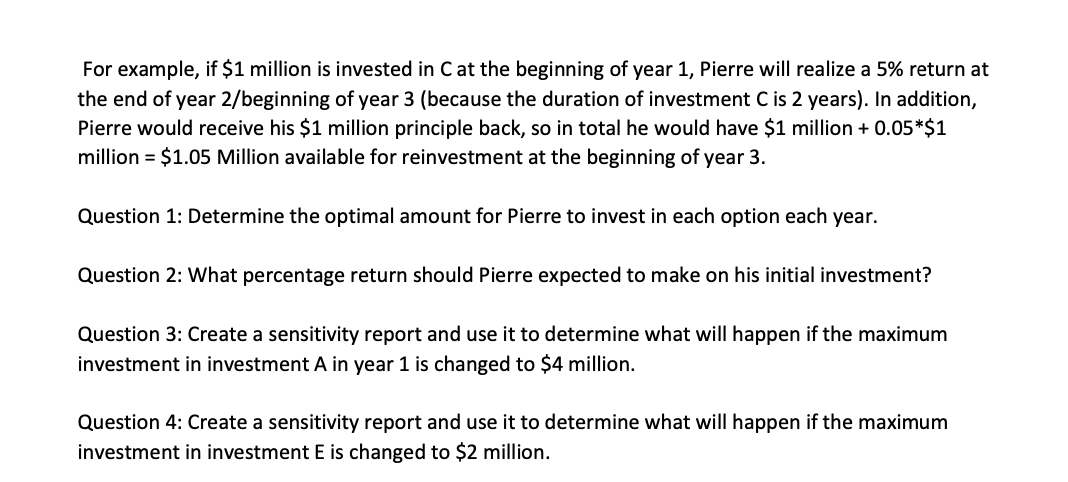
Pierre French, a day trading gambler/investor recently earned a windfall through speculation in alternative currencies (mostly Dogecoin). Pierre has a goal over the next several years to be elected to the state senate. This case study will consider the situations that Pierre must navigate as he manages this process. Part 1 The first item on Pierre's agenda is to devise a five-year investment plan. He has set aside $5 million to initially place into this portfolio, and will not add any other funds later. Any investment proceeds realized during the five-year window will be reinvested. The goal is to generate as much money as possible by the end of the fifth year. The proceeds will go towards his senate campaign. For brevity, we will call the investments A, B, C, D, and E. The below table shows the years that each investment can be invested in, the duration of time until the investments mature, and the maximum amount that can be invested in each investment (per period). For example, investment C can be invested in up to two times: at the beginning of year 1 or at the beginning of year 3 . Each time the maximum investment amount is $3 million (so, in total, $6 million could be placed in this investment). The returns from the investments are shown below. These returns are realized when an investment matures (i.e., they are not all annual returns). Some investments have variable returns that are based on the year in which the investment was made, while others return the same amount no matter when the investment was made. There is also an option to invest in cash every year. There is no maximum amount for cash investments. Finally, regulations require that the total amount invested in A over the course of the 5 years cannot exceed the combined amount invested in B, C, D, and E over the 5 years. For example, if $1 million is invested in C at the beginning of year 1, Pierre will realize a 5% return at the end of year 2 /beginning of year 3 (because the duration of investment C is 2 years). In addition, Pierre would receive his $1 million principle back, so in total he would have $1 million +0.05$1 million =$1.05 Million available for reinvestment at the beginning of year 3 . Question 1: Determine the optimal amount for Pierre to invest in each option each year. Question 2: What percentage return should Pierre expected to make on his initial investment? Question 3: Create a sensitivity report and use it to determine what will happen if the maximum investment in investment A in year 1 is changed to $4 million. Question 4: Create a sensitivity report and use it to determine what will happen if the maximum investment in investment E is changed to $2 million. Pierre French, a day trading gambler/investor recently earned a windfall through speculation in alternative currencies (mostly Dogecoin). Pierre has a goal over the next several years to be elected to the state senate. This case study will consider the situations that Pierre must navigate as he manages this process. Part 1 The first item on Pierre's agenda is to devise a five-year investment plan. He has set aside $5 million to initially place into this portfolio, and will not add any other funds later. Any investment proceeds realized during the five-year window will be reinvested. The goal is to generate as much money as possible by the end of the fifth year. The proceeds will go towards his senate campaign. For brevity, we will call the investments A, B, C, D, and E. The below table shows the years that each investment can be invested in, the duration of time until the investments mature, and the maximum amount that can be invested in each investment (per period). For example, investment C can be invested in up to two times: at the beginning of year 1 or at the beginning of year 3 . Each time the maximum investment amount is $3 million (so, in total, $6 million could be placed in this investment). The returns from the investments are shown below. These returns are realized when an investment matures (i.e., they are not all annual returns). Some investments have variable returns that are based on the year in which the investment was made, while others return the same amount no matter when the investment was made. There is also an option to invest in cash every year. There is no maximum amount for cash investments. Finally, regulations require that the total amount invested in A over the course of the 5 years cannot exceed the combined amount invested in B, C, D, and E over the 5 years. For example, if $1 million is invested in C at the beginning of year 1, Pierre will realize a 5% return at the end of year 2 /beginning of year 3 (because the duration of investment C is 2 years). In addition, Pierre would receive his $1 million principle back, so in total he would have $1 million +0.05$1 million =$1.05 Million available for reinvestment at the beginning of year 3 . Question 1: Determine the optimal amount for Pierre to invest in each option each year. Question 2: What percentage return should Pierre expected to make on his initial investment? Question 3: Create a sensitivity report and use it to determine what will happen if the maximum investment in investment A in year 1 is changed to $4 million. Question 4: Create a sensitivity report and use it to determine what will happen if the maximum investment in investment E is changed to $2 million
Step by Step Solution
There are 3 Steps involved in it

Get step-by-step solutions from verified subject matter experts
 Study Help