







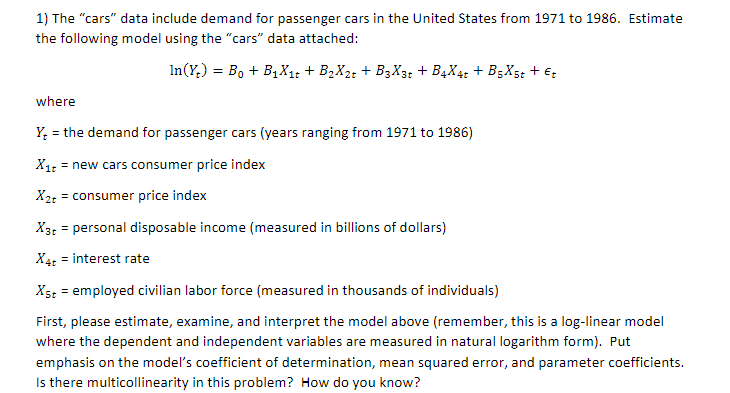
Question: . Please use Excel to complete the one question, illustrate the solution. 1) The cars data include demand for passenger cars in the United States
 .
.
Please use Excel to complete the one question, illustrate the solution.
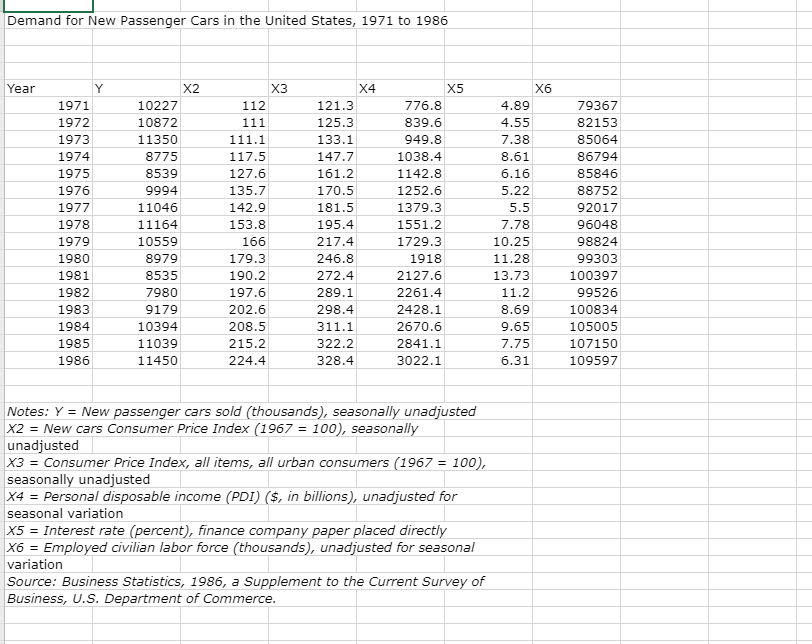
1) The "cars" data include demand for passenger cars in the United States from 1971 to 1986. Estimate the following model using the "cars" data attached: In(Y) = B. + B1X1t + B2X2: + B3X3 + B4X4+ + B5X5t + Et where Y = the demand for passenger cars (years ranging from 1971 to 1986) X 10 = new cars consumer price index X2+ = consumer price index X3t = personal disposable income measured in billions of dollars) X4c = interest rate Xst = employed civilian labor force (measured in thousands of individuals) First, please estimate, examine, and interpret the model above (remember, this is a log-linear model where the dependent and independent variables are measured in natural logarithm form). Put emphasis on the model's coefficient of determination, mean squared error, and parameter coefficients. Is there multicollinearity in this problem? How do you know? Demand for New Passenger Cars in the United States, 1971 to 1986 Year X4 X5 X6 1971 1972 1973 1974 1975 1976 1977 1978 1979 1980 1981 1982 1983 1984 1985 1986 10227 10872 11350 8775 8539 9994 11046 11164 10559 8979 8535 7980 9179 10394 11039 11450 3 112 111 111.1 117.5 127.6 135.7 142.9 153.8 166 179.3 190.2 197.6 202.6 208.5 215.2 224.4 121.3 125.3 133.1 147.7 161.2 170.5 181.5 195.4 217.4 246.8 272.4 289.1 298.4 311.1 322.2 328.4 776.8 839.6 949.8 1038.4 1142.8 1252.6 1379.3 1551.2 1729.3 1918 2127.6 2261.4 2428.1 2670.6 2841.1 3022.1 4.89 4.55 7.38 8.61 6.16 5.22 5.5 7.78 10.25 11.28 13.73 11.2 8.69 9.65 7.75 6.31 79367 82153 85064 86794 85846 88752 92017 96048 98824 99303 100397 99526 100834 105005 107150 109597 Notes: Y = New passenger cars sold (thousands), seasonally unadjusted X2 = New cars Consumer Price Index (1967 = 100), seasonally unadjusted X3 = Consumer Price Index, all items, all urban consumers (1967 = 100), seasonally unadjusted X4 = Personal disposable income (PDI) ($, in billions), unadjusted for seasonal variation X5 = Interest rate (percent), finance company paper placed directly X6 = Employed civilian labor force (thousands), unadjusted for seasonal variation Source: Business Statistics, 1986, a Supplement to the Current Survey of Business, U.S. Department of Commerce. 1) The "cars" data include demand for passenger cars in the United States from 1971 to 1986. Estimate the following model using the "cars" data attached: In(Y) = B. + B1X1t + B2X2: + B3X3 + B4X4+ + B5X5t + Et where Y = the demand for passenger cars (years ranging from 1971 to 1986) X 10 = new cars consumer price index X2+ = consumer price index X3t = personal disposable income measured in billions of dollars) X4c = interest rate Xst = employed civilian labor force (measured in thousands of individuals) First, please estimate, examine, and interpret the model above (remember, this is a log-linear model where the dependent and independent variables are measured in natural logarithm form). Put emphasis on the model's coefficient of determination, mean squared error, and parameter coefficients. Is there multicollinearity in this problem? How do you know? Demand for New Passenger Cars in the United States, 1971 to 1986 Year X4 X5 X6 1971 1972 1973 1974 1975 1976 1977 1978 1979 1980 1981 1982 1983 1984 1985 1986 10227 10872 11350 8775 8539 9994 11046 11164 10559 8979 8535 7980 9179 10394 11039 11450 3 112 111 111.1 117.5 127.6 135.7 142.9 153.8 166 179.3 190.2 197.6 202.6 208.5 215.2 224.4 121.3 125.3 133.1 147.7 161.2 170.5 181.5 195.4 217.4 246.8 272.4 289.1 298.4 311.1 322.2 328.4 776.8 839.6 949.8 1038.4 1142.8 1252.6 1379.3 1551.2 1729.3 1918 2127.6 2261.4 2428.1 2670.6 2841.1 3022.1 4.89 4.55 7.38 8.61 6.16 5.22 5.5 7.78 10.25 11.28 13.73 11.2 8.69 9.65 7.75 6.31 79367 82153 85064 86794 85846 88752 92017 96048 98824 99303 100397 99526 100834 105005 107150 109597 Notes: Y = New passenger cars sold (thousands), seasonally unadjusted X2 = New cars Consumer Price Index (1967 = 100), seasonally unadjusted X3 = Consumer Price Index, all items, all urban consumers (1967 = 100), seasonally unadjusted X4 = Personal disposable income (PDI) ($, in billions), unadjusted for seasonal variation X5 = Interest rate (percent), finance company paper placed directly X6 = Employed civilian labor force (thousands), unadjusted for seasonal variation Source: Business Statistics, 1986, a Supplement to the Current Survey of Business, U.S. Department of Commerce
Step by Step Solution
There are 3 Steps involved in it

Get step-by-step solutions from verified subject matter experts
 Study Help