







Question: Please use Haskell program (.hs). Thank You. Problem description: A directed graph can be implemented as a list, whose elements are pairs of nodes. Assume
Please use Haskell program (.hs). Thank You.
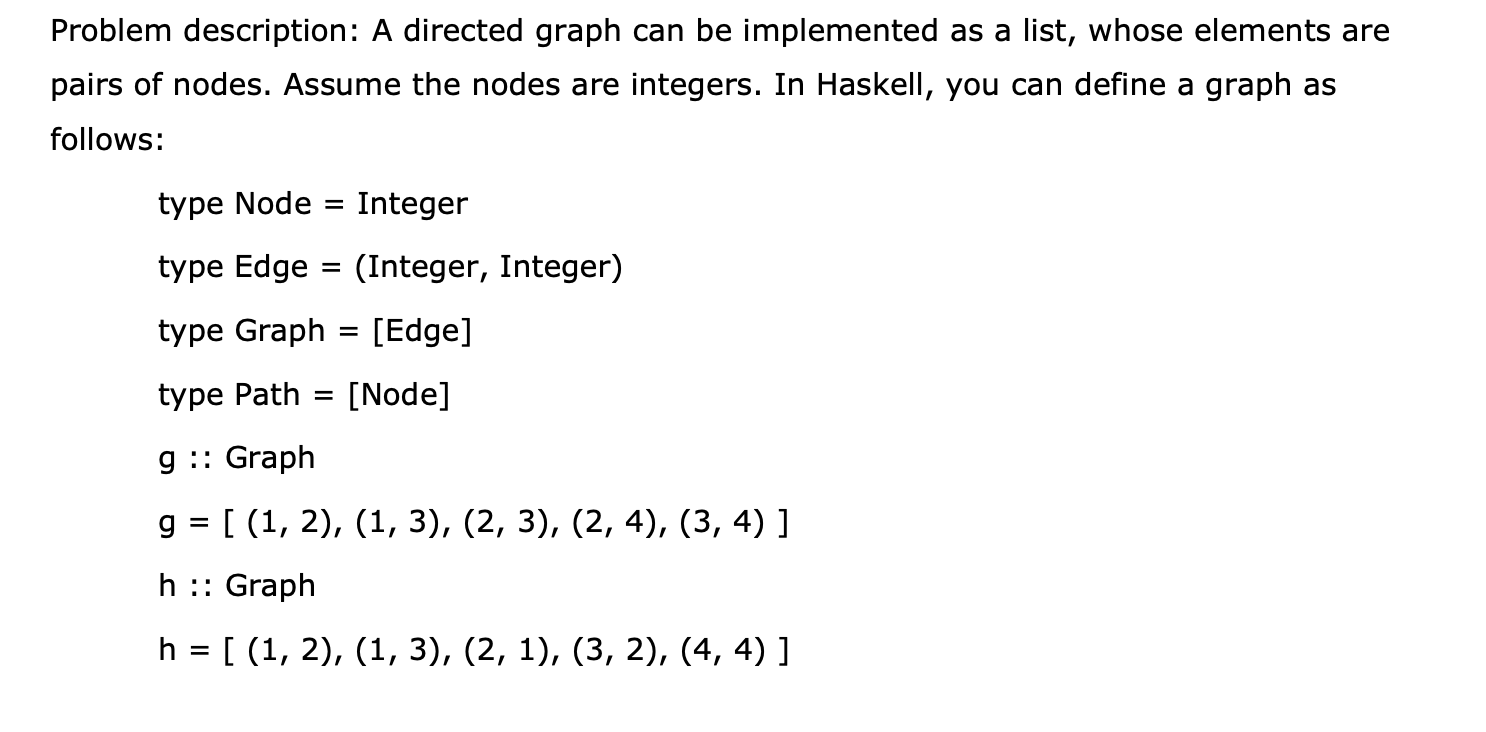


Problem description: A directed graph can be implemented as a list, whose elements are pairs of nodes. Assume the nodes are integers. In Haskell, you can define a graph as follows: type Node = Integer type Edge = (Integer, Integer) type Graph = [Edge] type Path = [Node] g :: Graph g = [ (1, 2), (1, 3), (2, 3), (2, 4), (3, 4) ] h :: Graph h = [ (1, 2), (1, 3), (2, 1), (3, 2), (4,4) ] 3. Write a function named detach that takes a node N and a graph G and returns the graph formed by removing N from G. For example, detach 3 g => [(1, 2), (2, 4)]. 4. Write a function named paths that accepts two nodes V1 and V2 (and a graph G) and returns a list of all possible cycle-free paths from V1 to V2. For example, paths 2 2 g => [[2]], paths 3 2 g => [], paths 1 4 g => [[1, 2, 3, 4], [1, 2, 4], [1, 3, 4]]. Problem description: A directed graph can be implemented as a list, whose elements are pairs of nodes. Assume the nodes are integers. In Haskell, you can define a graph as follows: type Node = Integer type Edge = (Integer, Integer) type Graph = [Edge] type Path = [Node] g :: Graph g = [ (1, 2), (1, 3), (2, 3), (2, 4), (3, 4) ] h :: Graph h = [ (1, 2), (1, 3), (2, 1), (3, 2), (4,4) ] 3. Write a function named detach that takes a node N and a graph G and returns the graph formed by removing N from G. For example, detach 3 g => [(1, 2), (2, 4)]. 4. Write a function named paths that accepts two nodes V1 and V2 (and a graph G) and returns a list of all possible cycle-free paths from V1 to V2. For example, paths 2 2 g => [[2]], paths 3 2 g => [], paths 1 4 g => [[1, 2, 3, 4], [1, 2, 4], [1, 3, 4]]
Step by Step Solution
There are 3 Steps involved in it

Get step-by-step solutions from verified subject matter experts
 Study Help