







Question: Please use insertion sort to sort the array L, and output the N-th move of the array. (N can be smaller than or equal to
Please use insertion sort to sort the array L, and output the N-th move of the array. (N can be smaller than or equal to the the maximum steps needed to sort the array)
import java.util.*;
public class Solution {
public int[] insertionSort(int[] list,int N) {
int arr[] = {11, 12, 5, 13, 6};
return arr;
}
}
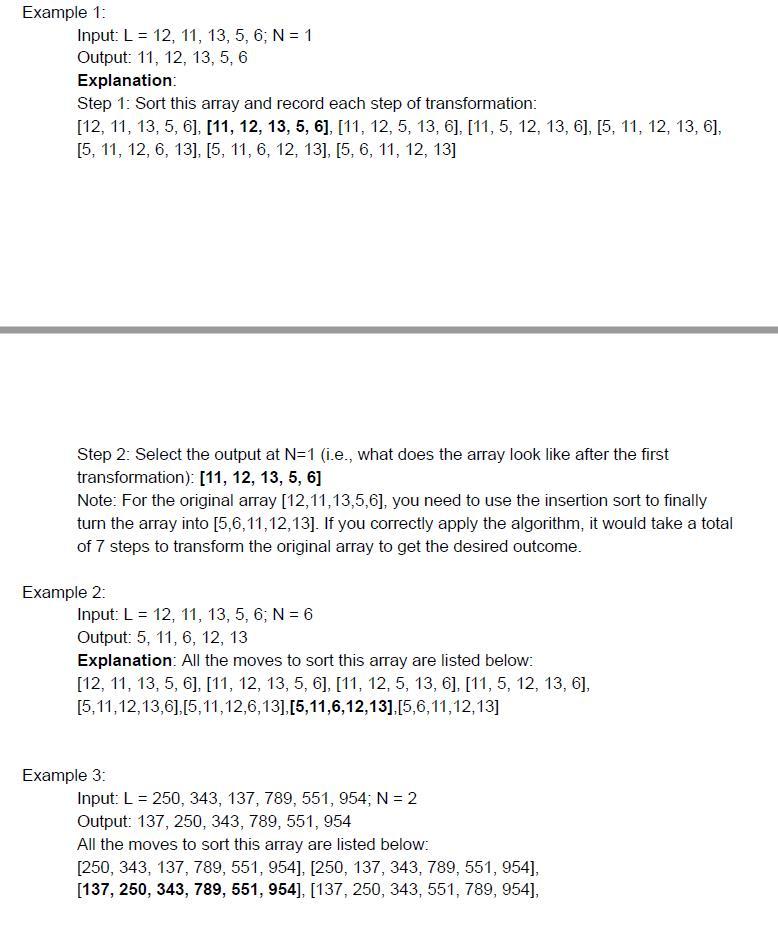
Example 1: Input: L = 12, 11, 13, 5, 6; N = 1 Output: 11, 12, 13, 5, 6 Explanation: Step 1: Sort this array and record each step of transformation: [12, 11, 13, 5, 6], [11, 12, 13, 5, 6], [11, 12, 5, 13,6], [11, 5, 12, 13, 6], [5, 11, 12, 13, 6], [5, 11, 12, 6, 13], [5, 11, 6, 12, 13], [5, 6, 11, 12, 13] Step 2: Select the output at N=1 (i.e., what does the array look like after the first transformation): [11, 12, 13, 5, 6] Note: For the original array (12,11,13,5,6), you need to use the insertion sort to finally turn the array into [5,6,11,12,13). If you correctly apply the algorithm, it would take a total of 7 steps to transform the original array to get the desired outcome. Example 2: Input: L = 12, 11, 13, 5, 6; N = 6 Output: 5, 11, 6, 12, 13 Explanation: All the moves to sort this array are listed below: [12, 11, 13, 5, 6], [11, 12, 13, 5, 6], [11, 12, 5, 13, 6], [11, 5, 12, 13, 6), [5,11,12,13,6],[5,11,12,6,13],[5,11,6,12,13],[5,6,11,12,13] Example 3: Input: L = 250, 343, 137, 789, 551, 954; N = 2 Output: 137, 250, 343, 789, 551, 954 All the moves to sort this array are listed below: [250, 343, 137, 789, 551, 954], [250, 137, 343, 789, 551, 954], [137, 250, 343, 789, 551, 954), (137, 250, 343, 551, 789, 954)
Step by Step Solution
There are 3 Steps involved in it

Get step-by-step solutions from verified subject matter experts
 Study Help