







Question: Please use java to solve this problem. Thank you. For each item below, provide the completed Java class. Each class is described below - you
Please use java to solve this problem. Thank you.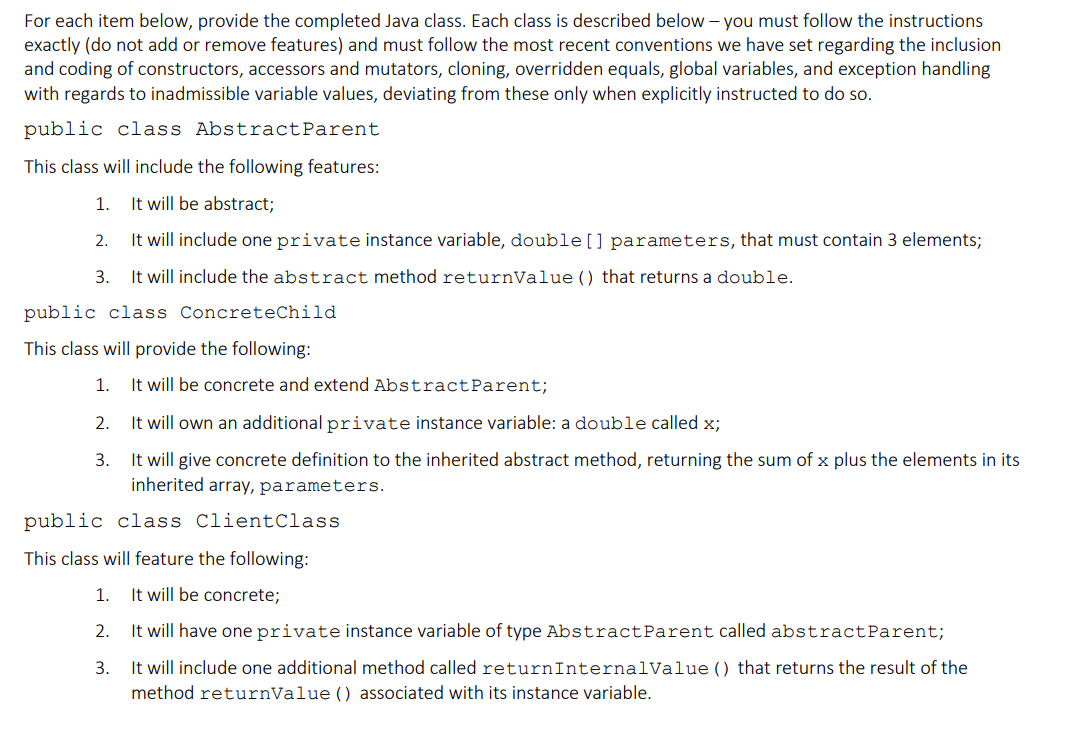
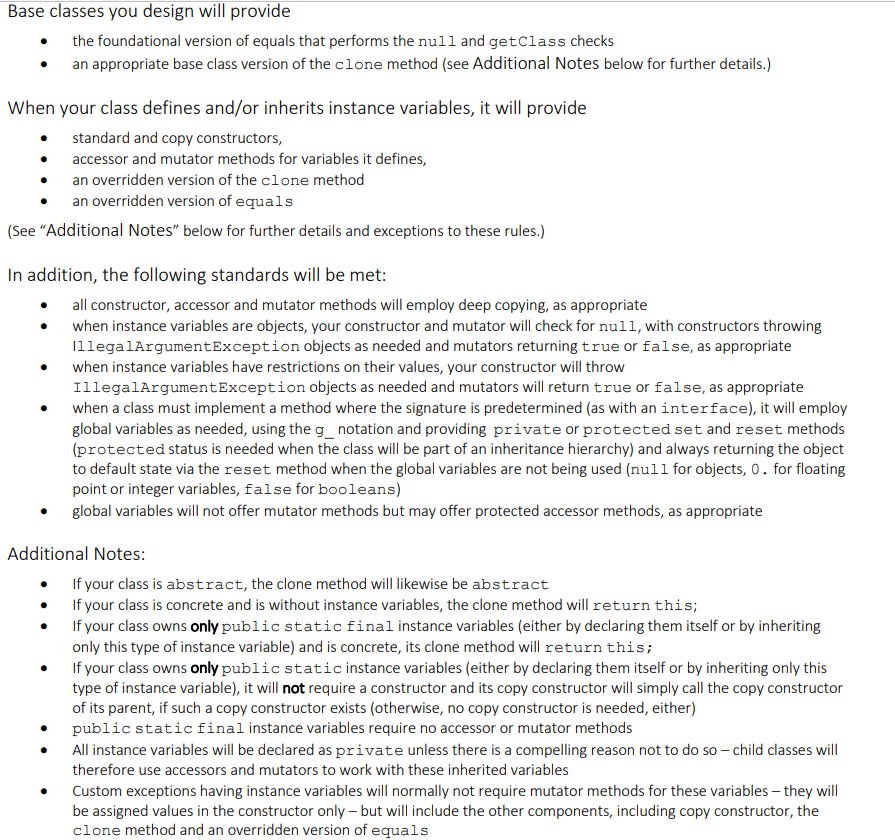
For each item below, provide the completed Java class. Each class is described below - you must follow the instructions exactly (do not add or remove features) and must follow the most recent conventions we have set regarding the inclusion and coding of constructors, accessors and mutators, cloning, overridden equals, global variables, and exception handling with regards to inadmissible variable values, deviating from these only when explicitly instructed to do so. public class Abstractparent This class will include the following features: 1. It will be abstract; 2. It will include one private instance variable, double [ ] parameters, that must contain 3 elements; 3. It will include the abstract method returnValue () that returns a double. public class Concretechild This class will provide the following: 1. It will be concrete and extend AbstractParent; 2. It will own an additional private instance variable: a double called x; 3. It will give concrete definition to the inherited abstract method, returning the sum of x plus the elements in its inherited array, parameters. public class ClientClass This class will feature the following: 1. It will be concrete; 2. It will have one private instance variable of type AbstractParent called abstractParent; 3. It will include one additional method called returninternalValue () that returns the result of the method returnValue () associated with its instance variable. Base classes you design will provide - the foundational version of equals that performs the null and getclass checks - an appropriate base class version of the clone method (see Additional Notes below for further details.) When your class defines and/or inherits instance variables, it will provide - standard and copy constructors, - accessor and mutator methods for variables it defines, - an overridden version of the clone method - an overridden version of equals (See "Additional Notes" below for further details and exceptions to these rules.) In addition, the following standards will be met: - all constructor, accessor and mutator methods will employ deep copying, as appropriate - when instance variables are objects, your constructor and mutator will check for null, with constructors throwing IllegalArgumentException objects as needed and mutators returning true or false, as appropriate - when instance variables have restrictions on their values, your constructor will throw IllegalArgumentException objects as needed and mutators will return true or false, as appropriate - when a class must implement a method where the signature is predetermined (as with an inter face), it will employ global variables as needed, using the g_ notation and providing private or protected set and reset methods (protected status is needed when the class will be part of an inheritance hierarchy) and always returning the object to default state via the reset method when the global variables are not being used (null for objects, 0 . for floating point or integer variables, false for booleans) - global variables will not offer mutator methods but may offer protected accessor methods, as appropriate Additional Notes: - If your class is abstract, the clone method will likewise be abstract - If your class is concrete and is without instance variables, the clone method will return this; - If your class owns only public static final instance variables (either by declaring them itself or by inheriting only this type of instance variable) and is concrete, its clone method will return this; - If your class owns only public static instance variables (either by declaring them itself or by inheriting only this type of instance variable), it will not require a constructor and its copy constructor will simply call the copy constructor of its parent, if such a copy constructor exists (otherwise, no copy constructor is needed, either) - public static final instance variables require no accessor or mutator methods - All instance variables will be declared as private unless there is a compelling reason not to do so - child classes will therefore use accessors and mutators to work with these inherited variables - Custom exceptions having instance variables will normally not require mutator methods for these variables - they will be assigned values in the constructor only - but will include the other components, including copy constructor, the clone method and an overridden version of equals
Step by Step Solution
There are 3 Steps involved in it

Get step-by-step solutions from verified subject matter experts
 Study Help