







Question: Please use Matlab to complete Write a program using the bubble-point method to simulate the behavior of a multicomponent mixture of hydrocarbons. The distillation column
Please use Matlab to complete
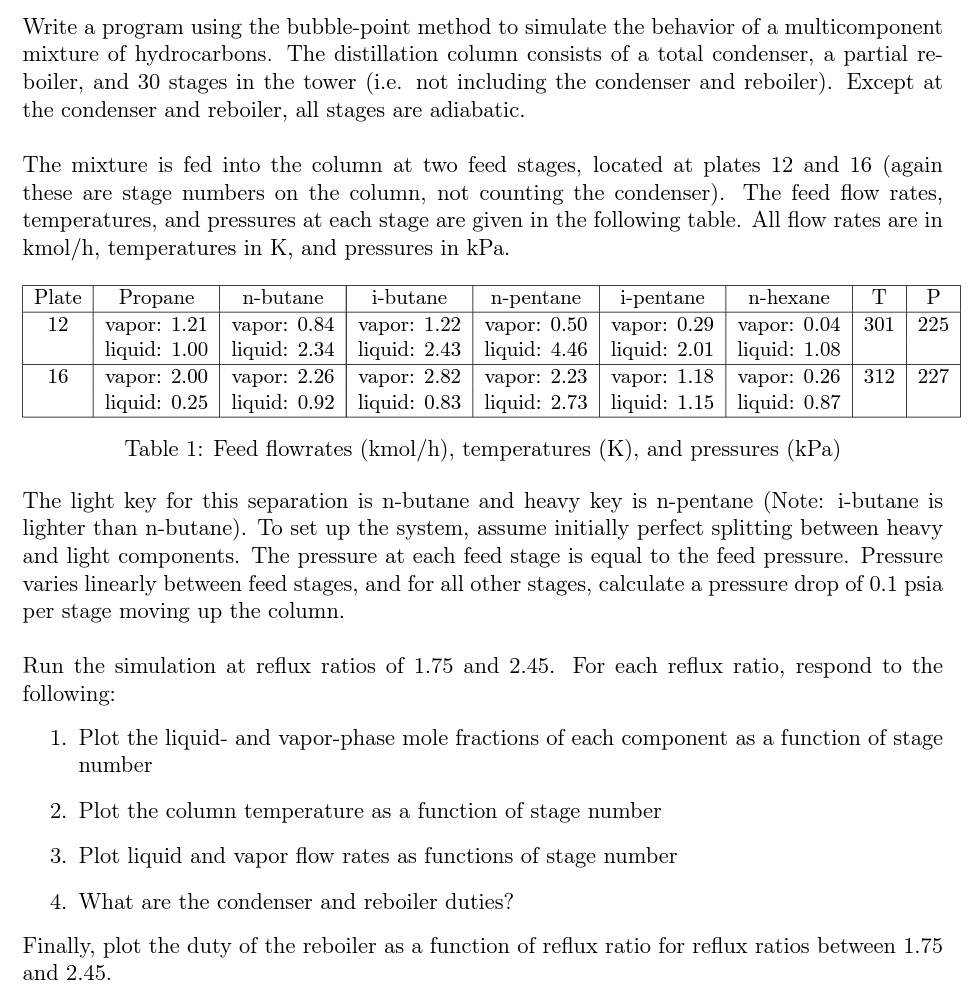
Write a program using the bubble-point method to simulate the behavior of a multicomponent mixture of hydrocarbons. The distillation column consists of a total condenser, a partial reboiler, and 30 stages in the tower (i.e. not including the condenser and reboiler). Except at the condenser and reboiler, all stages are adiabatic. The mixture is fed into the column at two feed stages, located at plates 12 and 16 (again these are stage numbers on the column, not counting the condenser). The feed flow rates, temperatures, and pressures at each stage are given in the following table. All flow rates are in kmol/h, temperatures in K, and pressures in kPa. Table 1: Feed flowrates (kmol/h), temperatures (K), and pressures (kPa) The light key for this separation is n-butane and heavy key is n-pentane (Note: i-butane is lighter than n-butane). To set up the system, assume initially perfect splitting between heavy and light components. The pressure at each feed stage is equal to the feed pressure. Pressure varies linearly between feed stages, and for all other stages, calculate a pressure drop of 0.1 psia per stage moving up the column. Run the simulation at reflux ratios of 1.75 and 2.45. For each reflux ratio, respond to the following: 1. Plot the liquid- and vapor-phase mole fractions of each component as a function of stage number 2. Plot the column temperature as a function of stage number 3. Plot liquid and vapor flow rates as functions of stage number 4. What are the condenser and reboiler duties? Finally, plot the duty of the reboiler as a function of reflux ratio for reflux ratios between 1.75 and 2.45
Step by Step Solution
There are 3 Steps involved in it

Get step-by-step solutions from verified subject matter experts
 Study Help