







Question: Please use Matlab to make the plot! 2. (30pts) You are boiling water on the stove in a brand new pan, and you notice that
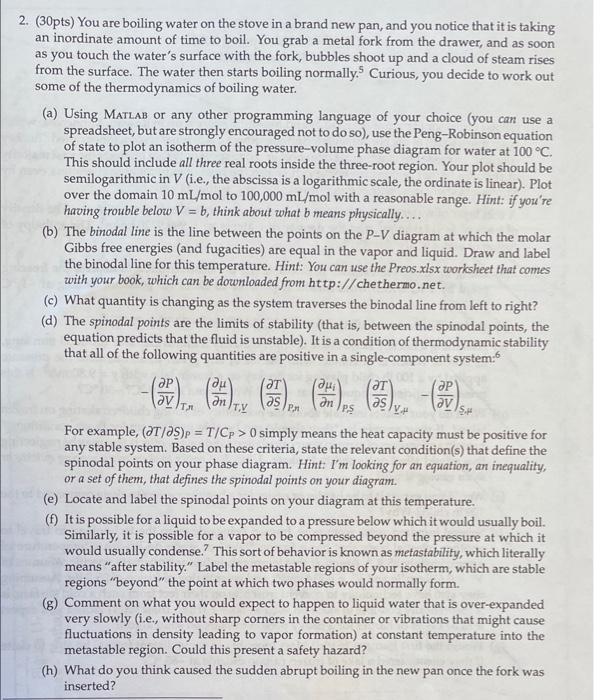
2. (30pts) You are boiling water on the stove in a brand new pan, and you notice that it is taking an inordinate amount of time to boil. You grab a metal fork from the drawer, and as soon as you touch the water's surface with the fork, bubbles shoot up and a cloud of steam rises from the surface. The water then starts boiling normally. Curious, you decide to work out some of the thermodynamics of boiling water. (a) Using Matlab or any other programming language of your choice (you can use a spreadsheet, but are strongly encouraged not to do so), use the Peng-Robinson equation of state to plot an isotherm of the pressure-volume phase diagram for water at 100 C. This should include all three real roots inside the three-root region. Your plot should be semilogarithmic in V (i.e., the abscissa is a logarithmic scale, the ordinate is linear). Plot over the domain 10 mL/mol to 100,000 mL/mol with a reasonable range. Hint: if you're having trouble below V = b, think about what b means physically.... (b) The binodal line is the line between the points on the P-V diagram at which the molar Gibbs free energies (and fugacities) are equal in the vapor and liquid. Draw and label the binodal line for this temperature. Hint: You can use the Preos.xlsx worksheet that comes with your book, which can be downloaded from http://chethermo.net. (e) What quantity is changing as the system traverses the binodal line from left to right? (d) The spinodal points are the limits of stability (that is, between the spinodal points, the equation predicts that the fluid is unstable). It is a condition of thermodynamic stability that all of the following quantities are positive in a single-component system: () (1) ( )( ) ( (a), (). ( For example, cr/asp = T/Cp > O simply means the heat capacity must be positive for any stable system. Based on these criteria, state the relevant condition(s) that define the spinodal points on your phase diagram. Hint: I'm looking for an equation, an inequality, or a set of them, that defines the spinodal points on your diagram. (e) Locate and label the spinodal points on your diagram at this temperature. (f) It is possible for a liquid to be expanded to a pressure below which it would usually boil. Similarly, it is possible for a vapor to be compressed beyond the pressure at which it would usually condense. This sort of behavior is known as metastability, which literally means "after stability." Label the metastable regions of your isotherm, which are stable regions "beyond" the point at which two phases would normally form. (g) Comment on what you would expect to happen to liquid water that is over-expanded very slowly (i.e., without sharp corners in the container or vibrations that might cause fluctuations in density leading to vapor formation) at constant temperature into the metastable region. Could this present a safety hazard? (h) What do you think caused the sudden abrupt boiling in the new pan once the fork was inserted? 2. (30pts) You are boiling water on the stove in a brand new pan, and you notice that it is taking an inordinate amount of time to boil. You grab a metal fork from the drawer, and as soon as you touch the water's surface with the fork, bubbles shoot up and a cloud of steam rises from the surface. The water then starts boiling normally. Curious, you decide to work out some of the thermodynamics of boiling water. (a) Using Matlab or any other programming language of your choice (you can use a spreadsheet, but are strongly encouraged not to do so), use the Peng-Robinson equation of state to plot an isotherm of the pressure-volume phase diagram for water at 100 C. This should include all three real roots inside the three-root region. Your plot should be semilogarithmic in V (i.e., the abscissa is a logarithmic scale, the ordinate is linear). Plot over the domain 10 mL/mol to 100,000 mL/mol with a reasonable range. Hint: if you're having trouble below V = b, think about what b means physically.... (b) The binodal line is the line between the points on the P-V diagram at which the molar Gibbs free energies (and fugacities) are equal in the vapor and liquid. Draw and label the binodal line for this temperature. Hint: You can use the Preos.xlsx worksheet that comes with your book, which can be downloaded from http://chethermo.net. (e) What quantity is changing as the system traverses the binodal line from left to right? (d) The spinodal points are the limits of stability (that is, between the spinodal points, the equation predicts that the fluid is unstable). It is a condition of thermodynamic stability that all of the following quantities are positive in a single-component system: () (1) ( )( ) ( (a), (). ( For example, cr/asp = T/Cp > O simply means the heat capacity must be positive for any stable system. Based on these criteria, state the relevant condition(s) that define the spinodal points on your phase diagram. Hint: I'm looking for an equation, an inequality, or a set of them, that defines the spinodal points on your diagram. (e) Locate and label the spinodal points on your diagram at this temperature. (f) It is possible for a liquid to be expanded to a pressure below which it would usually boil. Similarly, it is possible for a vapor to be compressed beyond the pressure at which it would usually condense. This sort of behavior is known as metastability, which literally means "after stability." Label the metastable regions of your isotherm, which are stable regions "beyond" the point at which two phases would normally form. (g) Comment on what you would expect to happen to liquid water that is over-expanded very slowly (i.e., without sharp corners in the container or vibrations that might cause fluctuations in density leading to vapor formation) at constant temperature into the metastable region. Could this present a safety hazard? (h) What do you think caused the sudden abrupt boiling in the new pan once the fork was inserted
Step by Step Solution
There are 3 Steps involved in it

Get step-by-step solutions from verified subject matter experts
 Study Help