







Question: Please use python method for coding. Please try coding without respective files. . Function Name: secret Parameters: secretFiles - a list of strings; each string
Please use python method for coding. Please try coding without respective files. 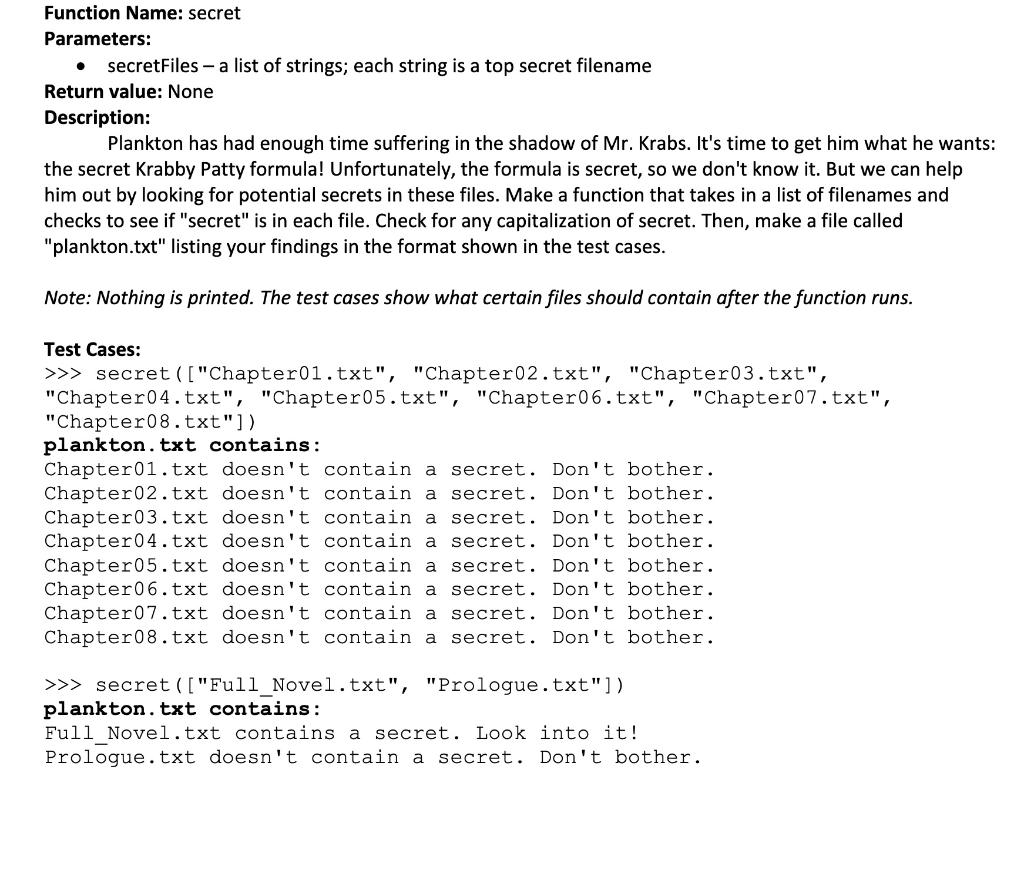
. Function Name: secret Parameters: secretFiles - a list of strings; each string is a top secret filename Return value: None Description: Plankton has had enough time suffering in the shadow of Mr. Krabs. It's time to get him what he wants: the secret Krabby Patty formula! Unfortunately, the formula is secret, so we don't know it. But we can help him out by looking for potential secrets in these files. Make a function that takes in a list of filenames and checks to see if "secret" is in each file. Check for any capitalization of secret. Then, make a file called "plankton.txt" listing your findings in the format shown in the test cases. Note: Nothing is printed. The test cases show what certain files should contain after the function runs. Test Cases: >>> secret (["Chapter01.txt", "Chapter02.txt", "Chapter03.txt", "Chapter04.txt", "Chapter05.txt", "Chapter06.txt", "Chapter07.txt", "Chapter08.txt"]) plankton. txt contains: Chapter01.txt doesn't contain a secret. Don't bother. Chapter02.txt doesn't contain a secret. Don't bother. Chapter03.txt doesn't contain a secret. Don't bother. Chapter04.txt doesn't contain a secret. Don't bother. Chapter05.txt doesn't contain a secret. Don't bother. Chapter06.txt doesn't contain a secret. Don't bother. Chapter07.txt doesn't contain a secret. Don't bother. Chapter08.txt doesn't contain a secret. Don't bother. >>> secret (["Full_Novel.txt", "Prologue.txt"]) plankton.txt contains: Full Novel.txt contains a secret. Look into it! Prologue.txt doesn't contain a secret. Don't bother
Step by Step Solution
There are 3 Steps involved in it

Get step-by-step solutions from verified subject matter experts
 Study Help