







Question: PLEASE USE PYTHON PYTHON PYTHON PYTHON PYTHON PYTHON PYTHON PYTHON PYTHON Figure 1: Cameraman. The digital images are represented with matrices. Each entry of the
PLEASE USE PYTHON PYTHON PYTHON PYTHON PYTHON PYTHON PYTHON PYTHON
PYTHON
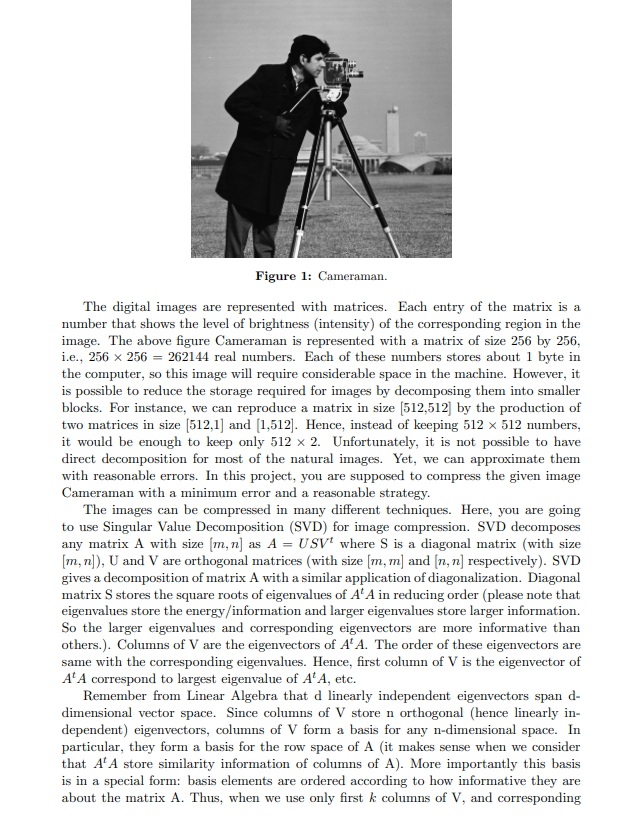
Figure 1: Cameraman. The digital images are represented with matrices. Each entry of the matrix is a number that shows the level of brightness (intensity) of the corresponding region in the image. The above figure Cameraman is represented with a matrix of size 256 by 256, i.e., 256 X 256 = 262144 real numbers. Each of these numbers stores about 1 byte in the computer, so this image will require considerable space in the machine. However, it is possible to reduce the storage required for images by decomposing them into smaller blocks. For instance, we can reproduce a matrix in size (512,512) by the production of two matrices in size (512,1) and (1,512). Hence, instead of keeping 512 x 512 numbers, it would be enough to keep only 512 x 2. Unfortunately, it is not possible to have direct decomposition for most of the natural images. Yet, we can approximate them with reasonable errors. In this project, you are supposed to compress the given image Cameraman with a minimum error and a reasonable strategy. The images can be compressed in many different techniques. Here, you are going to use Singular Value Decomposition (SVD) for image compression. SVD decomposes any matrix A with size (m, n) as A = USV where S is a diagonal matrix (with size [m, n]), U and V are orthogonal matrices (with size (m, m] and [n, n) respectively). SVD gives a decomposition of matrix A with a similar application of diagonalization. Diagonal matrix S stores the square roots of eigenvalues of A' A in reducing order (please note that eigenvalues store the energy/information and larger eigenvalues store larger information. So the larger eigenvalues and corresponding eigenvectors are more informative than others.). Columns of V are the eigenvectors of A' A. The order of these eigenvectors are same with the corresponding eigenvalues. Hence, first column of V is the eigenvector of A' A correspond to largest eigenvalue of A' A, etc. Remember from Linear Algebra that d linearly independent eigenvectors span d- dimensional vector space. Since columns of V store n orthogonal (hence linearly in- dependent) eigenvectors, columns of V form a basis for any n-dimensional space. In particular, they form a basis for the row space of A (it makes sense when we consider that A' A store similarity information of columns of A). More importantly this basis is in a special form: basis elements are ordered according to how informative they are about the matrix A. Thus, when we use only first k columns of V, and corresponding columns/rows of matrices S and U, and remove the remaining columns /rows we get an approximation to matrix A. Lets call this approximation as "k-rank approximation of A" (please note that k-rank approximation of A is supposed to be a matrix in the same size of A). Follow the following steps and answer the questions clearly. Please include all the figures and plots you generated in your report. 1. Load the attached grayscale image cameraman.tif. To use MATLAB functions without an error I recommend you convert the image cameraman to double. 2. How many entries do you need to store if compression is not applied to the given image (what is the total number of pixels in the image)? 3. Find U.S.V matrices as a result of SVD. What are the size of each of these matrices? 4. Calculate 3, 50, 70, 100-rank approximations through SVD. For each case calculate the approximation error as the mean-squared error (an error will be a scalar.), and also calculate the total number of entries the machine needs to store. Plot the errors with respect to rank as a line graph. 5. Plot the figures for each of the approximations you generated in the previous step. In the title of the figures state the rank of the approximation, calculated mean- squared error and how many entries need to be stored. Include these figures in your report. 6. Visually which approximations are good enough in your opinion? So by considering the number of entries how much can you compress the image without large error
Step by Step Solution
There are 3 Steps involved in it

Get step-by-step solutions from verified subject matter experts
 Study Help