







Question: Please use R programming to solve the question plz. Suppose (X1,,Xk),k1, has k-variate Hypergeometric (n,N,n1,,nk) distribution, with joint pmf: f(x1,,xk)=(n1x1)(nkxk)(Nn1nknx1xk)/(Nn),xj=0,1,,nj1jk,x1++xkn where N1,1nN,nj1 are integers, 1jk,j=1knjN.
Please use R programming to solve the question plz.
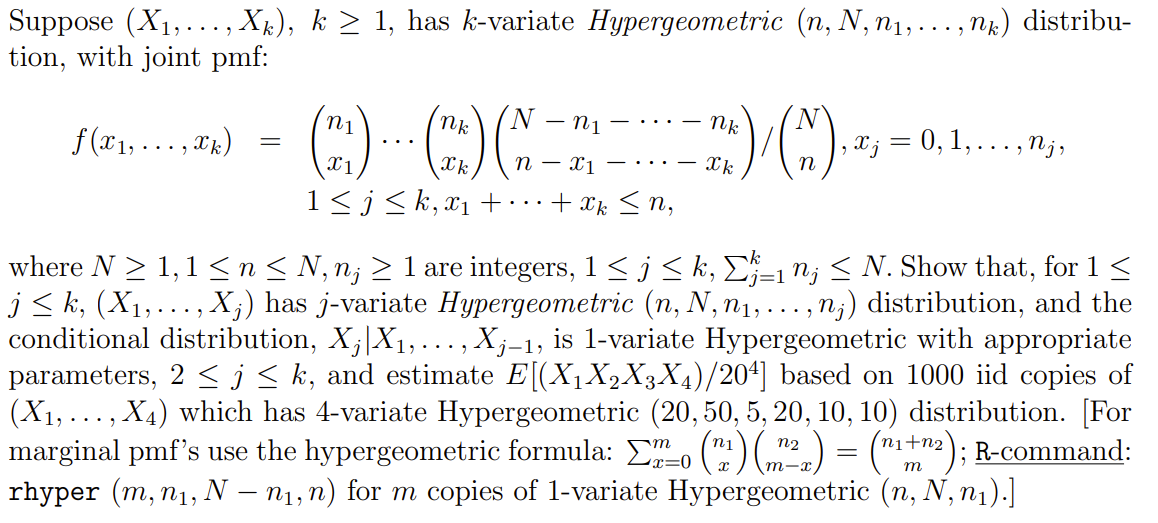
Suppose (X1,,Xk),k1, has k-variate Hypergeometric (n,N,n1,,nk) distribution, with joint pmf: f(x1,,xk)=(n1x1)(nkxk)(Nn1nknx1xk)/(Nn),xj=0,1,,nj1jk,x1++xkn where N1,1nN,nj1 are integers, 1jk,j=1knjN. Show that, for 1 jk,(X1,,Xj) has j-variate Hypergeometric (n,N,n1,,nj) distribution, and the conditional distribution, XjX1,,Xj1, is 1-variate Hypergeometric with appropriate parameters, 2jk, and estimate E[(X1X2X3X4)/204] based on 1000 iid copies of (X1,,X4) which has 4 -variate Hypergeometric (20,50,5,20,10,10) distribution. [For marginal pmf's use the hypergeometric formula: x=0m(n1x)(n2mx)=(n1+n2m); R-command: rhyper (m,n1,Nn1,n) for m copies of 1-variate Hypergeometric (n,N,n1).]
Step by Step Solution
There are 3 Steps involved in it

Get step-by-step solutions from verified subject matter experts
 Study Help