







Question: please use r studio You are playing a game with two dice, according to the following rules: In the first roll, if the total of
please use r studio
You are playing a game with two dice, according to the following rules:
In the first roll, if the total of the dice is 2, 3, or 12, you lose the game. In the first roll, if the total of the dice is 7 or 11, you win the game. For any other outcome, roll the dice again. If you get the same outcome again, you win. If you get a 7, you lose. Otherwise, repeat rolling the dice until you win or lose. To win after the second roll, you must get the outcome right before this one. Example games:
Roll 7. Win after a single roll. Roll 3. Loss after a single roll. Roll 5. Roll a 7. Loss after two rolls. Roll a 5. Roll a 4. Roll a 4. Win after three rolls. Roll a 8. Roll a 6. Roll a 8. Roll a 7. Loss after four rolls. Most games end after a small number of rolls, but there is a small probability of seeing arbitrarily large number of rolls until a game ends.
We will simulate this game of dice with random-number generators: Roll two dice as many times as needed, run the game until it ends, and store the number of rolls until the game has ended.
Write a function named gamecounts(ngames) that will play this game ngames times, and returns a vector such that the i-th element gives the count of games that ended after i rolls, up to 30 rolls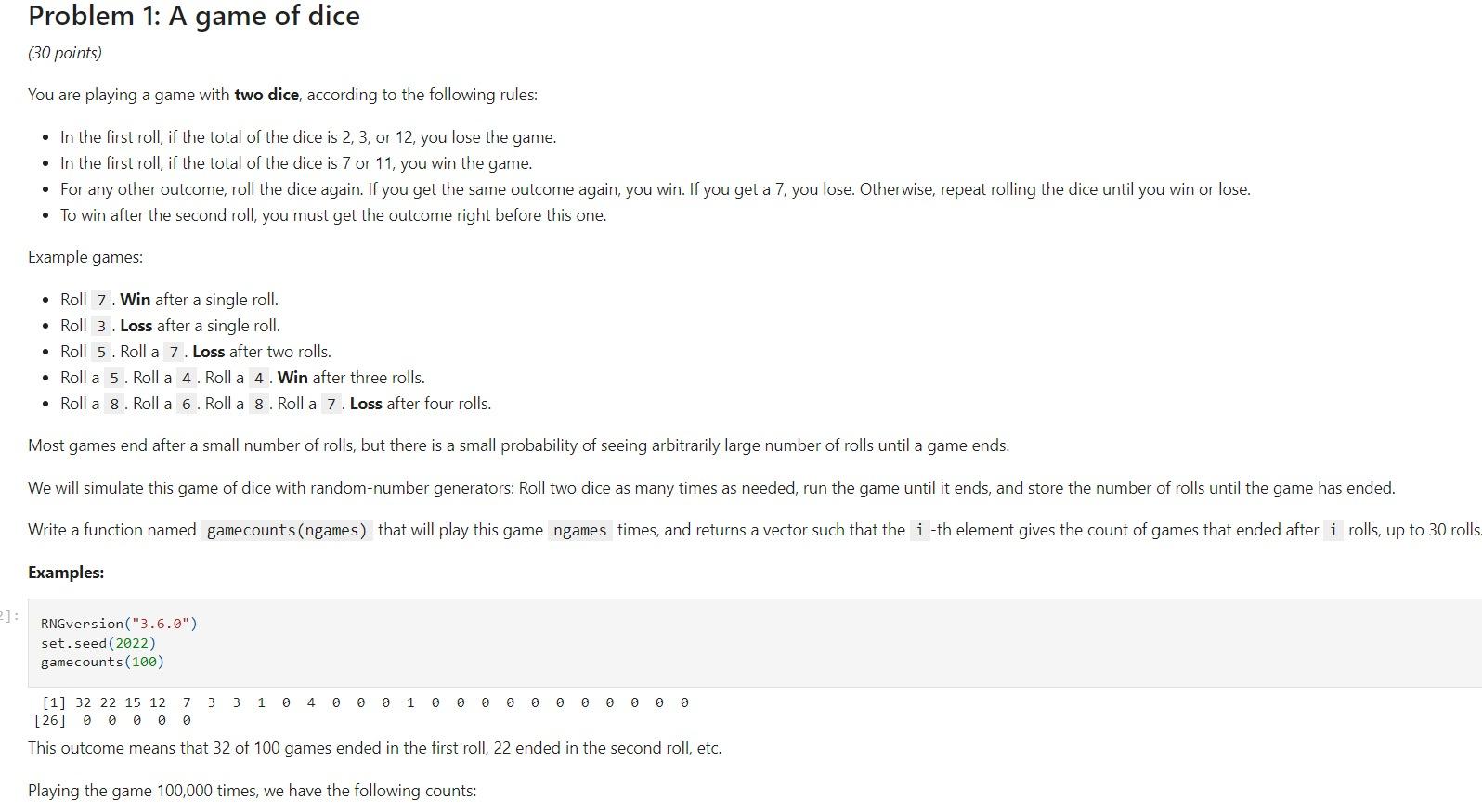
Problem 1: A game of dice (30 points) You are playing a game with two dice, according to the following rules: In the first roll, if the total of the dice is 2, 3, or 12, you lose the game. In the first roll, if the total of the dice is 7 or 11, you win the game. For any other outcome, roll the dice again. If you get the same outcome again, you win. If you get a 7, you lose. Otherwise, repeat rolling the dice until you win or lose. To win after the second roll, you must get the outcome right before this one. Example games: Roll 7. Win after a single roll. Roll 3. Loss after a single roll. Roll 5. Roll a 7. Loss after two rolls. Roll a 5. Roll a 4. Roll a 4. Win after three rolls. Roll a 8. Roll a 6. Roll a 8. Roll a 7. Loss after four rolls. Most games end after a small number of rolls, but there is a small probability of seeing arbitrarily large number of rolls until a game ends. We will simulate this game of dice with random-number generators: Roll two dice as many times as needed, run the game until it ends, and store the number of rolls until the game has ended. Write a function named gamecounts(ngames) that will play this game ngames times, and returns a vector such that the i-th element gives the count of games that ended after i rolls, up to 30 rolls Examples: 2]: RNGversion ("3.6.0") set.seed (2022) gamecounts (100) 0 0 0 [1] 32 22 15 12 7 3 3 1 4 0 0 0 1 0 0 0 [26] 0 0 0 0 This outcome means that 32 of 100 games ended in the first roll, 22 ended in the second roll, etc. Playing the game 100,000 times, we have the following counts
Step by Step Solution
There are 3 Steps involved in it

Get step-by-step solutions from verified subject matter experts
 Study Help