







Question: please use the appendix data to solve. Good luck Appendix B: Useful Relations for the One-Dimensional Harmonic Oscillator The eigenstates of the 1D harmonic oscillator
please use the appendix data to solve. Good luck
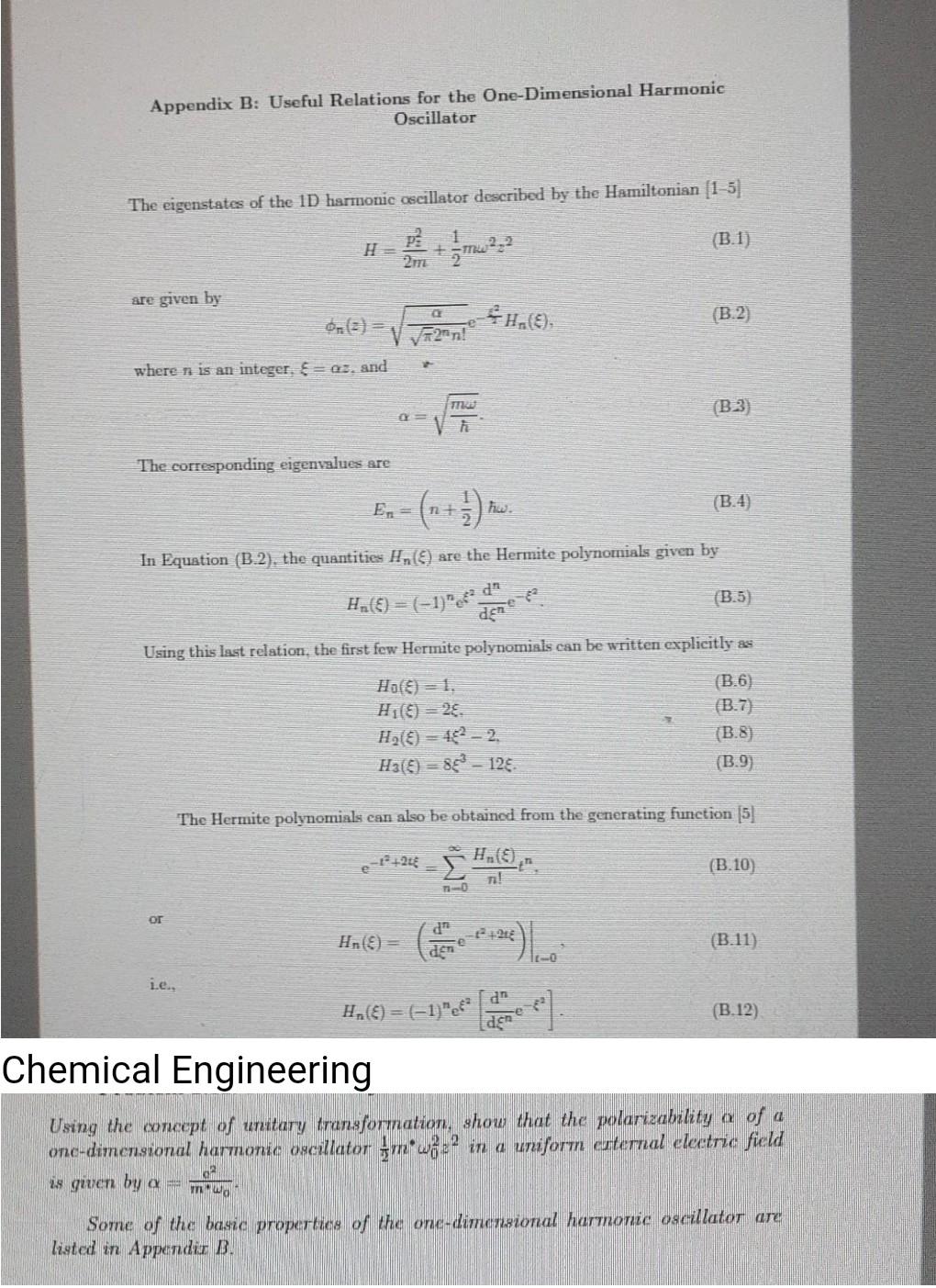
Appendix B: Useful Relations for the One-Dimensional Harmonic Oscillator The eigenstates of the 1D harmonic oscillator described by the Hamiltonian (1-5) (B.1) H Amu 1 2 272 are given by 4H.(). (B.2 R2nn! where nu is an integer = 03. and TT (B3) The corresponding eigenvalues are En = (n + 5) hw. (B.4 In Equation (B.2), the quantities H, (E) are the Hermite polynomials given by H.(E)= (-1)" da (3.5) Using this last relation, the first few Hermite polynomials can be written explicitly as Ho(E) = 1. Hi() = 28. H2(E) = 452 = 2. H3(3) = 882 12 (B.6) (B.7) (3.8) (B.9) The Hermite polynomials can also be obtained from the generating function (5) HO e-++218 (B.10) ni! 10 or Hn) = dr den ( (B.11) ie, H.(E) = (-1)" el (B.12) Chemical Engineering Using the concept of unitary transformation, show that the polarizability a of a one-dimensional harmonic oscillator mw:? in a uniform erternal electric field is given by aa mwo Some of the basic properties of the one-dimensional harmonic oscillator are listed in Appendur B
Step by Step Solution
There are 3 Steps involved in it

Get step-by-step solutions from verified subject matter experts
 Study Help