







Question: please use the data found in the case to evaluate the quality of service and to create recommendations. develop alternate recommendations and then using a
please use the data found in the case to evaluate the quality of service and to create recommendations. 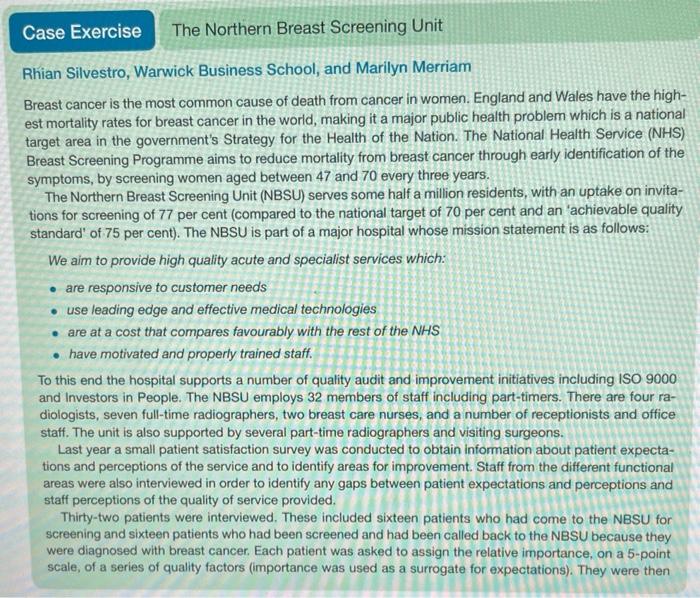
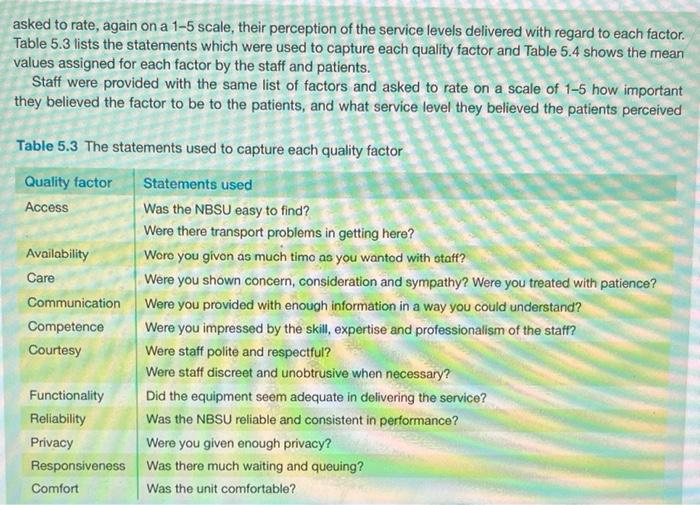
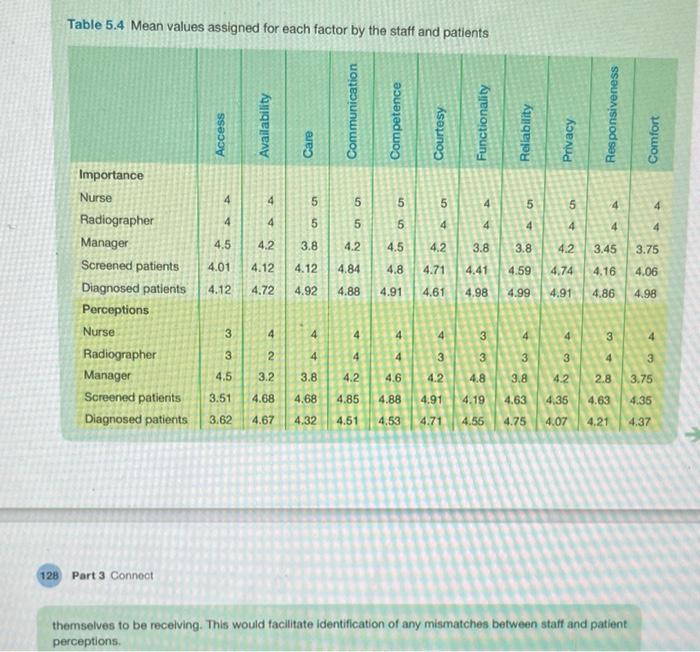
Rhian Silvestro, Warwick Business School, and Marilyn Merriam Breast cancer is the most common cause of death from cancer in women. England and Wales have the highest mortality rates for breast cancer in the world, making it a major public health problem which is a national target area in the government's Strategy for the Health of the Nation. The National Health Service (NHS) Breast Screening Programme aims to reduce mortality from breast cancer through early identification of the symptoms, by screening women aged between 47 and 70 every three years. The Northern Breast Screening Unit (NBSU) serves some half a million residents, with an uptake on invitations for screening of 77 per cent (compared to the national target of 70 per cent and an 'achievable quality standard' of 75 per cent). The NBSU is part of a major hospital whose mission statement is as follows: We aim to provide high quality acute and specialist services which: - are responsive to customer needs - use leading edge and effective medical technologies - are at a cost that compares favourably with the rest of the NHS - have motivated and properly trained staff. To this end the hospital supports a number of quality audit and improvement initiatives including ISO 9000 and Investors in People. The NBSU employs 32 members of staff including part-timers. There are four radiologists, seven full-time radiographers, two breast care nurses, and a number of receptionists and office staff. The unit is also supported by several part-time radiographers and visiting surgeons. Last year a small patient satisfaction survey was conducted to obtain information about patient expectations and perceptions of the service and to identify areas for improvement. Staff from the different functional areas were also interviewed in order to identify any gaps between patient expectations and perceptions and staff perceptions of the quality of service provided. Thirty-two patients were interviewed. These included sixteen patients who had come to the NBSU for screening and sixteen patients who had been screened and had been called back to the NBSU because they were diagnosed with breast cancer. Each patient was asked to assign the relative importance, on a 5-point scale, of a series of quality factors (importance was used as a surrogate for expectations). They were then asked to rate, again on a 1-5 scale, their perception of the service levels delivered with regard to each factor. Table 5.3 lists the statements which were used to capture each quality factor and Table 5.4 shows the mean values assigned for each factor by the staff and patients. Staff were provided with the same list of factors and asked to rate on a scale of 1-5 how important they believed the factor to be to the patients, and what service level they believed the patients perceived Table 5.3 The statements used to capture each quality factor Table 5.4 Mean values assigned for each factor by the staff and patients 128 Part 3 Connect themselves to be recelving. This would facilitate identification of any mismatches between staft and patient perceptions develop alternate recommendations and then using a criteria matrix or weighted preference charts create recommendations.
Step by Step Solution
There are 3 Steps involved in it
1 Expert Approved Answer
Step: 1 Unlock

Question Has Been Solved by an Expert!
Get step-by-step solutions from verified subject matter experts
Step: 2 Unlock
Step: 3 Unlock
 Study Help