





Question: Please use the given methods from the image and do not add or remove any. Thank you For this assignment, you will write an implementation

Please use the given methods from the image and do not add or remove any. Thank you

For this assignment, you will write an implementation of a Priority Queue. For this ADT, removal operations always return the object in the queue of highest priority that has been in the queue the longest. That is, no object of a given priority is ever removed as long as the queue contains one or more object of a higher priority. Within a given priority FIFO order must be preserved. Your implementation will be:

1. Binary Heap

Implementation must have identical behavior, and must implement the PriorityQueue interface (provided). The implementation must have two constructors, a default constructor with no arguments that uses the DEFAULT_MAX_CAPACITY constant from the PriorityQueue interface, and a constructor that takes a single integer parameter that represents the maximum capacity of the priority queue. The PriorityQueue interface follows:
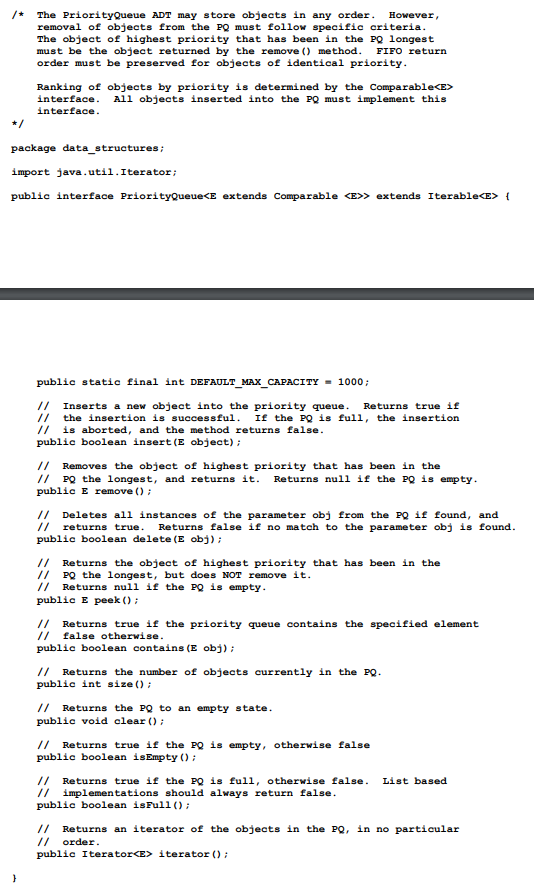
Please use the given methods from the image and do not add

The PriorityQueue ADT may store objects in any order. However, removal of objects from the PQ must follow specific criteria. The object of highest priority that has been in the Pg longest must be the object returned by the remove() method. FIFO return order must be preserved for objects of identical priority. Ranking of objects by priority is determined by the comparable interface. All objects inserted into the PQ must implement this interface. package data_structures; import java.util.Iterator; public interface PriorityQueue> extends Iterable { public static final int DEFAULT_MAX_CAPACITY = 1000; Inserts a new object into the priority queue. Returns true if the insertion is successful. If the Po is full, the insertion is aborted, and the method returns false. public boolean insert (E object); // Removes the object of highest priority that has been in the Po the longest, and returns it. Returns null if the PQ is empty. public E remove(); 11 Deletes all instances of the parameter obj from the PQ if found, and // returns true. Returns false if no match to the parameter obj is found. public boolean delete (E obj); Returns the object of highest priority that has been in the PO the longest, but does NOT remove it. // Returns null if the PQ is empty. public E peek(); // Returns true if the priority queue contains the specified element false otherwise. public boolean contains (E obj); Returns the number of objects currently in the PQ. public int size(); // Returns the Pg to an empty state. public void clear(); // Returns true if the PQ is empty, otherwise false public boolean isEmpty(); Returns true if the PQ is full, otherwise false. List based // implementations should always return false. public boolean isFull(); Returns an iterator of the objects in the PQ, in no particular order. public Iterator iterator(); }

Step by Step Solution

There are 3 Steps involved in it

1 Expert Approved Answer
Step: 1 Unlock blur-text-image
Question Has Been Solved by an Expert!

Get step-by-step solutions from verified subject matter experts

Step: 2 Unlock
Step: 3 Unlock

Students Have Also Explored These Related Databases Questions!