







Question: Please use the graph below to answer the next THREE questions. The gr c) The monopolist charges a price that exceeds marginal cost. 1. (4
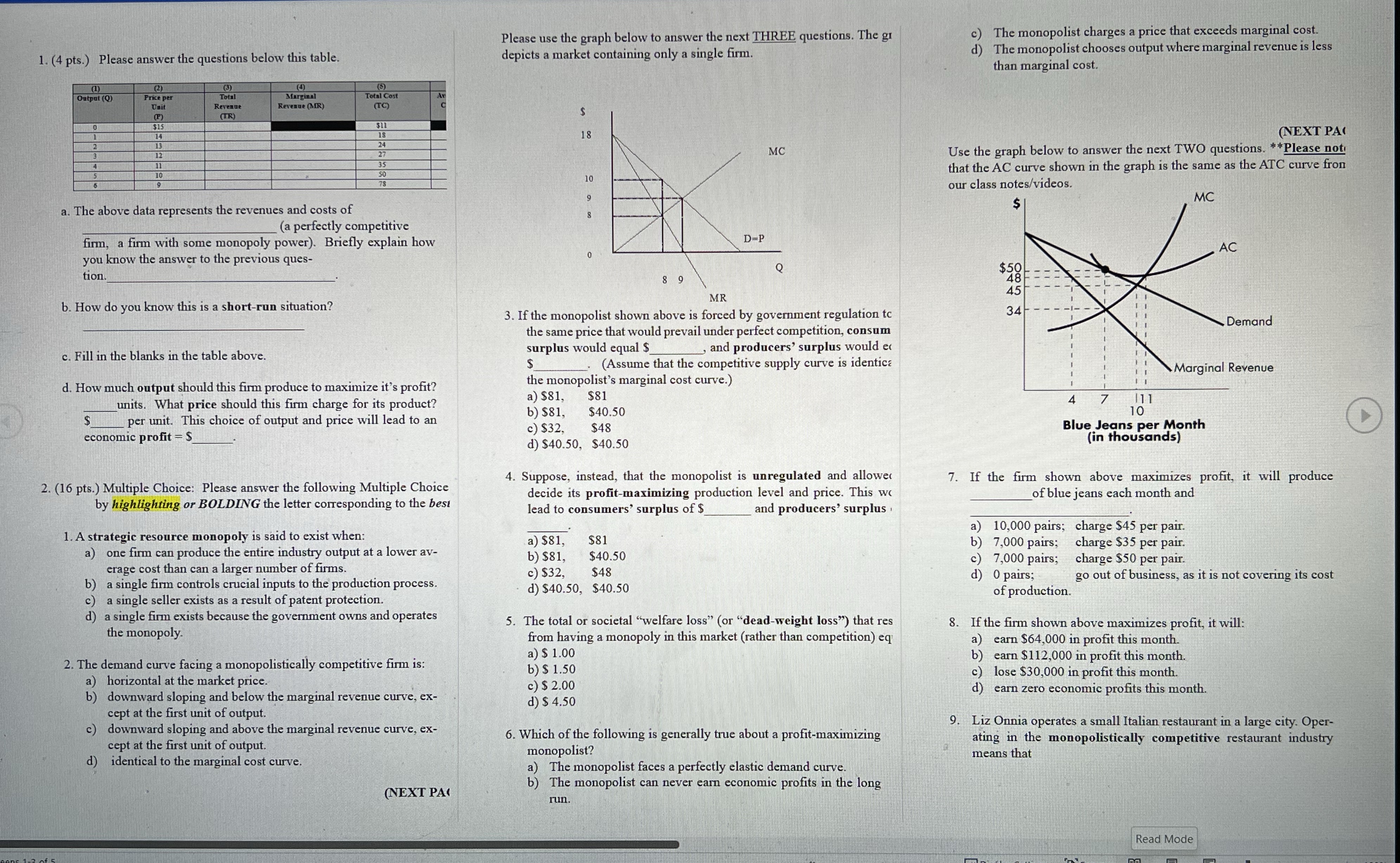
Please use the graph below to answer the next THREE questions. The gr c) The monopolist charges a price that exceeds marginal cost. 1. (4 pts.) Please answer the questions below this table. depicts a market containing only a single firm. d) The monopolist chooses output where marginal revenue is less than marginal cost. (1) (2) (3) (4) (5) Output (Q) Price per Total Marginal Total Cost Upit Revenue Revenue (MR) (TC) (P) (TR) $15 18 (NEXT PAC MC Use the graph below to answer the next TWO questions. * *Please not that the AC curve shown in the graph is the same as the ATC curve fron our class notes/videos. a. The above data represents the revenues and costs of $ (a perfectly competitive firm, a firm with some monopoly power). Briefly explain how D-P you know the answer to the previous ques- tion. $50 45 b. How do you know this is a short-run situation? MR 3. If the monopolist shown above is forced by government regulation to 34 the same price that would prevail under perfect competition, consum c. Fill in the blanks in the table above. surplus would equal $_ , and producers' surplus would er $ (Assume that the competitive supply curve is identice d. How much output should this firm produce to maximize it's profit? the monopolist's marginal cost curve.) units. What price should this firm charge for its product? a) $81, $81 $ per unit. This choice of output and price will lead to an b) $81, $40.50 10 c) $32, $48 Blue Jeans per Month economic profit = S d) $40.50, $40.50 (in thousands) 4. Suppose, instead, that the monopolist is unregulated and allowed 2. (16 pts.) Multiple Choice: Please answer the following Multiple Choice 7. If the firm shown above maximizes profit, it will produce decide its profit-maximizing production level and price. This wc of blue jeans each month and by highlighting or BOLDING the letter corresponding to the best lead to consumers' surplus of $ and producers' surplus . 1. A strategic resource monopoly is said to exist when: a) 10,000 pairs; charge $45 per pair. a) $81, $81 a) one firm can produce the entire industry output at a lower av- 7,000 pairs; charge $35 per pair. b) $81, $40.50 erage cost than can a larger number of firms. 7,000 pairs; charge $50 per pair. c) $32, $48 b) a single firm controls crucial inputs to the production process. 0 pairs; go out of business, as it is not covering its cost d) $40.50, $40.50 c) a single seller exists as a result of patent protection. of production. d) a single firm exists because the government owns and operates 5. The total or societal "welfare loss" (or "dead-weight loss") that res the monopoly. 8. If the firm shown above maximizes profit, it will: from having a monopoly in this market (rather than competition) eq a) earn $64,000 in profit this month. a) $ 1.00 2. The demand curve facing a monopolistically competitive firm is: earn $112,000 in profit this month. b) $ 1.50 a) horizontal at the market price. c ) lose $30,000 in profit this month. c) $ 2.00 b ) d) downward sloping and below the marginal revenue curve, ex- earn zero economic profits this month. d) $ 4.50 cept at the first unit of output. c ) downward sloping and above the marginal revenue curve, ex- Liz Onnia operates a small Italian restaurant in a large city. Oper- 6. Which of the following is generally true about a profit-maximizing cept at the first unit of output. ating in the monopolistically competitive restaurant industry monopolist? 1) identical to the marginal cost curve. means that The monopolist faces a perfectly elastic demand curve. b) (NEXT PAC The monopolist can never earn economic profits in the long run. Read Mode
Step by Step Solution
There are 3 Steps involved in it

Get step-by-step solutions from verified subject matter experts
 Study Help