







Question: Please use the same format to answer the question! Rock Solid Bank and Trust (RSB&T) offers only checking accounts. Customers can write checks and use
Please use the same format to answer the question!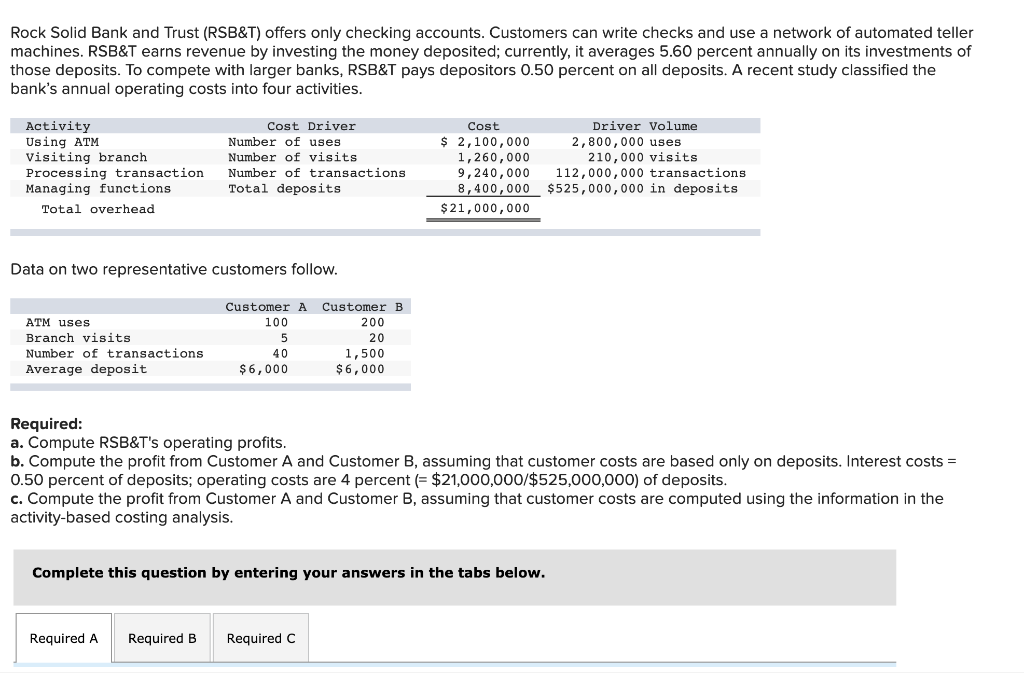
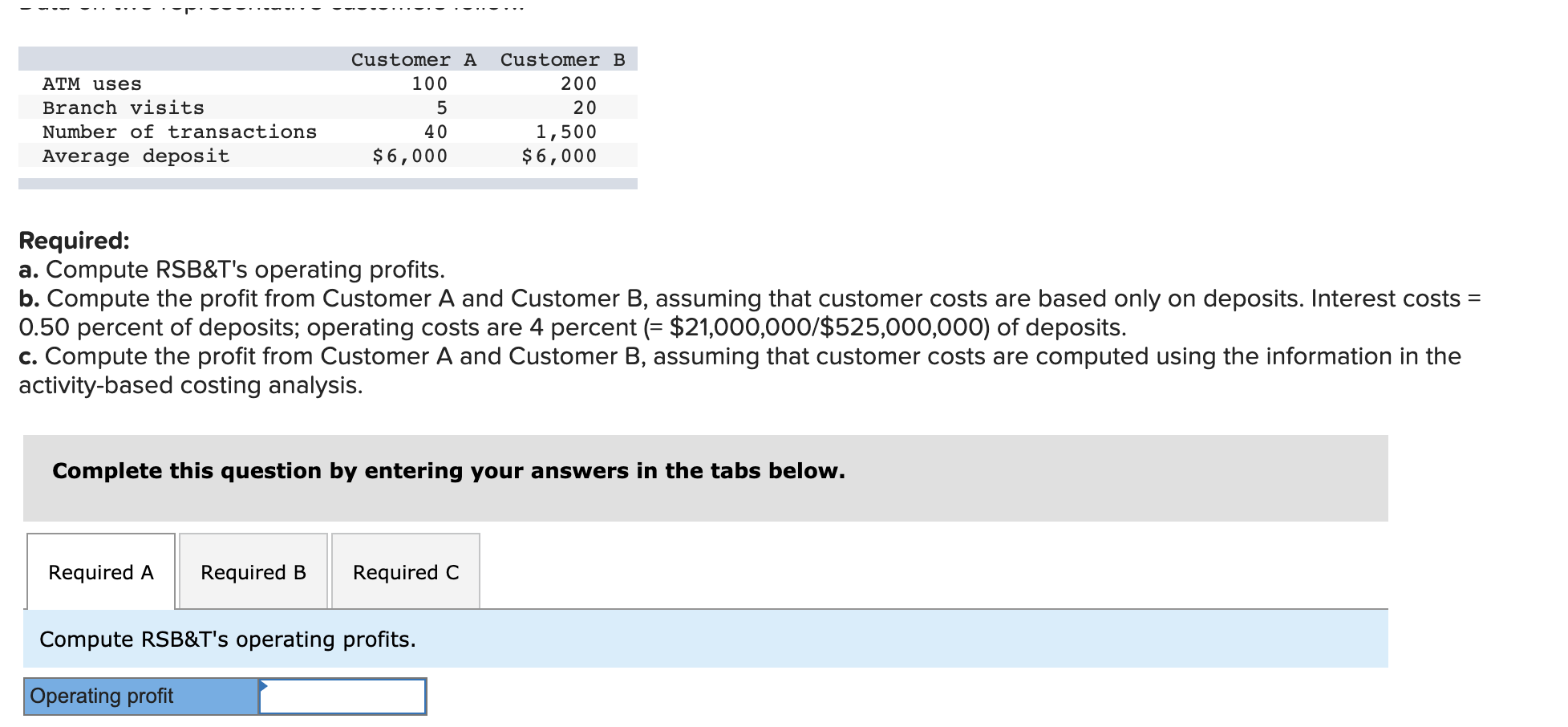
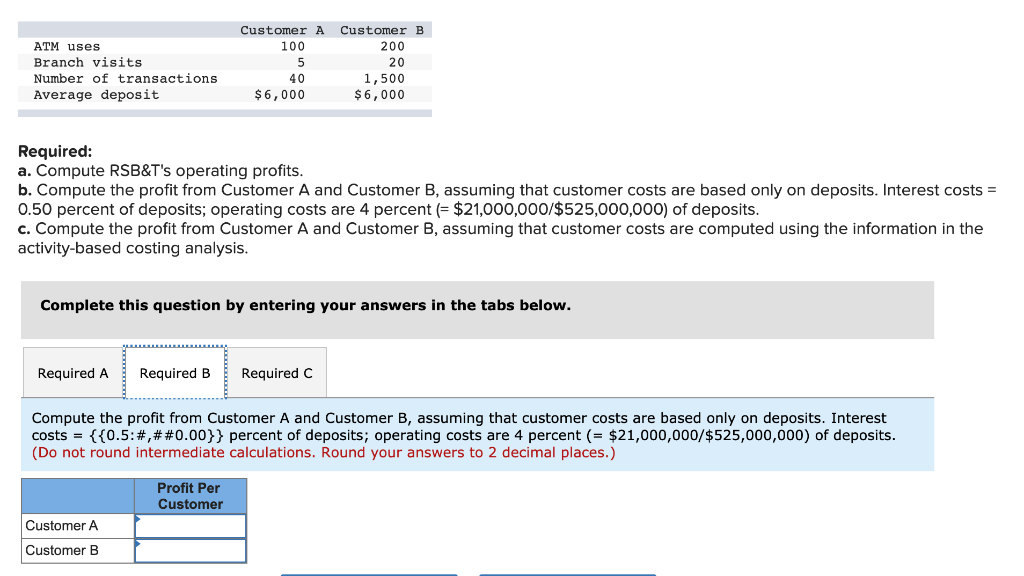
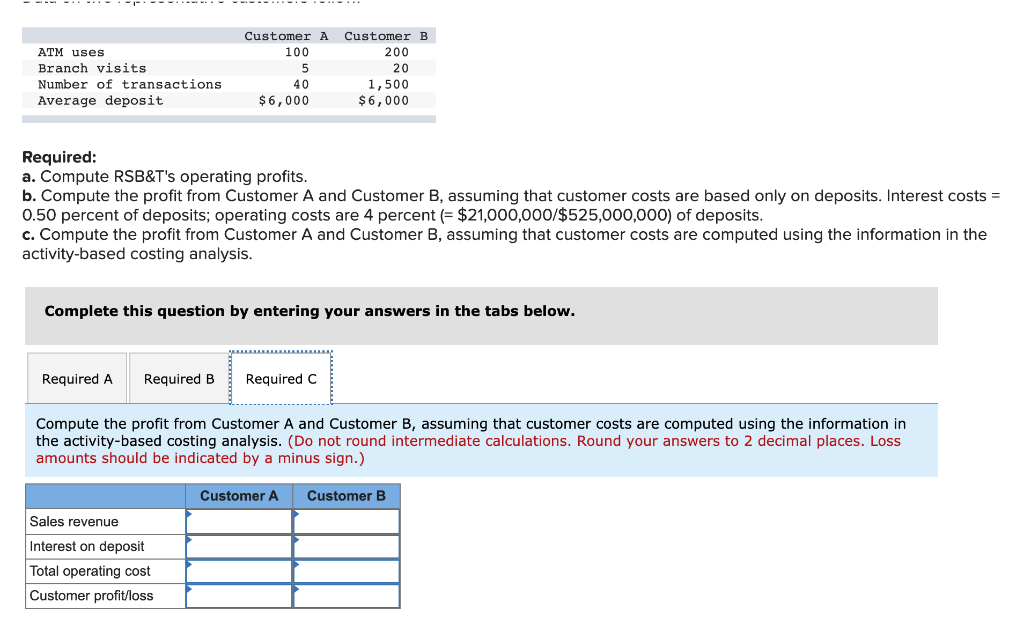
Rock Solid Bank and Trust (RSB&T) offers only checking accounts. Customers can write checks and use a network of automated teller machines. RSB&T earns revenue by investing the money deposited; currently, it averages 5.60 percent annually on its investments of those deposits. To compete with larger banks, RSB&T pays depositors 0.50 percent on all deposits. A recent study classified the bank's annual operating costs into four activities. Activity Using ATM Visiting branch Processing transaction Managing functions Total overhead Cost Driver Number of uses Number of visits Number of transactions Total deposits Cost Driver Volume $ 2,100,000 2,800,000 uses 1,260,000 210,000 visits 9, 240,000 112,000,000 transactions 8,400,000 $525,000,000 in deposits $21,000,000 Data on two representative customers follow. Customer A 100 ATM uses Branch visits Number of transactions Average deposit Customer B 200 20 1,500 $6,000 40 $6,000 Required: a. Compute RSB&T's operating profits. b. Compute the profit from Customer A and Customer B, assuming that customer costs are based only on Interest costs = 0.50 percent of deposits; operating costs are 4 percent = $21,000,000/$525,000,000) of deposits. c. Compute the profit from Customer A and Customer B, assuming that customer costs are computed using the information in the activity-based costing analysis. Complete this question by entering your answers in the tabs below. Required A Required B Required C ATM uses Branch visits Number of transactions Average deposit Customer A 100 5 40 $6,000 Customer B 200 20 1,500 $6,000 Required: a. Compute RSB&T's operating profits. b. Compute the profit from Customer A and Customer B, assuming that customer costs are based only on deposits. Interest costs = 0.50 percent of deposits; operating costs are 4 percent (= $21,000,000/$525,000,000) of deposits. c. Compute the profit from Customer A and Customer B, assuming that customer costs are computed using the information in the activity-based costing analysis. Complete this question by entering your answers in the tabs below. Required A Required B Required C Compute RSB&T's operating profits. Operating profit ATM uses Branch visits Number of transactions Average deposit Customer A 100 5 40 $6,000 Customer B 200 20 1,500 $6,000 Required: a. Compute RSB&T's operating profits. b. Compute the profit from Customer A and Customer B, assuming that customer costs are based only on deposits. Interest costs = 0.50 percent of deposits; operating costs are 4 percent (= $21,000,000/$525,000,000) of deposits. c. Compute the profit from Customer A and Customer B, assuming that customer costs are computed using the information in the activity-based costing analysis. Complete this question by entering your answers in the tabs below. Required A Required B Required C Compute the profit from Customer A and Customer B, assuming that customer costs are based only on deposits. Interest costs = {{0.5:#,##0.00}} percent of deposits; operating costs are 4 percent (= $21,000,000/$525,000,000) of deposits. (Do not round intermediate calculations. Round your answers to 2 decimal places.) Profit Per Customer Customer A Customer B ATM uses Branch visits Number of transactions Average deposit Customer A 100 5 40 $6,000 Customer B 200 20 1,500 $6,000 Required: a. Compute RSB&T's operating profits. b. Compute the profit from Customer A and Customer B, assuming that customer costs are based only on deposits. Interest costs = 0.50 percent of deposits; operating costs are 4 percent (= $21,000,000/$525,000,000) of deposits. c. Compute the profit from Customer A and Customer B, assuming that customer costs are computed using the information in the activity-based costing analysis. Complete this question by entering your answers in the tabs below. Required A Required B Required C Compute the profit from Customer A and Customer B, assuming that customer costs are computed using the information in the activity-based costing analysis. (Do not round intermediate calculations. Round your answers to 2 decimal places. Loss amounts should be indicated by a minus sign.) Customer A Customer B Sales revenue Interest on deposit Total operating cost Customer profit/loss
Step by Step Solution
There are 3 Steps involved in it

Get step-by-step solutions from verified subject matter experts
 Study Help