Question: Please use word so I can put the answer down 3. The Grand Valley Company, run by the J. Motwani family, produces two products: bed
Please use word so I can put the answer down
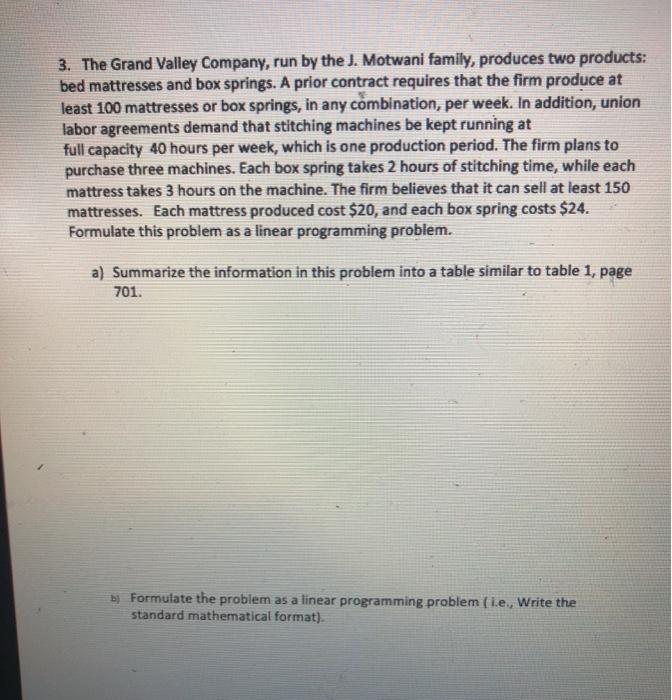
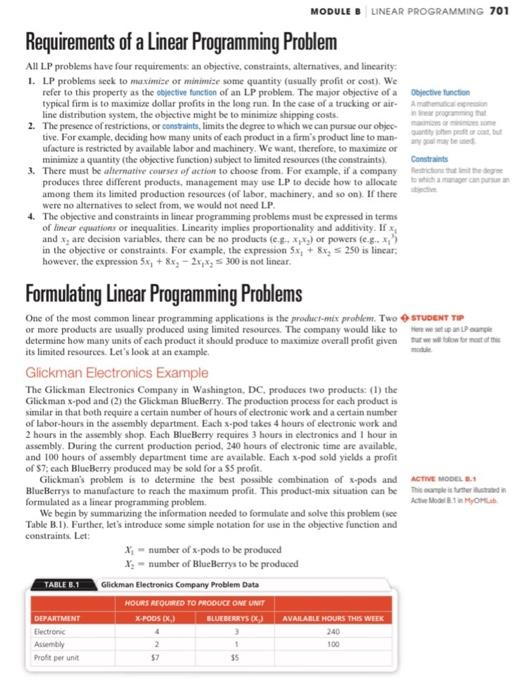
3. The Grand Valley Company, run by the J. Motwani family, produces two products: bed mattresses and box springs. A prior contract requires that the firm produce at least 100 mattresses or box springs, in any combination, per week. In addition, union labor agreements demand that stitching machines be kept running at full capacity 40 hours per week, which is one production period. The firm plans to purchase three machines. Each box spring takes 2 hours of stitching time, while each mattress takes 3 hours on the machine. The firm believes that it can sell at least 150 mattresses. Each mattress produced cost $20, and each box spring costs $24. Formulate this problem as a linear programming problem. a) Summarize the information in this problem into a table similar to table 1, page 701. Formulate the problem as a linear programming problem (i.e., Write the standard mathematical format). MODULEB LINEAR PROGRAMMING 701 Requirements of a Linear Programming Problem All LP problems have four requirements: an objective, constraints, alternatives, and linearity: 1. LP problems seek to maximise or minimize some quantity (usually profit or cost). We refer to this property as the objective function of an LP problem. The major objective of a objective function typical firm is to maximize dollar profits in the long run. In the case of a trucking or air-te line distribution system, the objective might be to minimize shipping costs. 2. The presence of restrictions or constraints, limits the degree to which we can pursue our objemme tive. For example, deciding how many units of each product in a firm's product line to man ufacture is restricted by available labor and machinery, We want, therefore, to maximize or minimize a quantity (the objective function) subject to limited resources (the constraints) Constraints 3. There must be alternative course of action to choose from. For example, if a company de produces three different products, management may use LP to decide how to allocate the among them is limited production resources (of labor, machinery, and so on). If there were no alternatives to select from, we would not need LP. 4. The objective and constraints in linear programming problems must be expressed in terms of linear equations or inequalities. Linearity implies proportionality and additivity. If and are decision variables, there can be no products (e-- XX) or powers (eg. in the objective or constraints. For example, the expression 5x + 8x,









 Study Help