







Question: please utilize code to solve this problem code is copied below: GlowScript 2.9 VPython # Parameters xmin = -10 xmax = 10 scene.center = vec((xmax+xmin)/2,0,0)
please utilize code to solve this problem code is copied below:
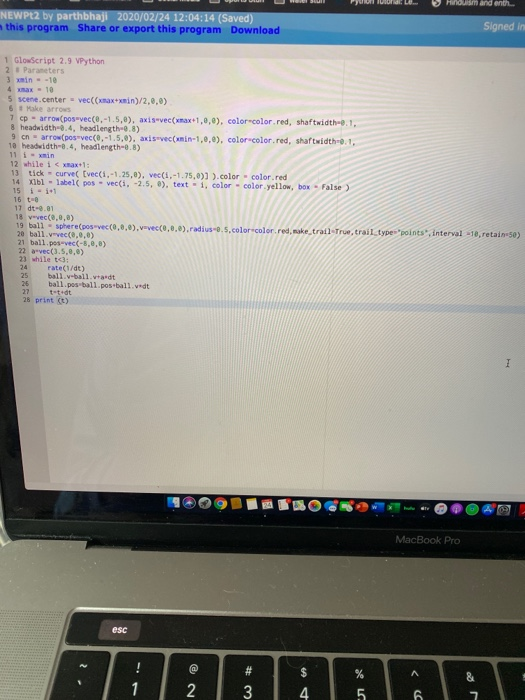
GlowScript 2.9 VPython
# Parameters
xmin = -10
xmax = 10
scene.center = vec((xmax+xmin)/2,0,0)
# Make arrows
cp = arrow(pos=vec(0,-1.5,0), axis=vec(xmax+1,0,0), color=color.red, shaftwidth=0.1,
headwidth=0.4, headlength=0.8)
cn = arrow(pos=vec(0,-1.5,0), axis=vec(xmin-1,0,0), color=color.red, shaftwidth=0.1,
headwidth=0.4, headlength=0.8)
i = xmin
while i
tick = curve( [vec(i,-1.25,0), vec(i,-1.75,0)] ).color = color.red
Xlbl = label( pos = vec(i, -2.5, 0), text = i, color = color.yellow, box = False )
i = i+1
t=0
dt=0.01
v=vec(0,0,0)
ball = sphere(pos=vec(0,0,0),v=vec(0,0,0),radius=0.5,color=color.red,make_trail=True,trail_type="points",interval =10,retain=50)
ball.v=vec(0,0,0)
ball.pos=vec(-8,0,0)
a=vec(3.5,0,0)
while t 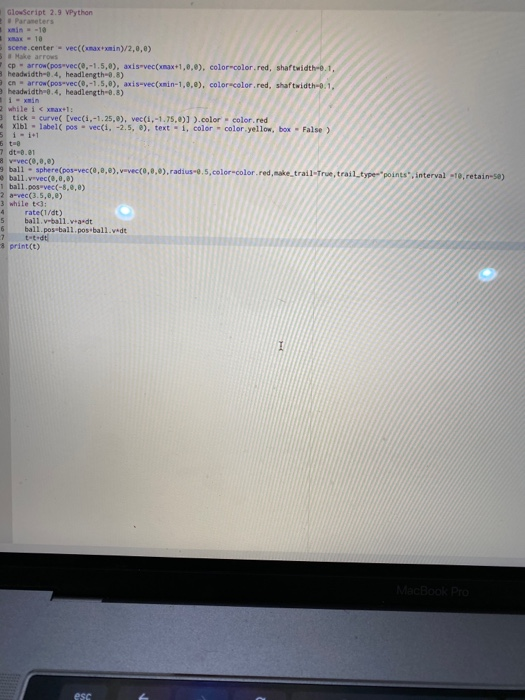
rate(1/dt)
ball.v=ball.v+a*dt
ball.pos=ball.pos+ball.v*dt
t=t+dt
print(t)
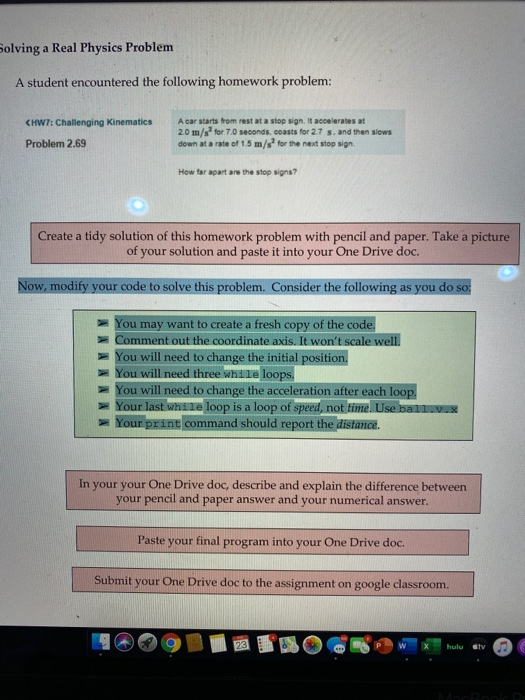
question says "Were you able to create the code to answer the final question? It was as follows if it wasn't clear, "A car starts from rest at a stop sign. It accelerates at 2.0 m/s2 for 7.0 seconds, coasts For 2.7 s, and then slows down at a rate of 1.5 m/s2for the next stop sign. How far apart are the stop signs?" if not clear.
please solve the question from the last picture about the ball, utilizing the code abvoe on glowscript.org
unclear words in question written below but attached is more clear image 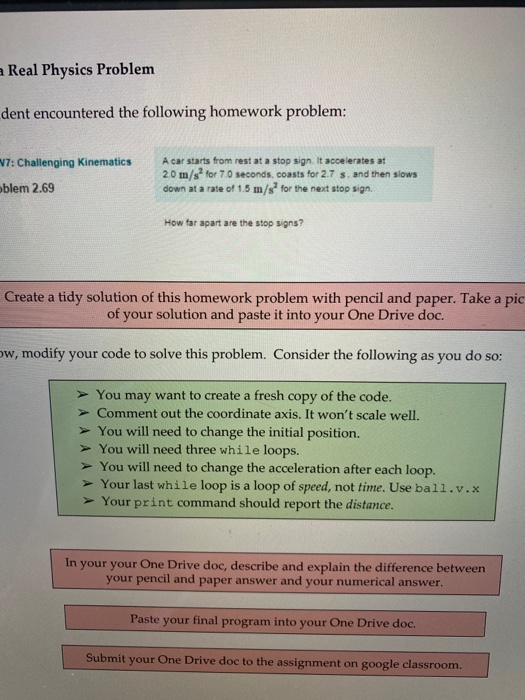
GlowScript 2.9 VPython Parameters min = 10 1 scene.center - vec((maxxmin)/2,0,0) p arrow(posavec(-1.5,), axis vecmax+1,0,0), color color.red, shaftwidth: 3 headwidth-0.4, headlength-0.8) n arrow(posavec (0.-1.5.0), axis-vec(xmin-1,0,0), color-color.red, shaftwidth-0.1. e headwidth-0.4. headlength-0.8) 1 - xmin while i max.1 3 tick curve [vec(1,-1.25.), vec(i.-1.75,0)) ).color - color.red Xlbl - label pos - vec(1, -2.5, ), text = 1, color color yellow, box - False) 5 1 - 1+1 radius-0.5, color-color.red, make trail-True, trail_type"points", interval retain-sa) 1 dt 0.2L vevec(0,0,0) 9 ball - sphere(pos-vec(0,0,0).vave ball.vavec(0,0,0) 1 ball.pos vec(-8,0,0) 2 avec(3.5,0,0) 3 while to: rate(1/dt) ball.veball.vardt ball.poseball poseball.vedt tut.dt 8 print(t) Solving a Real Physics Problem A student encountered the following homework problem: CHW7: Challenging Kinematics Problem 2.69 A car starts from restat a stop sign. It accelerates at 2.0 m/stor 7.0 seconds, coasts for 2.7 s. and then slows down at a rate of 1.5 m/s for the next stop sign How far apart are the stop signs? Create a tidy solution of this homework problem with pencil and paper. Take a picture of your solution and paste it into your One Drive doc. Now, modify your code to solve this problem. Consider the following as you do so You may want to create a fresh copy of the code. Comment out the coordinate axis. It won't scale well. You will need to change the initial position You will need three while loops. You will need to change the acceleration after each loop. Your last white loop is a loop of speed, not time. Use ball Your print command should report the distance. In your your One Drive doc, describe and explain the difference between your pencil and paper answer and your numerical answer. Paste your final program into your One Drive doc. Submit your One Drive doc to the assignment on google classroom. - Real Physics Problem dent encountered the following homework problem: W7: Challenging Kinematics oblem 2.69 A car starts from rest at a stop sign. It accelerates at 20 m/s2 for 70 seconds, coasts for 27 s. and then slows down at a rate of 1.5 m/s for the next stop sign How far apart are the stop signs? Create a tidy solution of this homework problem with pencil and paper. Take a pic of your solution and paste it into your One Drive doc. w, modify your code to solve this problem. Consider the following as you do so: You may want to create a fresh copy of the code. Comment out the coordinate axis. It won't scale well. You will need to change the initial position. > You will need three while loops. You will need to change the acceleration after each loop. Your last while loop is a loop of speed, not time. Use ball.v.x Your print command should report the distance. your your One Drive doc, describe and explain the difference between your pencil and paper answer and your numerical answer. Paste your final program into your One Drive doc. Submit your One Drive doc to the assignment on google classroom. PUUTUU Him and enth U N USUI NEWPt2 by parthbhaji 2020/02/24 12:04:14 (Saved this program Share or export this program Download Signed in 1 GlowScript 2.9 VPython 2 Patters 3 inte 4 x = 10 5 scene.center - vec((max+xmin)/2,0,0) 6 + Makers 7 cp - arrow(posavec(0, -1.5,0), axis vec(max.1,0,), color-color.red, shaftwidth-0.1. 8 headwidth-0.4, headlength 0.8) 9 cn - arrow(pos vec(, -1.5,0), axis vec(min-1,0,0), color-color.red, shaftwidth-0.1. 10 headwidth-0.4, headlength-0.8) 11 min 12 while i max.1 13 tick - curve [vec(1,-1.25,0), vec(1.-1.75,0)) ).color color.red 14 Xibl - label( pos - vec(i. -2.5, e), text - i, color color yellow, box - False) 1 dt 9. 18 v vec(0,0,0) 19 ball - sphere os vec(0,0,0).vavec(0,0,0).radius 8.5.color color.red, make traileTrue, trail_types points interval -10, retain 50) 20 ball. v ec(0,0,0) 21 ball.posvec(-8,0,0) 22 avec(3.5,e,e) 23 while 3: rate(1/dt) ball.veball.vtadt ball.pos ball.poseball.vedt 28 print (t) MacBook Pro esc # * 20 W Step by Step Solution
There are 3 Steps involved in it
1 Expert Approved Answer
Step: 1 Unlock

Question Has Been Solved by an Expert!
Get step-by-step solutions from verified subject matter experts
Step: 2 Unlock
Step: 3 Unlock
 Study Help