







Question: PLEASE UTILIZE THE FOLLOWING READING MATERIAL BELOW: SUMMARIZE YOUR FINDINGS PLEASE MAKE COPY PASTE AVAILABLE As I write this editorial for the first issue in
PLEASE UTILIZE THE FOLLOWING READING MATERIAL BELOW:

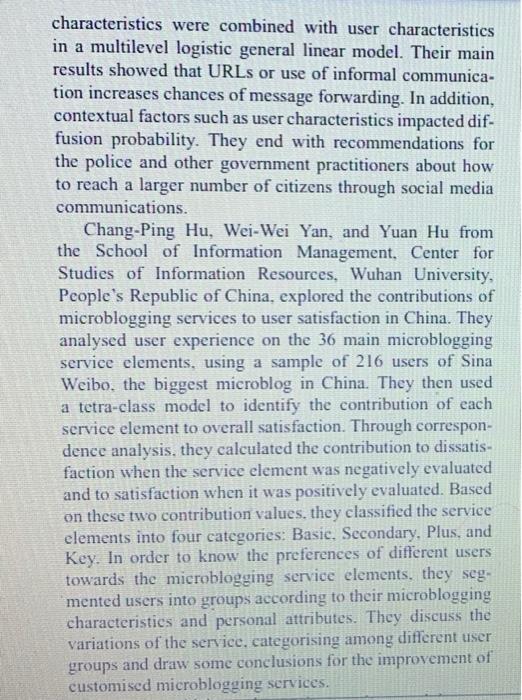
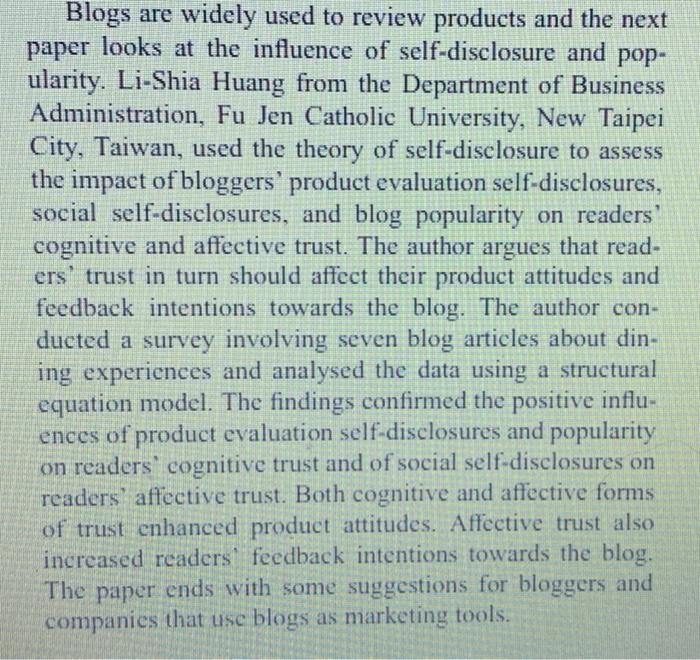
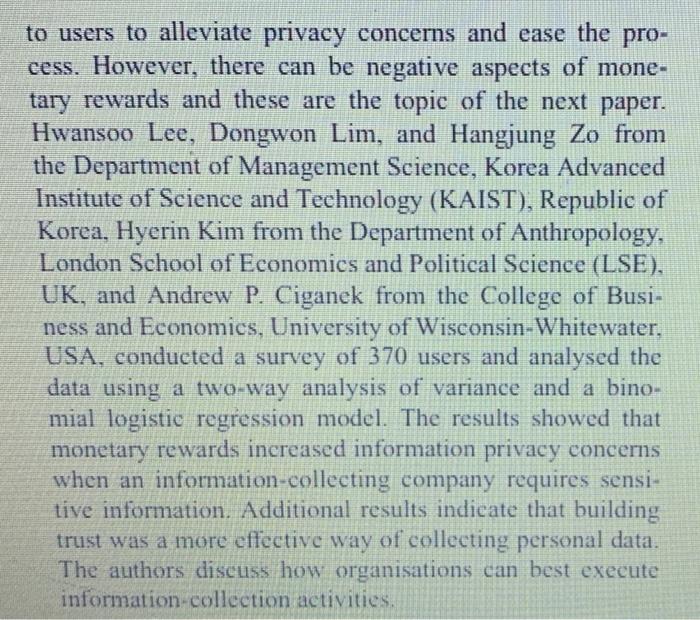
As I write this editorial for the first issue in the 34th year of Behaviour & Information Technology (BIT), we are recovering from the retail extravaganza of Black Fri- day and Cyber Monday. We import many good things into the UK from the USA, from great TV dramas such as Homeland to fast food outlets (well, my grandkids are great fans of McDonald's). However, thanks to Amazon UK, Black Friday seems to have embedded itself into the British psyche. Having been interested in retail psychol- ogy for many years, I am regularly called on by radio and newspaper journalists to explain the kinds of tricks that retailers use to make us buy more. This year, it was a BBC London radio spot, and just before I explained things like creating artificial urgency and apparent shortages to hype sales, people were interviewed shopping in Oxford Street, London's busiest shopping area. One quote really struck home to me. A reporter asked a man what he had joined a long queue to buy, expecting to be told about some great bargain he had spotted. The answer was 'I don't know but I'm sure I'll get something! The man was standing in a real bricks and mor- ' tar store', but the same psychology is at work in online retailing - possibly even more so when retailers and sup- pliers turn to social media to encourage us to feel part of a buying frenzy. As the papers in this issue remind us, e-business is no longer just part of the business scene, for many companies it is the whole business. And such busi- nesses increasingly turn to social media to keep us engaged and make us feel part of something bigger than just being a bunch of customers. Done well. such digital marketing probably does keep us loyal and encourage us to buy more. or at least to stick to our favourite retailers. But I do think that automated customer relationship management risks alienating us by failing to understand what might really be inferred from our purchasing behaviour. I have no problem with Amazon suggesting crime and mystery books that I might wish to read, as my penchant for such books is pretty obvious and I do indeed succumb to many an offer. However, although I do use Booking.com to buy hotel rooms. I find many of its suggestions irritating. In I May 2014. I travelled to Sapporo in Japan from London for an International Standards meeting. Since then. I keep get- ting offers about 'great hotels in Sapporo', which I suppose is plausible. I went there once and might want to go again. The system could not be expected to know that the next meeting of the committee was going to be in Chicago! But being on a very limited budget for such trips, I booked well in advance. From the time of booking in March until the trip in May, I received great offers for hotels in Sapporo every couple of weeks. I realise that I may be asking a lot of a recommender algorithm, but I found it very annoying. In fact, I find it sufficiently irritating that I am considering *unsubscribing' from Hotel.com. Which reminds me of another dumb system feature. Almost every time I unsubscribe from a website, I get taken to a page asking me some questions about the reasons why I am leaving so they can improve their customer expe- rience and service'. About five times out of six the first option to tick is 'I no longer wish to receive these emails'. I guess I am turning into a 'grumpy old man' but that is 1 not an answer worth giving. Of course I no longer wish to receive the emails - that is what ticking unsubscribe means! Ask me a real question. As I have said before, even rudimentary usability test- ing would reveal that such questions are pointless and irritating. Usability testing does not need to be expensive and is certainly a lot cheaper than having unusable systems in a market where your competitors are only a click away, If you think that you really cannot afford proper testing, at least read the questions you are asking users on your sys- tem out loud. If that is not enough to make such blunders clear to you, then maybe you should not be in e-business at all! a Social media are becoming increasingly important for communication between government organisations and citizens. Bob van de Velde from Communication Science, VU University Amsterdam, Albert Meijer from Utrecht University, School of Governance, and Vincent Homburg from the Faculty of Social Sciences (Public Administra- tion), Erasmus University Rotterdam, all in The Nether- lands, have developed an explanatory model of these new communication patterns. They analysed messages from 964 Dutch police force Twitter accounts using trace data drawn from the Twitter'M API to explain why certain police tweets are forwarded and others are not. Based on an iterative human calibration procedure, message topics were automatically coded based on customised lexicons. A principal component analysis of message characteristics generated four distinct patterns of use in (im)personal com- munication and new/versus reproduced content. Message characteristics were combined with user characteristics in a multilevel logistic general linear model. Their main results showed that URLs or use of informal communica- tion increases chances of message forwarding. In addition, contextual factors such as user characteristics impacted dif- fusion probability. They end with recommendations for the police and other government practitioners about how to reach a larger number of citizens through social media communications. Chang-Ping Hu, Wei-Wei Yan, and uan Hu from the School of Information Management, Center for Studies of Information Resources, Wuhan University, People's Republic of China, explored the contributions of microblogging services to user satisfaction in China. They analysed user experience on the 36 main microblogging service elements, using a sample of 216 users of Sina Weibo, the biggest microblog in China. They then used a tetra-class model to identify the contribution of each service element to overall satisfaction. Through correspon- dence analysis, they calculated the contribution to dissatis- faction when the service element was negatively evaluated and to satisfaction when it was positively evaluated. Based on these two contribution values, they classified the service elements into four categories: Basic. Secondary, Plus, and Key. In order to know the preferences of different users towards the microblogging service elements, they seg. mented users into groups according to their microblogging characteristics and personal attributes. They discuss the variations of the service, categorising among different user groups and draw some conclusions for the improvement of customised microblogging services. Blogs are widely used to review products and the next paper looks at the influence of self-disclosure and pop- ularity. Li-Shia Huang from the Department of Business Administration, Fu Jen Catholic University, New Taipei City, Taiwan, used the theory of self-disclosure to assess the impact of bloggers' product evaluation self-disclosures, social self-disclosures, and blog popularity on readers cognitive and affective trust. The author argues that read- ers' trust in turn should affect their product attitudes and feedback intentions towards the blog. The author con- ducted a survey involving seven blog articles about din- ing experiences and analysed the data using a structural equation model. The findings confirmed the positive influ- ences of product evaluation self-disclosures and popularity on readers" cognitive trust and of social self-disclosures on readers affective trust. Both cognitive and affective forms of trust enhanced product attitudes. Affective trust also increased readers feedback intentions towards the blog. The paper ends with some suggestions for bloggers and companies that use blogs as marketing tools. e-Business Many e-commerce companies collect users' personal data for marketing purposes and often offer a monetary reward to users to alleviate privacy concerns and ease the pro- cess. However, there can be negative aspects of mone- tary rewards and these are the topic of the next paper. Hwansoo Lee, Dongwon Lim, and Hangjung Zo from the Department of Management Science, Korea Advanced Institute of Science and Technology (KAIST), Republic of Korea, Hyerin Kim from the Department of Anthropology. London School of Economics and Political Science (LSE), UK, and Andrew P. Ciganek from the College of Busi- ness and Economics, University of Wisconsin-Whitewater, USA, conducted a survey of 370 users and analysed the data using a two-way analysis of variance and a bino- mial logistic regression model. The results showed that monetary rewards increased information privacy concerns when an information-collecting company requires sensi- live information. Additional results indicate that building trust was a more effective way of collecting personal data. The authors discuss how organisations can best execute information collection activities, Jung Lee from Bang College of Business, KIMEP Uni- versity, Kazakhstan, and Jae-Nam Lee from the Korea University Business School, Seoul, Korea, challenge the conventional assumption that online customers with high purchase intention routinely move to the purchase stage. They examined the process of how online customers form purchase intention and behaviour taking into account the product value distribution (PVD). Their hypothesis was that the expected product value (PVD average) determines purchase intention, whereas the actual probability of attain- ing the expected product value (PVD variance) moderates purchase behaviour. They argue that the expected prod- uct value has significance only when repeated purchase is assumed and that most consumers do not repeatedly purchase the same product in reality. Thus, they believe that the actual probability of attaining the expected prod- uct value more critically affects customer behaviour than docs its expected value. They verified their research model through a survey on 300 online mall shoppers in Korea. They report that the results confirmed the effectiveness of their model The next paper deals with the role of complaints in online shopping and their impact on customer satisfaction. Ing-Long Wu and Chi-Ying Huang from the Department of Information Management, National Chung Cheng Uni- versity, Taiwan, examined the determinants of complaint intentions in online shopping. When online consumers pur- chase products/services using web-based technologies, two major issues arise: exchange behaviour and technology use. In their study, they integrate justice perception and the expectation confirmation model (ECM) of information system continuance to understand customer satisfaction and complaint intentions. Data were collected for online consumers with negative service experiences. The results of testing the structural model indicated that distribu- tive and interactional justices significantly contributed to customer satisfaction and complaint intentions, but procedural justice did not. ECM-based features, such as perceived usefulness, were all important in determin- ing customer satisfaction and complaint intentions. The authors end with a discussion of the implications for managers and scholars. Although the prominent concept of the last decade user experience maintains its significance in diverse disciplines, especially design, its focus has changed to eliciting positive user experiences by pursuing new possibilities for consumer products rather than by solely seeking solutions to existing problems. Designers continue to aim for rich user experiences with a variety of prod- ucts, but have neglected self-service (interactive)-kiosks. Asli Gunay and Cidem Erbu from Industrial Design, Middle East Technical University, Ankara, Turkey, review the positive psychology literature and then demonstrate the dimensions of positive user experiences with self-service kiosks in an empirical study conducted on coffee vending machines and automated tellers. The final paper in this issue of BIT looks at change management within business organisations. Kwang Park from the Division of Business, Yeungnam University College, South Korea, and Chang Koh from the Depart- ment of Information Technology and Decision Sciences. University of North Texas, USA, consider the potential disruption caused by real-time information in supply chain management (SCM) systems. The authors report that their study validated the role of change management in SCM performance
SUMMARIZE YOUR FINDINGS
PLEASE MAKE COPY PASTE AVAILABLE
Step by Step Solution
There are 3 Steps involved in it
1 Expert Approved Answer
Step: 1 Unlock

Question Has Been Solved by an Expert!
Get step-by-step solutions from verified subject matter experts
Step: 2 Unlock
Step: 3 Unlock
 Study Help