



Question: PLEASE walk me through how the blue solutions are found step by step. Sincerely many Thanks! :) 3. Normalization: Given R(A,B,C,D,E) and the set of
PLEASE walk me through how the blue solutions are found step by step. Sincerely many Thanks! :)
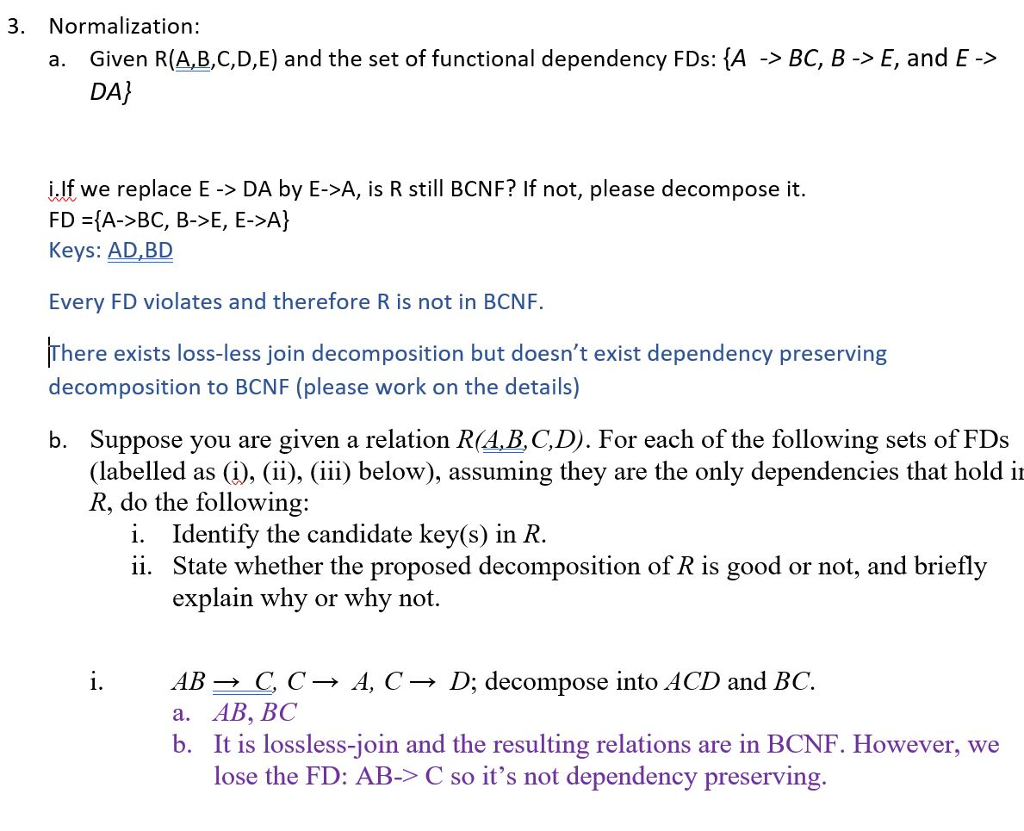
3. Normalization: Given R(A,B,C,D,E) and the set of functional dependency FDs: (A ->BC, B ->E, and E-> DAJ a. i.lf we replace E -> DA by E->A, is R still BCNF? If not, please decompose it. FD -(A->BC, B->E, E->A) Keys: AD,BD Every FD violates and therefore R is not in BCNF. here exists loss-less join decomposition but doesn't exist dependency preserving decomposition to BCNF (please work on the details) Suppose you are given a relation R(A,B, C,D). For each of the following sets of FDs (labelled as (i), (ii), (iii) below), assuming they are the only dependencies that hold i R, do the following: b. i. Identify the candidate key(s) in R ii. State whether the proposed decomposition of R is good or not, and briefly explain why or why not. AB-C. C 4, C-> D; decompose into ACD and BC. a. AB, BC b. It is lossless-join and the resulting relations are in BCNF. However, we 1. lose the FD: AB-> C so it's not dependency preserving
Step by Step Solution
There are 3 Steps involved in it

Get step-by-step solutions from verified subject matter experts