







Question: please work it all out. I do not think that part a is correct. thank you and i will leave a thumbs up. Closing Prices
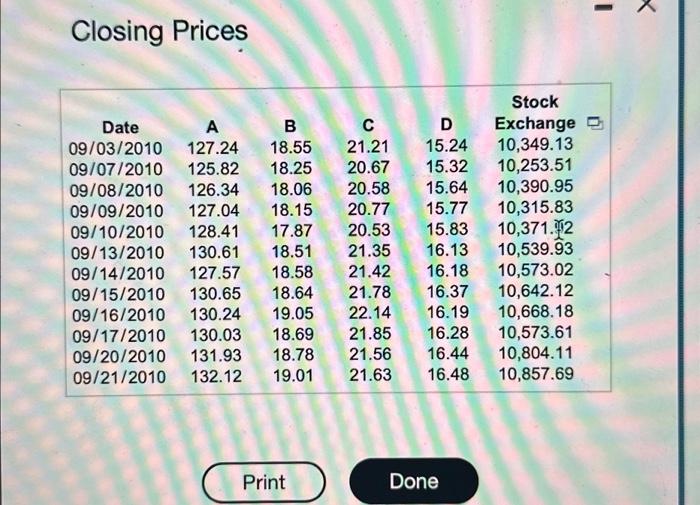
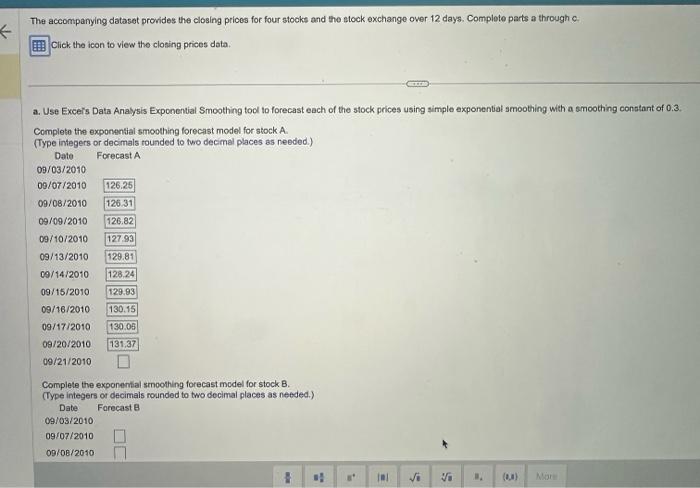
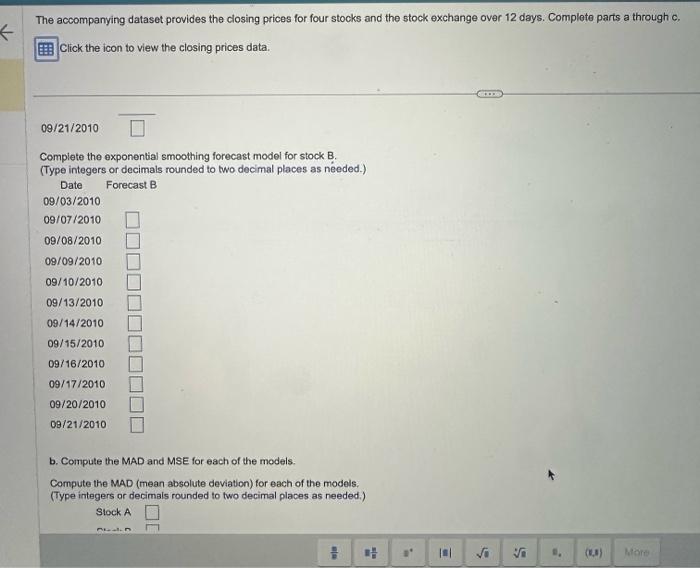
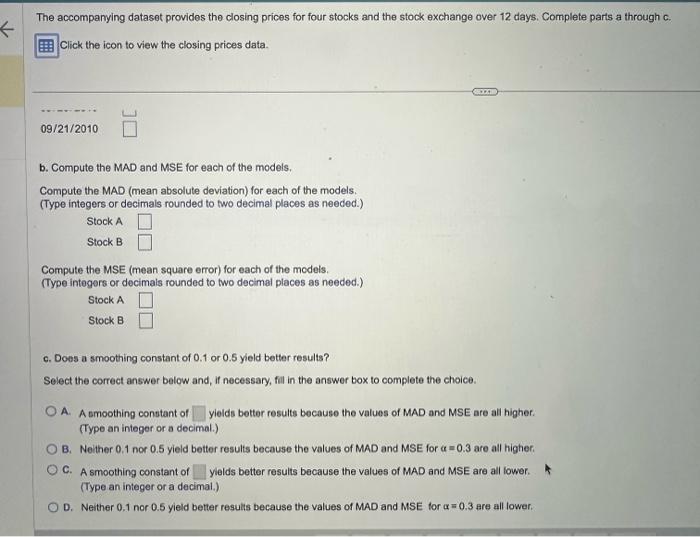
Closing Prices The accompanying dataset provides the closing prioes for four stocks and the stock exchange over 12 days, Complote parts a through c. Click the icon to view the closing prices data. a. Use Exceis Data Analysis Exponential Smoothing tool to forecast each of the stock prices using simple exponential smoothing with a smoothing constant of 0.3. Complete the exponential smoothing forecast model for stock A (Type integers or decimals tounded to two decimal places as needed.) Date Forecast A 09/03/2010 09/07/2010 09/08/2010 09/09/2010 09/10/2010 12793 09/13/2010129.81 c9/14/2010128.24 09/15/2010129.93 09/16/2010130.15 09/17/2010130.04 09/20/2010131,37 09/21/2010 Complete the exponential smoothing forecast model for stock B. (Type integers or decimals rounded to two decimal places as needed.) Date Farecast B 09/03/2010 09/07/2010 09/08/2010 The accompanying dataset provides the closing prices for four stocks and the stock exchange over 12 days. Complote parts a through c. Click the icon to view the closing prices data. 09/21/2010 Complete the exponential smoothing forecast model for stock B. (Type integers or decimals rounded to two decimal places as needed.) Date Forecast B 09/03/2010 09/07/2010 09/08/2010 09/09/2010 09/10/2010 09/13/2010 09/14/2010 09/15/2010 09/16/2010 09/17/2010 09/20/2010 09/21/2010 b. Compute the MAD and MSE for each of the models: Compute the MAD (mean absolute deviation) for each of the models. (Type integers or decimais rounded to two decimal places as needed.) Stock A The accompanying dataset provides the closing prices for four stocks and the stock exchange over 12 days. Complete parts a through c. Click the icon to view the closing prices data. 09/21/2010 b. Compute the MAD and MSE for each of the models. Compute the MAD (mean absolute deviation) for each of the models. (Type integers or decimals rounded to two decimal places as needed.) Stock A Stock B Compute the MSE (mean square error) for each of the models. (Type integers or decimals rounded to two decimal places as needed.) Stock A Stock B c. Does a smoothing constant of 0.1 or 0.5 yield better results? Select the correct answer below and, if necessary, fill in the answer box to complete the choice. A. A smoothing constant of yields better results because the values of MAD and MSE are all higher. (Type an integer or a decimal.) B. Neither 0.1 nor 0.5 yield better results because the values of MAD and MSE for =0.3 are all higher: C. A smoothing constant of yields better results because the values of MAD and MSE are all lower. (Type an integer or a decimal.) D. Neither 0.1 nor 0.5 yield better results because the values of MAD and MSE for =0.3 are all lower. Closing Prices The accompanying dataset provides the closing prioes for four stocks and the stock exchange over 12 days, Complote parts a through c. Click the icon to view the closing prices data. a. Use Exceis Data Analysis Exponential Smoothing tool to forecast each of the stock prices using simple exponential smoothing with a smoothing constant of 0.3. Complete the exponential smoothing forecast model for stock A (Type integers or decimals tounded to two decimal places as needed.) Date Forecast A 09/03/2010 09/07/2010 09/08/2010 09/09/2010 09/10/2010 12793 09/13/2010129.81 c9/14/2010128.24 09/15/2010129.93 09/16/2010130.15 09/17/2010130.04 09/20/2010131,37 09/21/2010 Complete the exponential smoothing forecast model for stock B. (Type integers or decimals rounded to two decimal places as needed.) Date Farecast B 09/03/2010 09/07/2010 09/08/2010 The accompanying dataset provides the closing prices for four stocks and the stock exchange over 12 days. Complote parts a through c. Click the icon to view the closing prices data. 09/21/2010 Complete the exponential smoothing forecast model for stock B. (Type integers or decimals rounded to two decimal places as needed.) Date Forecast B 09/03/2010 09/07/2010 09/08/2010 09/09/2010 09/10/2010 09/13/2010 09/14/2010 09/15/2010 09/16/2010 09/17/2010 09/20/2010 09/21/2010 b. Compute the MAD and MSE for each of the models: Compute the MAD (mean absolute deviation) for each of the models. (Type integers or decimais rounded to two decimal places as needed.) Stock A The accompanying dataset provides the closing prices for four stocks and the stock exchange over 12 days. Complete parts a through c. Click the icon to view the closing prices data. 09/21/2010 b. Compute the MAD and MSE for each of the models. Compute the MAD (mean absolute deviation) for each of the models. (Type integers or decimals rounded to two decimal places as needed.) Stock A Stock B Compute the MSE (mean square error) for each of the models. (Type integers or decimals rounded to two decimal places as needed.) Stock A Stock B c. Does a smoothing constant of 0.1 or 0.5 yield better results? Select the correct answer below and, if necessary, fill in the answer box to complete the choice. A. A smoothing constant of yields better results because the values of MAD and MSE are all higher. (Type an integer or a decimal.) B. Neither 0.1 nor 0.5 yield better results because the values of MAD and MSE for =0.3 are all higher: C. A smoothing constant of yields better results because the values of MAD and MSE are all lower. (Type an integer or a decimal.) D. Neither 0.1 nor 0.5 yield better results because the values of MAD and MSE for =0.3 are all lower
Step by Step Solution
There are 3 Steps involved in it

Get step-by-step solutions from verified subject matter experts
 Study Help