







Question: Please work on excel with formulas included! only work on problem 2 please Thank you! 2. Now assume that the facts in Problem 1 remain
Please work on excel with formulas included! only work on problem 2 please
Thank you!
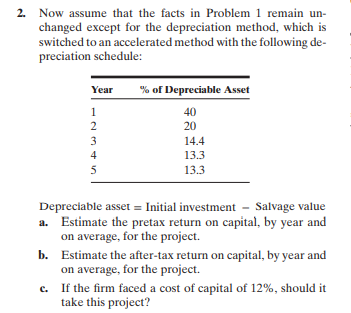
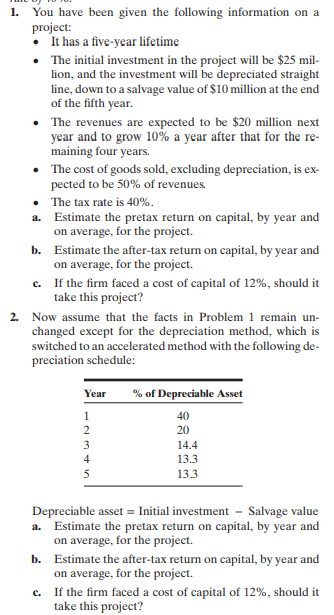
2. Now assume that the facts in Problem 1 remain un- changed except for the depreciation method, which is switched to an accelerated method with the following de- preciation schedule: Year 1 2 3 4 5 % of Depreciable Asset 40 20 14.4 13.3 13.3 Depreciable asset = Initial investment - Salvage value a. Estimate the pretax return on capital, by year and on average, for the project. b. Estimate the after-tax return on capital, by year and on average, for the project. If the firm faced a cost of capital of 12%, should it take this project? 1. You have been given the following information on a project: It has a five-year lifetime The initial investment in the project will be $25 mil- lion, and the investment will be depreciated straight line, down to a salvage value of $10 million at the end of the fifth year. The revenues are expected to be $20 million next year and to grow 10% a year after that for the re- maining four years. The cost of goods sold, excluding depreciation, is ex- pected to be 50% of revenues. The tax rate is 40%. a. Estimate the pretax return on capital, by year and on average, for the project. b. Estimate the after-tax return on capital, by year and on average, for the project. c. If the firm faced a cost of capital of 12%, should it take this project? 2. Now assume that the facts in Problem 1 remain un- changed except for the depreciation method, which is switched to an accelerated method with the following de- preciation schedule: Year 1 2 3 4 5 % of Depreciable Asset 40 20 14.4 13.3 13.3 Depreciable asset = Initial investment - Salvage value a. Estimate the pretax return on capital, by year and on average, for the project. b. Estimate the after-tax return on capital, by year and on average, for the project. c. If the firm faced a cost of capital of 12%, should it take this project? 2. Now assume that the facts in Problem 1 remain un- changed except for the depreciation method, which is switched to an accelerated method with the following de- preciation schedule: Year 1 2 3 4 5 % of Depreciable Asset 40 20 14.4 13.3 13.3 Depreciable asset = Initial investment - Salvage value a. Estimate the pretax return on capital, by year and on average, for the project. b. Estimate the after-tax return on capital, by year and on average, for the project. If the firm faced a cost of capital of 12%, should it take this project? 1. You have been given the following information on a project: It has a five-year lifetime The initial investment in the project will be $25 mil- lion, and the investment will be depreciated straight line, down to a salvage value of $10 million at the end of the fifth year. The revenues are expected to be $20 million next year and to grow 10% a year after that for the re- maining four years. The cost of goods sold, excluding depreciation, is ex- pected to be 50% of revenues. The tax rate is 40%. a. Estimate the pretax return on capital, by year and on average, for the project. b. Estimate the after-tax return on capital, by year and on average, for the project. c. If the firm faced a cost of capital of 12%, should it take this project? 2. Now assume that the facts in Problem 1 remain un- changed except for the depreciation method, which is switched to an accelerated method with the following de- preciation schedule: Year 1 2 3 4 5 % of Depreciable Asset 40 20 14.4 13.3 13.3 Depreciable asset = Initial investment - Salvage value a. Estimate the pretax return on capital, by year and on average, for the project. b. Estimate the after-tax return on capital, by year and on average, for the project. c. If the firm faced a cost of capital of 12%, should it take this project
Step by Step Solution
There are 3 Steps involved in it

Get step-by-step solutions from verified subject matter experts
 Study Help