







Question: Please work this with Python The human body has a surface area of2m2, and the surface temperature of bare skinis 32C (The area of the
Please work this with Python
The human body has a surface area of2m2, and the surface temperature of bare skinis 32C (The area of the human body is presented just as a cool information, you wont useit to solve the following items. However, you MUST be careful with units (mandm)).
a. Given the emissivity of the human body is= 0.97, what is our radiant exitance (orradiance integrated across all angles) inW/m2?
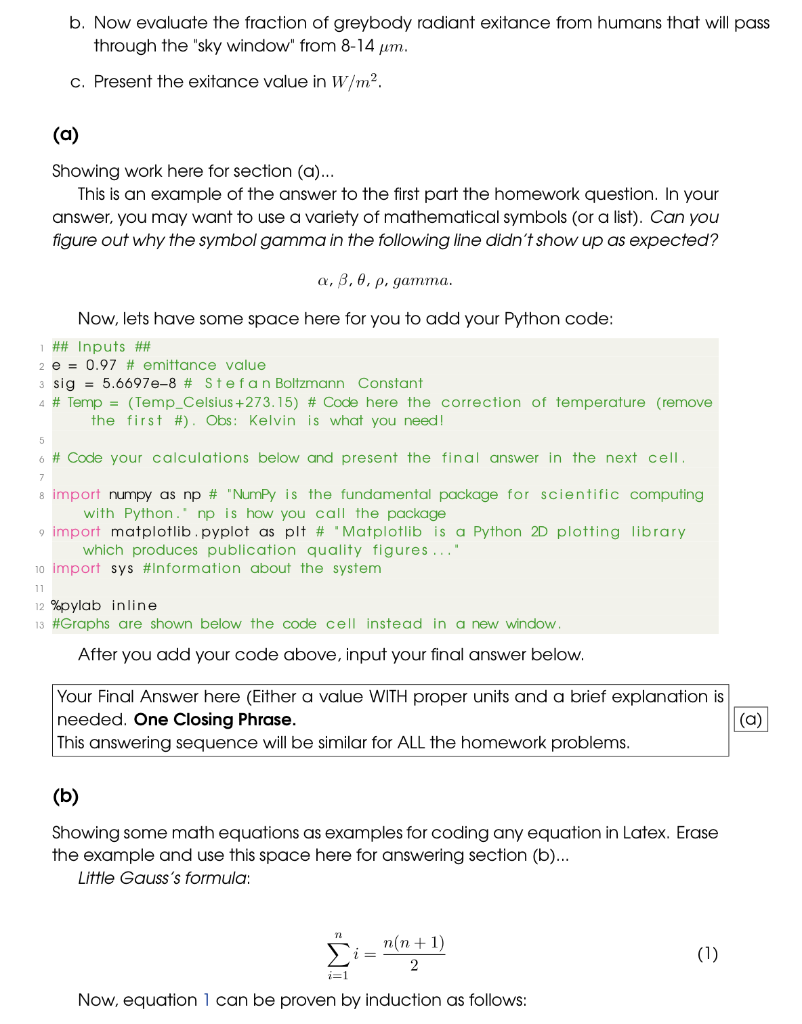
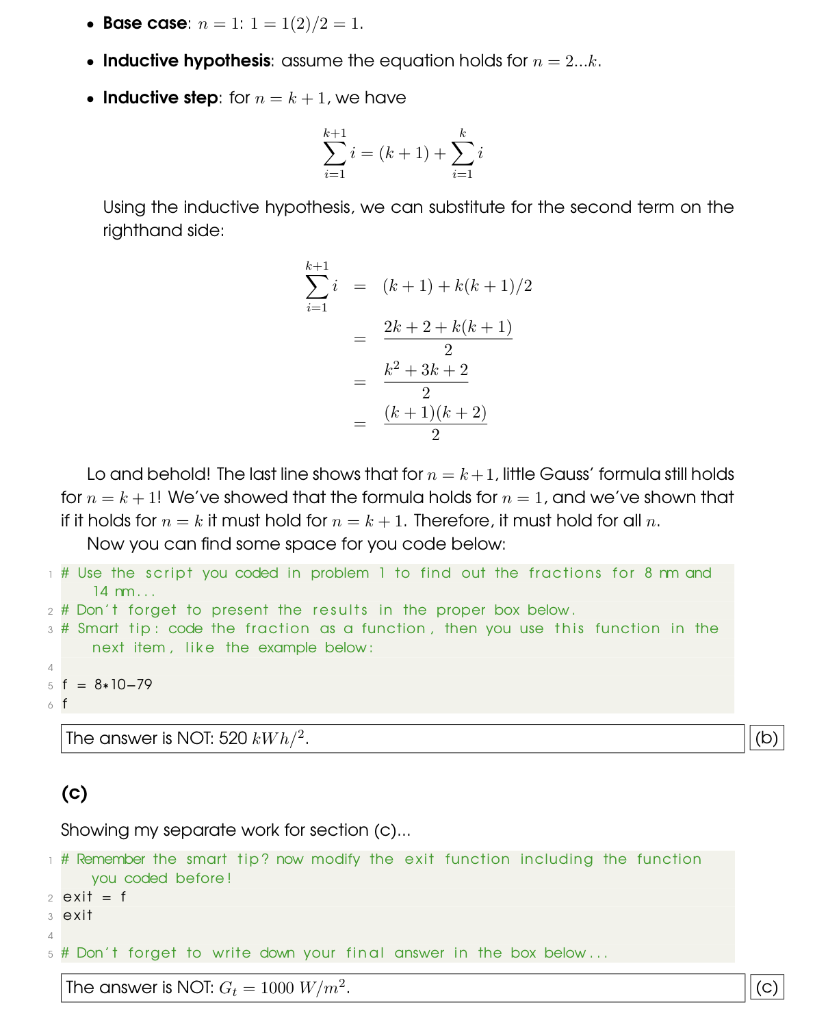
b. Now evaluate the fraction of greybody radiant exitance from humans that will pass through the "sky window" from 8-14 um. c. Present the exitance value in W/m. (a) Showing work here for section (a)... This is an example of the answer to the first part the homework question. In your answer, you may want to use a variety of mathematical symbols (or a list). Can you figure out why the symbol gamma in the following line didn't show up as expected? ax, 8, 9, p. gamma. Now, lets have some space here for you to add your Python code: 1 ## Inputs ## 2 = 0.97 # emittance value 3 sig = 5.6697e-8 # Stefan Boltzmann Constant 4 # Temp = (Temp_Celsius +273.15) # Code here the correction of temperature (remove the first #). Obs: Kelvin is what you need! 6 # Code your calculations below and present the final answer in the next cell. 8 import numpy as np # "Numpy is the fundamental package for scientific computing with Python. np is how you call the package 9 import matplotlib.pyplot as plt # "Matplotlib is a Python 2D plotting library which produces publication quality figures..." 10 import sys #Information about the system 11 12 %pylab inline 13 #Graphs are shown below the code cell instead in a new window. After you add your code above, input your final answer below. Your Final Answer here (Either a value WITH proper units and a brief explanation is needed. One Closing Phrase. (a) This answering sequence will be similar for ALL the homework problems. (b) Showing some math equations as examples for coding any equation in Latex. Erase the example and use this space here for answering section (b)... Little Gauss's formula: i= n(n+1) (1) 2 i=1 Now, equation 1 can be proven by induction as follows: Base case: n=1: 1 = 1(2)/2 = 1. Inductive hypothesis: assume the equation holds for n = 2...k. Inductive step: for n=k+1, we have k+1 Si =(k+1) + i=1 ll Using the inductive hypothesis, we can substitute for the second term on the righthand side: k+1 (k + 1) + kk +1)/2 i=1 2k +2+k(k+1) 2 k2 + 3k + 2 2 (k+1)(k+2) 2 Lo and behold! The last line shows that for n=k+1, little Gauss' formula still holds for n=k+1! We've showed that the formula holds for n = 1, and we've shown that if it holds for n=k it must hold for n=k+1. Therefore, it must hold for all n. Now you can find some space for you code below: 1 # Use the script you coded in problem 1 to find out the fractions for 8 mm and 14 nm... 2 # Don't forget to present the results in the proper box below. 3 # Smart tip: code the fraction as a function, then you use this function in the next item, like the example below: 4 5 f = 8:10-79 The answer is NOT: 520 kWh/2 (b) Showing my separate work for section (c)... 1 # Remember the smart tip? now modify the exit function including the function you coded before ! 2 exit = f 3 exit 4 5 # Don't forget to write down your final answer in the box below... The answer is NOT: G = 1000 W/m2 (c)
Step by Step Solution
There are 3 Steps involved in it

Get step-by-step solutions from verified subject matter experts
 Study Help