







Question: Please write a 1 1/2 to 2 page typed case analysis based on depth, content, and format. WILL CHECK FOR Plagiarism Chapter 16, Problem 1CA
Please write a 1 1/2 to 2 page typed case analysis based on depth, content, and format. WILL CHECK FOR Plagiarism 
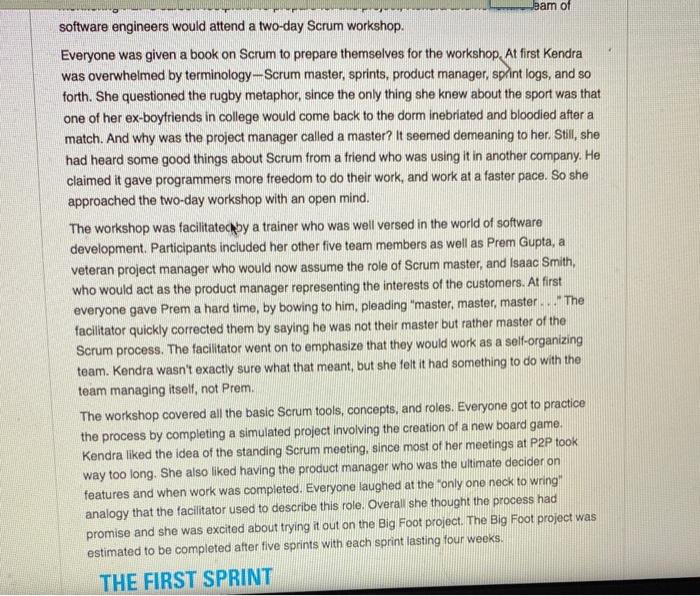
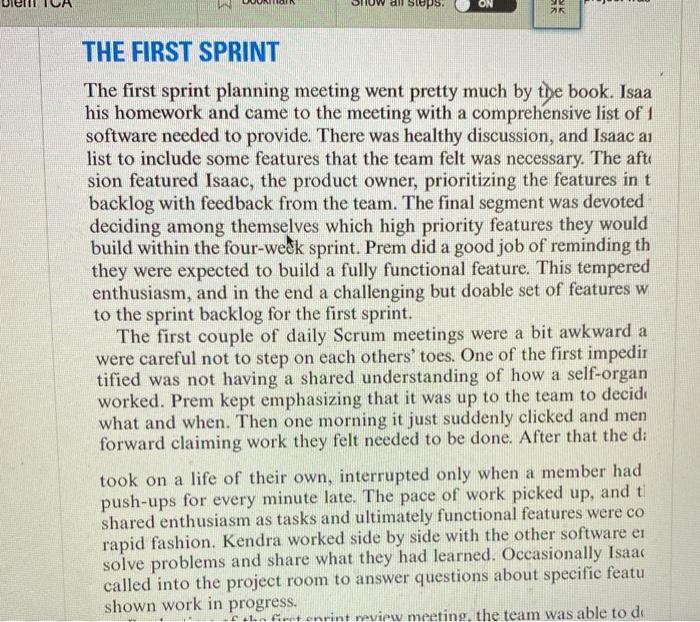
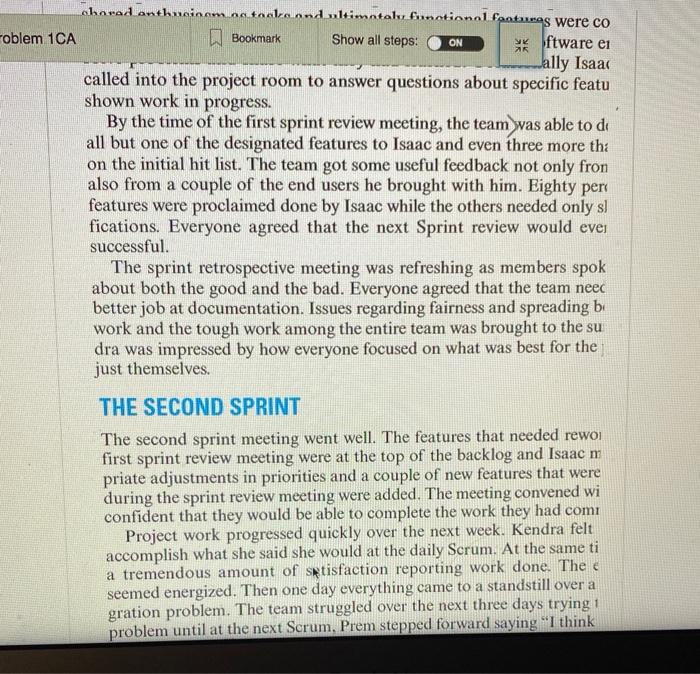
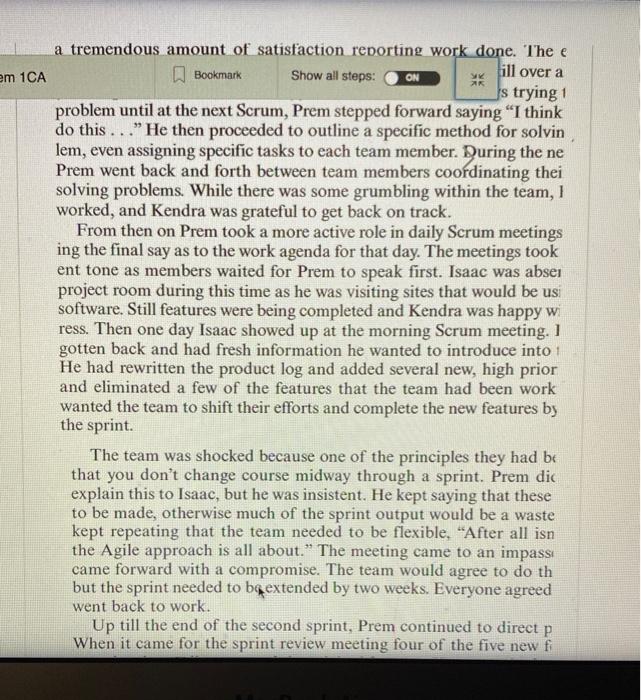
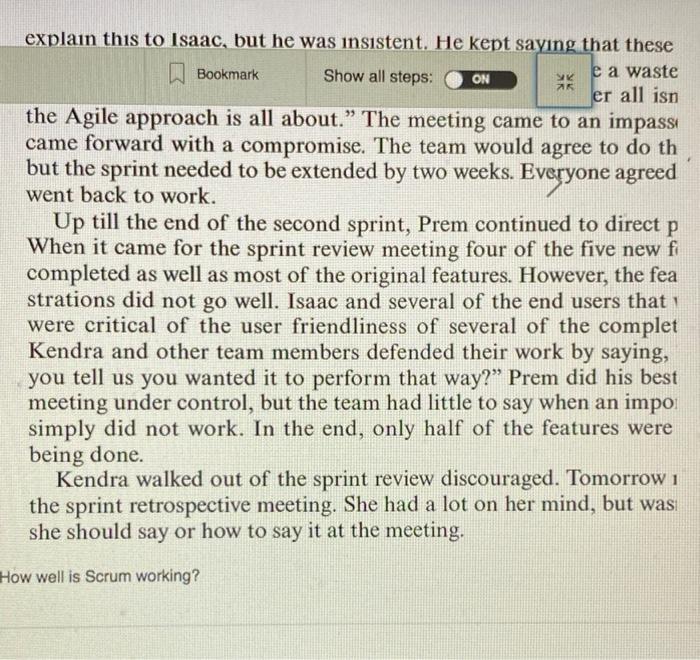
Chapter 16, Problem 1CA Bookmark Show all steps: ON Introducing Scrum at P2P PART A Kendra Hua had worked for six years as a software engineer in the IT department at Point 2 Point (P2P), a large freight movileg company. She liked her job and the people she worked with. While she did some maintenance work, she worked primarily on projects, usually full time. Her work covered a wide range of projects including system upgrades, inventory control, GPS tracking, billing, and customer databases. These projects were typically able to meet project requirements but were consistently late. Within the IT department it was common practice for a betting pool to emerge regarding completion dates. The rule of thumb was to take the original schedule and multiply it by 1.5 and start guessing from then on. Management decided to try to turn things around by changing the way P2P completed IT projects. Instead of the traditional waterfall approach in which all the requirements were defined upfront, the IT department was to start using Agile project management, and more specifically Scrum, to complete their projects. Kendra had just been assigned to the Big Foot project, which involved developing a system for monitoring P2P's carbon footprint. To prepare for this project, Kendra and her entire team of software engineers would attend a two-day Scrum workshop. Jeam of software engineers would attend a two-day Scrum workshop. Everyone was given a book on Scrum to prepare themselves for the workshop. At first Kendra was overwhelmed by terminology-Scrum master, sprints, product manager, sprint logs, and so forth. She questioned the rugby metaphor, since the only thing she knew about the sport was that one of her ex-boyfriends in college would come back to the dorm inebriated and bloodied after a match. And why was the project manager called a master? It seemed demeaning to her. Still, she had heard some good things about Scrum from a friend who was using it in another company. He claimed it gave programmers more freedom to do their work, and work at a faster pace. So she approached the two-day workshop with an open mind. The workshop was facilitated by a trainer who was well versed in the world of software development. Participants included her other five team members as well as Prem Gupta, a veteran project manager who would now assume the role of Scrum master, and Isaac Smith, who would act as the product manager representing the interests of the customers. At first everyone gave Prem a hard time, by bowing to him, pleading "master, master, master .... The facilitator quickly corrected them by saying he was not their master but rather master of the Scrum process. The facilitator went on to emphasize that they would work as a self-organizing team. Kendra wasn't exactly sure what that meant, but she felt it had something to do with the team managing itself, not Prem. The workshop covered all the basic Serum tools, concepts, and roles. Everyone got to practice the process by completing a simulated project involving the creation of a new board game. Kendra liked the idea of the standing Scrum meeting, since most of her meetings at P2P took way too long. She also liked having the product manager who was the ultimate decider on features and when work was completed. Everyone laughed at the only one neck to wring" analogy that the facilitator used to describe this role. Overal she thought the process had promise and she was excited about trying it out on the Big Foot project. The Big Foot project was estimated to be completed after five sprints with each sprint lasting four weeks. THE FIRST SPRINT all steps. AK THE FIRST SPRINT The first sprint planning meeting went pretty much by the book. Isaa his homework and came to the meeting with a comprehensive list of 1 software needed to provide. There was healthy discussion, and Isaac ai list to include some features that the team felt was necessary. The afte sion featured Isaac, the product owner, prioritizing the features in t backlog with feedback from the team. The final segment was devoted deciding among themselves which high priority features they would build within the four-wedk sprint. Prem did a good job of reminding th they were expected to build a fully functional feature. This tempered enthusiasm, and in the end a challenging but doable set of features w to the sprint backlog for the first sprint. The first couple of daily Scrum meetings were a bit awkward a were careful not to step on each others toes. One of the first impedir tified was not having a shared understanding of how a self-organ worked. Prem kept emphasizing that it was up to the team to decide what and when. Then one morning it just suddenly clicked and men forward claiming work they felt needed to be done. After that the di took on a life of their own, interrupted only when a member had push-ups for every minute late. The pace of work picked up, and t shared enthusiasm as tasks and ultimately functional features were co rapid fashion. Kendra worked side by side with the other software er solve problems and share what they had learned. Occasionally Isaac called into the project room to answer questions about specific featu shown work in progress. Lo first onrint review meeting the team was able to do obrad ON AK winom os tooko onda.ltimntal functional footaures were co oblem 1CA Bookmark Show all steps: ftware ei Jally Isaac called into the project room to answer questions about specific featu shown work in progress. By the time of the first sprint review meeting, the team was able to de all but one of the designated features to Isaac and even three more tha on the initial hit list. The team got some useful feedback not only fron also from a couple of the end users he brought with him. Eighty pery features were proclaimed done by Isaac while the others needed only s fications. Everyone agreed that the next Sprint review would ever successful. The sprint retrospective meeting was refreshing as members spok about both the good and the bad. Everyone agreed that the team neec better job at documentation. Issues regarding fairness and spreading be work and the tough work among the entire team was brought to the su dra was impressed by how everyone focused on what was best for the just themselves. THE SECOND SPRINT The second sprint meeting went well. The features that needed rewoi first sprint review meeting were at the top of the backlog and Isaac m priate adjustments in priorities and a couple of new features that were during the sprint review meeting were added. The meeting convened wi confident that they would be able to complete the work they had com Project work progressed quickly over the next week. Kendra felt accomplish what she said she would at the daily Scrum. At the same ti a tremendous amount of sptisfaction reporting work done. The e seemed energized. Then one day everything came to a standstill over a gration problem. The team struggled over the next three days trying 1 problem until at the next Scrum. Prem stepped forward saying "I think ON AK a tremendous amount of satisfaction reporting work done. The e em 1CA Bookmark Jill over a Show all steps: is trying 1 problem until at the next Scrum, Prem stepped forward saying I think do this..." He then proceeded to outline a specific method for solvin lem, even assigning specific tasks to each team member. During the ne Prem went back and forth between team members coordinating thei solving problems. While there was some grumbling within the team, 1 worked, and Kendra was grateful to get back on track. From then on Prem took a more active role in daily Scrum meetings ing the final say as to the work agenda for that day. The meetings took ent tone as members waited for Prem to speak first. Isaac was absei project room during this time as he was visiting sites that would be usi software. Still features were being completed and Kendra was happy wi ress. Then one day Isaac showed up at the morning Scrum meeting. I gotten back and had fresh information he wanted to introduce into 1 He had rewritten the product log and added several new, high prior and eliminated a few of the features that the team had been work wanted the team to shift their efforts and complete the new features by the sprint. The team was shocked because one of the principles they had be that you don't change course midway through a sprint. Prem die explain this to Isaac, but he was insistent. He kept saying that these to be made, otherwise much of the sprint output would be a waste kept repeating that the team needed to be flexible, "After all isn the Agile approach is all about." The meeting came to an impassi came forward with a compromise. The team would agree to do th but the sprint needed to be extended by two weeks. Everyone agreed went back to work. Up till the end of the second sprint, Prem continued to direct p When it came for the sprint review meeting four of the five new fi ON explain this to Isaac, but he was insistent. He kept saying that these Bookmark Show all steps: e a waste er all isn the Agile approach is all about. The meeting came to an impassi came forward with a compromise. The team would agree to do th but the sprint needed to be extended by two weeks. Everyone agreed went back to work. Up till the end of the second sprint, Prem continued to direct p When it came for the sprint review meeting four of the five new fi completed as well as most of the original features. However, the fea strations did not go well. Isaac and several of the end users that were critical of the user friendliness of several of the complet Kendra and other team members defended their work by saying, you tell us you wanted it to perform that way?" Prem did his best meeting under control, but the team had little to say when an impo. simply did not work. In the end, only half of the features were being done. Kendra walked out of the sprint review discouraged. Tomorrow 1 the sprint retrospective meeting. She had a lot on her mind, but was she should say or how to say it at the meeting. a How well is Scrum working
Step by Step Solution
There are 3 Steps involved in it
1 Expert Approved Answer
Step: 1 Unlock

Question Has Been Solved by an Expert!
Get step-by-step solutions from verified subject matter experts
Step: 2 Unlock
Step: 3 Unlock
 Study Help