







Question: Please write a clear and straight to the point answer. Thank you Questions 1-6 are based on the following case Littlefield Laboratories, LLC (LL) provides
Please write a clear and straight to the point answer. Thank you 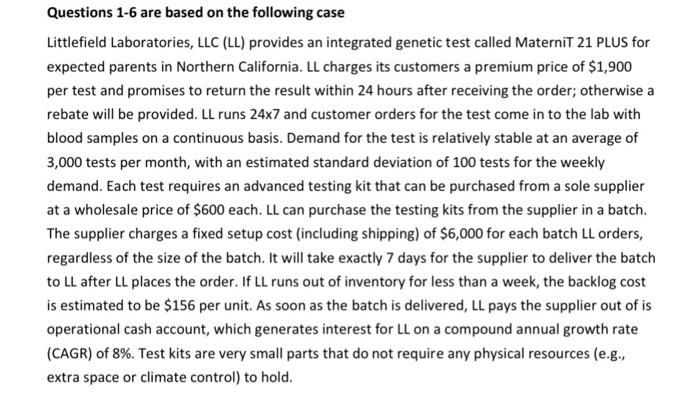
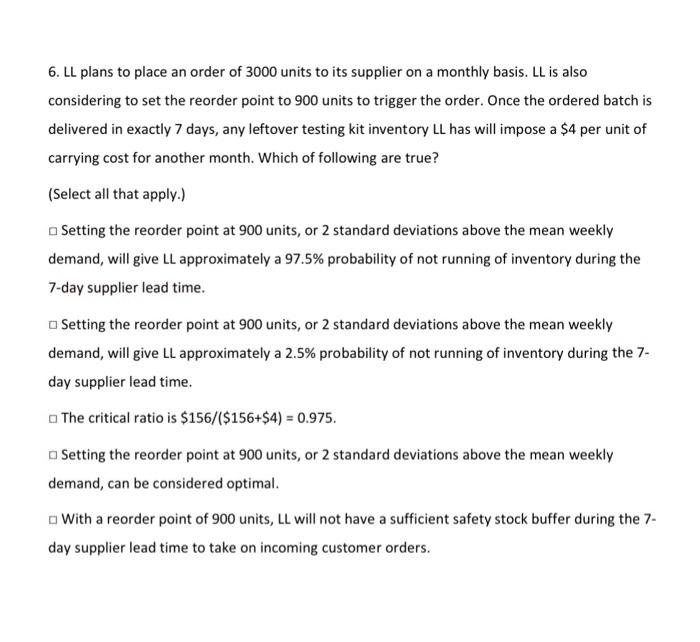
Questions 1-6 are based on the following case Littlefield Laboratories, LLC (LL) provides an integrated genetic test called Maternit 21 PLUS for expected parents in Northern California. LL charges its customers a premium price of $1,900 per test and promises to return the result within 24 hours after receiving the order; otherwise a rebate will be provided. LL runs 24x7 and customer orders for the test come in to the lab with blood samples on a continuous basis. Demand for the test is relatively stable at an average of 3,000 tests per month, with an estimated standard deviation of 100 tests for the weekly demand. Each test requires an advanced testing kit that can be purchased from a sole supplier at a wholesale price of $600 each. LL can purchase the testing kits from the supplier in a batch. The supplier charges a fixed setup cost (including shipping) of $6,000 for each batch LL orders, regardless of the size of the batch. It will take exactly 7 days for the supplier to deliver the batch to LL after LL places the order. If LL runs out of inventory for less than a week, the backlog cost is estimated to be $156 per unit. As soon as the batch is delivered, LL pays the supplier out of is operational cash account, which generates interest for LL on a compound annual growth rate (CAGR) of 8%. Test kits are very small parts that do not require any physical resources (e.g., extra space or climate control) to hold. 6. LL plans to place an order of 3000 units to its supplier on a monthly basis. LL is also considering to set the reorder point to 900 units to trigger the order. Once the ordered batch is delivered in exactly 7 days, any leftover testing kit inventory LL has will impose a $4 per unit of carrying cost for another month. Which of following are true? (Select all that apply.) Setting the reorder point at 900 units, or 2 standard deviations above the mean weekly demand, will give LL approximately a 97.5% probability of not running of inventory during the 7-day supplier lead time. Setting the reorder point at 900 units, or 2 standard deviations above the mean weekly demand, will give LL approximately a 2.5% probability of not running of inventory during the 7- day supplier lead time. The critical ratio is $156/($156+$4) = 0.975. Setting the reorder point at 900 units, or 2 standard deviations above the mean weekly demand, can be considered optimal. With a reorder point of 900 units, LL will not have a sufficient safety stock buffer during the 7- day supplier lead time to take on incoming customer orders Step by Step Solution
There are 3 Steps involved in it
1 Expert Approved Answer
Step: 1 Unlock

Question Has Been Solved by an Expert!
Get step-by-step solutions from verified subject matter experts
Step: 2 Unlock
Step: 3 Unlock
 Study Help