Question: Please write a closed-research legal memo using the case cases given, addressing whether Mr. Adler can assert an adverse possession claim to Scrub Lot 40.
Please write a closed-research legal memo using the case cases given, addressing whether Mr. Adler can assert an adverse possession claim to Scrub Lot 40. Please write up your memo using the issue, brief answer, statement of facts, discussion, conclusion format. In the discussion section, make sure identify the elements required to prove adverse possession and make references to Coward v. Hunto, Franklin Oil Company v. Herder and Eves v. Amicableidentify the elements required to prove adverse possession and reference. Then, for each element of adverse possession, clearly explain how Mr. Adler has (or hasn't) satisfied that element and any opposing arguments that may exist.
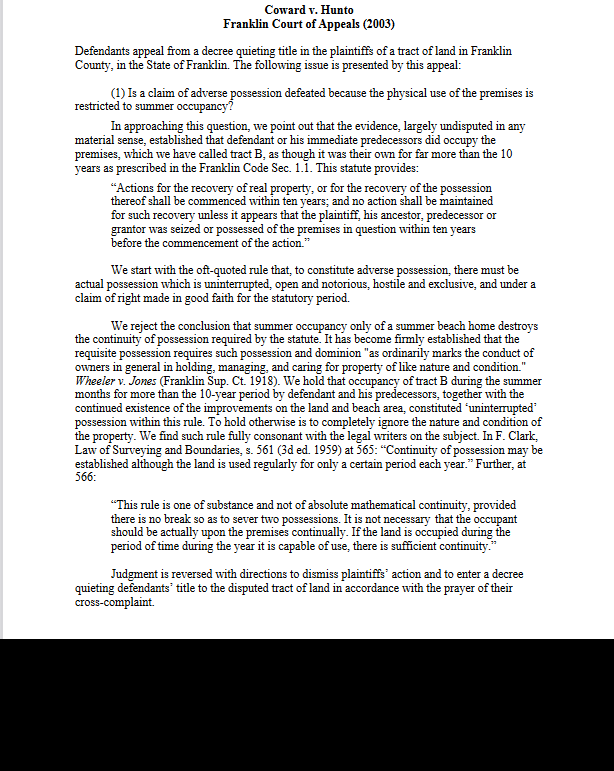
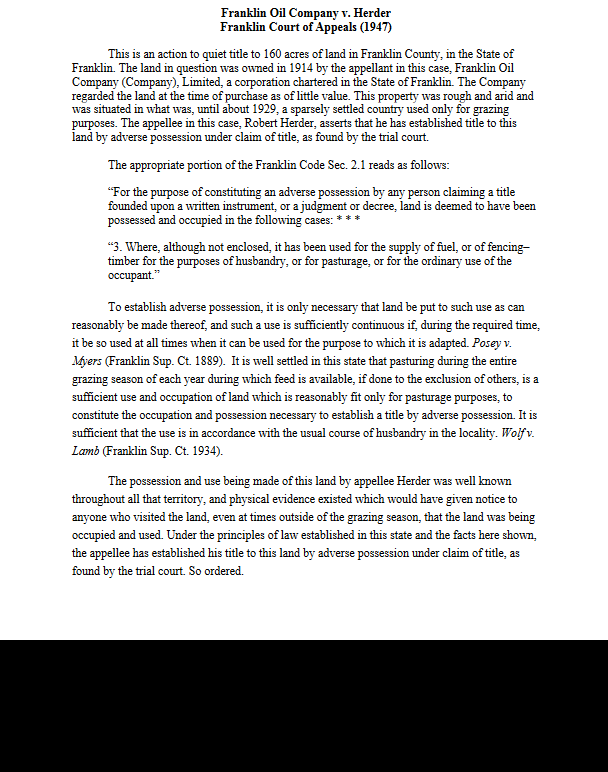
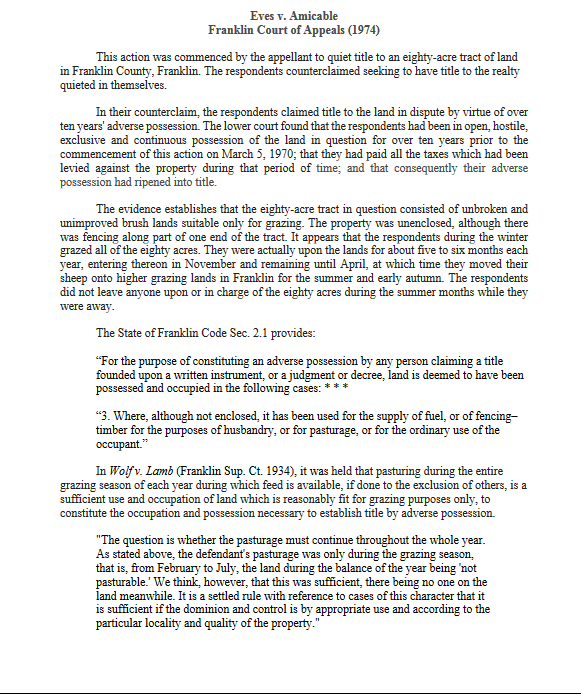
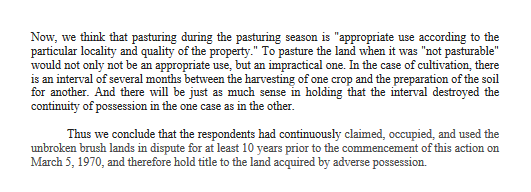
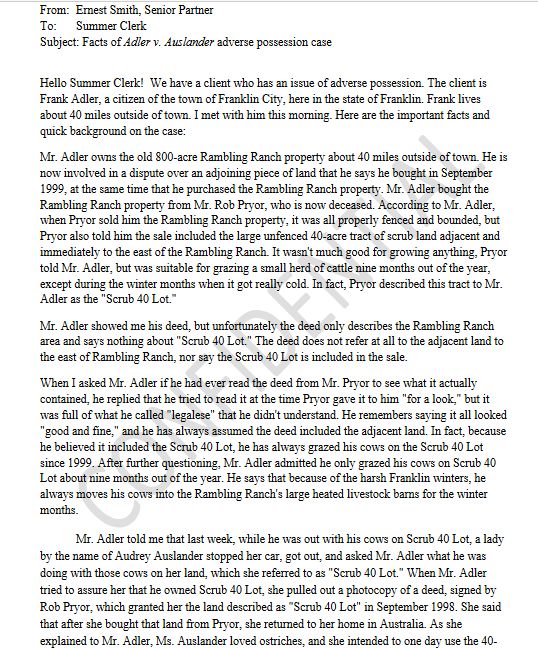
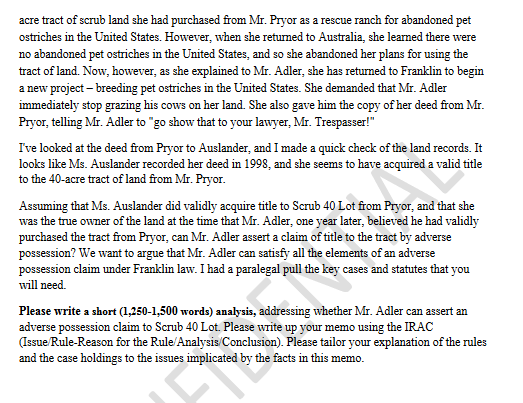
Coward v. Hunto Franklin Court of Appeals (2003) Defendants appeal from a decree quieting title in the plaintiffs of a tract of land in Franklin County, in the State of Franklin. The following issue is presented by this appeal: (1) Is a claim of adverse possession defeated because the physical use of the premises is restricted to summer occupancy? In approaching this question, we point out that the evidence, largely undisputed in any material sense, established that defendant or his immediate predecessors did occupy the premises, which we have called tract B, as though it was their own for far more than the 10 years as prescribed in the Franklin Code Sec. 1.1. This statute provides: "Actions for the recovery of real property, or for the recovery of the possession thereof shall be commenced within ten years; and no action shall be maintained for such recovery unless it appears that the plaintiff, his ancestor, predecessor or grantor was seized or possessed of the premises in question within ten years before the commencement of the action. We start with the oft-quoted rule that, to constitute adverse possession, there must be actual possession which is uninterrupted, open and notorious, hostile and exclusive, and under a claim of right made in good faith for the statutory period We reject the conclusion that summer occupancy only of a summer beach home destroys the continuity of possession required by the statute. It has become firmly established that the requisite possession requires such possession and dominion "as ordinarily marks the conduct of owners in general in holding, managing, and caring for property of like nature and condition." Wheeler v. Jones (Franklin Sup. Ct. 1918). We hold that occupancy of tract B during the summer months for more than the 10-year period by defendant and his predecessors, together with the continued existence of the improvements on the land and beach area, constituted 'uninterrupted' possession within this rule. To hold otherwise is to completely ignore the nature and condition of the property. We find such rule fully consonant with the legal writers on the subject. In F. Clark, Law of Surveying and Boundaries, s. 561 (3d ed. 1959) at 565: "Continuity of possession may be established although the land is used regularly for only a certain period each year." Further, at 566: "This rule is one of substance and not of absolute mathematical continuity, provided there is no break so as to sever two possessions. It is not necessary that the occupant should be actually upon the premises continually. If the land is occupied during the period of time during the year it is capable of use, there is sufficient continuity." Judgment is reversed with directions to dismiss plaintiffs' action and to enter a decree quieting defendants' title to the disputed tract of land in accordance with the prayer of their cross-complaint.Franklin Oil Company v. Herder Franklin Court of Appeals (1947) This is an action to quiet title to 160 acres of land in Franklin County, in the State of Franklin. The land in question was owned in 1914 by the appellant in this case, Franklin Oil Company (Company), Limited, a corporation chartered in the State of Franklin. The Company regarded the land at the time of purchase as of little value. This property was rough and arid and was situated in what was, until about 1929, a sparsely settled country used only for grazing purposes. The appellee in this case, Robert Herder, asserts that he has established title to this land by adverse possession under claim of title, as found by the trial court. The appropriate portion of the Franklin Code Sec. 2.1 reads as follows: "For the purpose of constituting an adverse possession by any person claiming a title founded upon a written instrument, or a judgment or decree, land is deemed to have been possessed and occupied in the following cases: * * * "3. Where, although not enclosed, it has been used for the supply of fuel, or of fencing- timber for the purposes of husbandry, or for pasturage, or for the ordinary use of the occupant." To establish adverse possession, it is only necessary that land be put to such use as can reasonably be made thereof, and such a use is sufficiently continuous if, during the required time, it be so used at all times when it can be used for the purpose to which it is adapted. Posey v. Myers (Franklin Sup. Ct. 1889). It is well settled in this state that pasturing during the entire grazing season of each year during which feed is available, if done to the exclusion of others, is a sufficient use and occupation of land which is reasonably fit only for pasturage purposes, to constitute the occupation and possession necessary to establish a title by adverse possession. It is sufficient that the use is in accordance with the usual course of husbandry in the locality. Wolfv. Lamb (Franklin Sup. Ct. 1934). The possession and use being made of this land by appellee Herder was well known throughout all that territory, and physical evidence existed which would have given notice to anyone who visited the land, even at times outside of the grazing season, that the land was being occupied and used. Under the principles of law established in this state and the facts here shown, the appellee has established his title to this land by adverse possession under claim of title, as found by the trial court. So ordered.Eves v. Amicable Franklin Court of Appeals (1974) This action was commenced by the appellant to quiet title to an eighty-acre tract of land in Franklin County, Franklin. The respondents counterclaimed seeking to have title to the realty quieted in themselves. In their counterclaim, the respondents claimed title to the land in dispute by virtue of over ten years' adverse possession. The lower court found that the respondents had been in open, hostile, exclusive and continuous possession of the land in question for over ten years prior to the commencement of this action on March 5, 1970; that they had paid all the taxes which had been levied against the property during that period of time; and that consequently their adverse possession had ripened into title. The evidence establishes that the eighty-acre tract in question consisted of unbroken and unimproved brush lands suitable only for grazing. The property was unenclosed, although there was fencing along part of one end of the tract. It appears that the respondents during the winter grazed all of the eighty acres. They were actually upon the lands for about five to six months each year, entering thereon in November and remaining until April, at which time they moved their sheep onto higher grazing lands in Franklin for the summer and early autumn. The respondents did not leave anyone upon or in charge of the eighty acres during the summer months while they were away. The State of Franklin Code Sec. 2.1 provides: "For the purpose of constituting an adverse possession by any person claiming a title founded upon a written instrument, or a judgment or decree, land is deemed to have been possessed and occupied in the following cases: * * * "3. Where, although not enclosed, it has been used for the supply of fuel, or of fencing- timber for the purposes of husbandry, or for pasturage, or for the ordinary use of the occupant." In Wolf v. Lamb (Franklin Sup. Ct. 1934), it was held that pasturing during the entire grazing season of each year during which feed is available, if done to the exclusion of others, is a sufficient use and occupation of land which is reasonably fit for grazing purposes only, to constitute the occupation and possession necessary to establish title by adverse possession. "The question is whether the pasturage must continue throughout the whole year. As stated above, the defendant's pasturage was only during the grazing season, that is, from February to July, the land during the balance of the year being 'not pasturable.' We think, however, that this was sufficient, there being no one on the land meanwhile. It is a settled rule with reference to cases of this character that it is sufficient if the dominion and control is by appropriate use and according to the particular locality and quality of the property."Now, we think that pasturing during the pasturing season is "appropriate use according to the particular locality and quality of the property." To pasture the land when it was "not pasturable" would not only not be an appropriate use, but an impractical one. In the case of cultivation, there is an interval of several months between the harvesting of one crop and the preparation of the soil for another. And there will be just as much sense in holding that the interval destroyed the continuity of possession in the one case as in the other. Thus we conclude that the respondents had continuously claimed, occupied, and used the unbroken brush lands in dispute for at least 10 years prior to the commencement of this action on March 5, 1970, and therefore hold title to the land acquired by adverse possession.From: Ernest Smith, Senior Partner To: Summer Clerk Subject: Facts of Adler v. Auslander adverse possession case Hello Summer Clerk! We have a client who has an issue of adverse possession. The client is Frank Adler, a citizen of the town of Franklin City, here in the state of Franklin. Frank lives about 40 miles outside of town. I met with him this morning. Here are the important facts and quick background on the case: Mr. Adler owns the old 800-acre Rambling Ranch property about 40 miles outside of town. He is now involved in a dispute over an adjoining piece of land that he says he bought in September 1999, at the same time that he purchased the Rambling Ranch property. Mr. Adler bought the Rambling Ranch property from Mr. Rob Pryor, who is now deceased. According to Mr. Adler, when Pryor sold him the Rambling Ranch property, it was all properly fenced and bounded, but Pryor also told him the sale included the large unfenced 40-acre tract of scrub land adjacent and immediately to the east of the Rambling Ranch. It wasn't much good for growing anything, Pryor told Mr. Adler, but was suitable for grazing a small herd of cattle nine months out of the year, except during the winter months when it got really cold. In fact, Pryor described this tract to Mr. Adler as the "Scrub 40 Lot." Mr. Adler showed me his deed, but unfortunately the deed only describes the Rambling Ranch area and says nothing about "Scrub 40 Lot." The deed does not refer at all to the adjacent land to the east of Rambling Ranch, nor say the Scrub 40 Lot is included in the sale. When I asked Mr. Adler if he had ever read the deed from Mr. Pryor to see what it actually contained, he replied that he tried to read it at the time Pryor gave it to him "for a look, " but it was full of what he called "legalese" that he didn't understand. He remembers saying it all looked "good and fine," and he has always assumed the deed included the adjacent land. In fact, because he believed it included the Scrub 40 Lot, he has always grazed his cows on the Scrub 40 Lot since 1999. After further questioning, Mr. Adler admitted he only grazed his cows on Scrub 40 Lot about nine months out of the year. He says that because of the harsh Franklin winters, he always moves his cows into the Rambling Ranch's large heated livestock barns for the winter months. Mr. Adler told me that last week, while he was out with his cows on Scrub 40 Lot, a lady by the name of Audrey Auslander stopped her car, got out, and asked Mr. Adler what he was doing with those cows on her land, which she referred to as "Scrub 40 Lot." When Mr. Adler tried to assure her that he owned Scrub 40 Lot, she pulled out a photocopy of a deed, signed by Rob Pryor, which granted her the land described as "Scrub 40 Lot" in September 1998. She said that after she bought that land from Pryor, she returned to her home in Australia. As she explained to Mr. Adler, Me. Auslander loved ostriches, and she intended to one day use the 40-acre tract of scrub land she had purchased from Mr. Pryor as a rescue ranch for abandoned pet ostriches in the United States. However, when she returned to Australia, she learned there were no abandoned pet ostriches in the United States, and so she abandoned her plans for using the tract of land. Now, however, as she explained to Mr. Adler, she has returned to Franklin to begin a new project - breeding pet ostriches in the United States. She demanded that Mr. Adler immediately stop grazing his cows on her land. She also gave him the copy of her deed from Mr. Pryor, telling Mr. Adler to "go show that to your lawyer, Mr. Trespasser!" I've looked at the deed from Pryor to Auslander, and I made a quick check of the land records. It looks like Ms. Auslander recorded her deed in 1998, and she seems to have acquired a valid title to the 40-acre tract of land from Mr. Pryor. Assuming that Ms. Auslander did validly acquire title to Scrub 40 Lot from Pryor, and that she was the true owner of the land at the time that Mr. Adler, one year later, believed he had validly purchased the tract from Pryor, can Mr. Adler assert a claim of title to the tract by adverse possession? We want to argue that Mr. Adler can satisfy all the elements of an adverse possession claim under Franklin law. I had a paralegal pull the key cases and statutes that you will need. Please write a short (1,250-1,500 words) analysis, addressing whether Mr. Adler can assert an adverse possession claim to Scrub 40 Lot. Please write up your memo using the IRAC (Issue Rule-Reason for the Rule/Analysis/Conclusion). Please tailor your explanation of the rules and the case holdings to the issues implicated by the facts in this memo
Step by Step Solution
There are 3 Steps involved in it
1 Expert Approved Answer
Step: 1 Unlock
Question Has Been Solved by an Expert!
Get step-by-step solutions from verified subject matter experts
Step: 2 Unlock
Step: 3 Unlock
Students Have Also Explored These Related Law Questions!









 Study Help